- Published On: May 18th, 2022Categories: Congress, Democrats, Max Richtman, Rep. John Larson, Social Security, Social Security Administration (SSA)

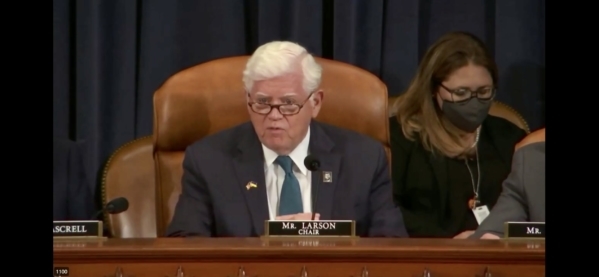
Witness after witness at Tuesday’s Congressional hearing on Social Security Administration (SSA) customer service testified that the agency is in dire need of additional resources in order to properly serve the public. The hearing was held by the House Ways and Means Social Security subcommittee, chaired by Rep. John Larson (D-CT), with testimony from a variety of witnesses from SSA and advocacy groups. While witnesses praised SSA employees for doing their best to provide the public with customer service during the pandemic, they painted a picture of an underfunded and overworked agency in desperate need of Congressional action.
“The Agency and its employees have done an extraordinary job of making the most effective use of the dollars they have been appropriated. But backlogs that pre-existed the pandemic have grown exponentially, staff levels have dropped precipitously, and the Agency will need the strong support of Congress if it is to continue fulfilling its mission to your constituents,” urged Max Richtman, President and CEO of the National Committee to Preserve Social Security and Medicare, in a written statement to the subcommittee.
Rebecca Vallas of the Century Foundation advocacy group told lawmakers at the hearing, “A decade-plus history of congress underfunding SSA’s already incredibly lean operating budget, worsened by the pandemic, has spurred several urgent crises in the agency’s customer service…The casualties are your constituents.”
Among the most pressing problems that have plagued SSA customer service are long hold times, disconnects, and busy signals on the agency’s toll-free phone line and excessive delays in Social Security Disability Insurance (SSDI) hearings. (Over 100,000 claimants have died waiting for their cases to be adjudicated.). In April, SSA was able to re-open most of its field offices after being shuttered for almost two years during the COVID pandemic.
SSA Deputy Commissioner for Operations, Grace Kim, credited managers, employees, labor unions, and advocates for the agency’s “ability to transition from remote work to walk-in service.” The field office re-openings went more smoothly than many advocates expected, but the agency must now contend with a huge backlog of work with inadequate resources.
“We are doing what we can with current staff and funding. The demand for service is high; we are losing staff; and morale is low,” testified Peggy Murphy, Director of the Social Security field office in Great Falls, Montana. “SSA is at a critical juncture as we face the future.”
Chairman Larson blamed SSA’s problems on budget cuts that Congress began imposing in 2010, pointing out that the agency’s operating funds have shrunk by 14% since then (adjusted for inflation), at the same time as demand for its services has skyrocketed as waves of Baby Boomers retire (at the rate of 10,000 every day).
Those budget cuts have forced SSA to lay off workers or allow vacant positions to remain unfilled, said Chairman Larson. “SSA has the lowest number of workers in 25 years despite almost double the number of beneficiaries.”
The Chairman pointed out that most of SSA’s operating budget is funded by payroll contributions from American workers “with each and every paycheck,” and that it is unjust for Congress to suppress funding for the agency that administers workers’ earned benefits.
Several witnesses voiced support for Chairman Larson’s Social Security 2100: A Sacred Trust legislation that would safeguard SSA customer service, including:
*A provision to prevent field office closures unless certain requirements are met.
*A provision to clarify that Congress did indeed intend for annual Social Security Statements to be mailed to workers age 25 and older so that they can plan for their financial security
The National Committee to Preserve Social Security and Medicare has enthusiastically endorsed Chairman Larson’s bill, which also boosts Social Security benefits across the board and extends the solvency of the program’s trust fund. Chairman Larson says that the bill will be marked-up in committee later in May or early June. The legislation has over 200 cosponsors in the House.
While the Social Security 2100 bill would improve SSA customer service, witnesses said that Congress must provide more robust funding for the struggling agency. “Our FY2022 appropriation is insufficient to provide the level of service your constituents expect and deserve,” said SSA’s Grace Kim.
The National Committee to Preserve Social Security and Medicare urges lawmakers to boost SSA funding to $15.55 billion for FY 2023, which is the amount submitted by the Agency itself to the Office of Management and Budget (OMB).
“Adequate funding for SSA is vitally important to your constituents and to our millions of members and supporters across the country who either are receiving Social Security or expect to do so in the future,” wrote Max Richtman in his statement to the subcommittee, “both to ensure that they receive the benefits they have earned and to maintain the public’s strong support for this essential program.”
Related Posts
- Published On: May 5th, 2022Categories: Centers for Medicare and Medicaid Services, Congress, Democrats, Medicare, Medicare Drug Coverage and Costs, Prescription Drug Prices, President Biden
Medicare Part D prescription drug beneficiaries can be in for a rude surprise after they sign up for coverage. In an article this week in Kaiser Health News, Susan Jaffe writes that the price of a drug may jump within a month of a patient enrolling in a Part D drug plan. She cites the case of Linda Griffith, a California woman who used Medicare’s plan finder to select coverage last December, only to find that the price of one of her medications had jumped from $70 to $275 by January.
“As early as three weeks after Medicare’s drug plan enrollment period ends on Dec. 7, insurance plans can change what they charge members for drugs — and they can do it repeatedly.” – Kaiser Health News, 5/3/22
In fact, an AARP analysis found that the prices for the 75 most frequently prescribed drugs for Medicare beneficiaries climbed by as much as 8% between the end of December 2021 and the end of January 2022.
If this sounds like a bait-and-switch, the Centers for Medicare and Medicaid Services says that is just the way our current drug pricing system works. According to Medicare’s website, “Your plan may raise the copayment or coinsurance you pay for a particular drug when the manufacturer raises their price, or when a plan starts to offer a generic form of a drug,”
“I want my money back, and I want to be charged the amount I agreed to pay for the drug… I think this needs to be fixed because other people are going to be cheated.” – Linda Griffith, Medicare Part D beneficiary (Kaiser Health News)
Fixing the problem would require a change in the law. The 2003 Medicare Modernization Act, passed during the George W. Bush administration, established Part D drug coverage (to be provided by private insurance companies like Humana, Aetna, and Cigna), but forbade Medicare from negotiating prices with Big Pharma. NCPSSM President and CEO Max Richtman recently told CNBC that the ban on price negotiation “was put in in the middle of the night. We were not in the room when that deal was made.”
For many years, the National Committee to Preserve Social Security and Medicare and other seniors’ advocates have fought for new legislation empowering Medicare to negotiate prices. That goal finally seemed within reach when Congress took up President Biden’s Build Back Better plan, which contained a Medicare price negotiation provision.
The House-passed version of the bill would have allowed negotiations for a limited number of drugs. It wasn’t everything that advocates had hoped, but it would have been a good start. In the end, the Build Back Better plan failed to garner enough support in the Senate, due largely to the opposition of Senator Joe Manchin (D-WV).
Though Medicare price negotiation would be the single most effective way to lower seniors’ drug costs, other solutions have been percolating on Capitol Hill. These include an out-of-pocket cap on Part D drug costs and limiting drug price increases to the rate of inflation. All of these proposals have garnered the support of wide majorities in public opinion surveys. A 2021 Kaiser Health News poll found 83% of the public — including majorities of Democrats and Republicans —favored the federal government negotiating lower drug prices for both Medicare and private insurance.
Unfortunately, Big Pharma has used its multi-billion dollar lobbying and advertising arsenal to kill meaningful drug price reform so far. Some lawmakers apparently feel more beholden to drug makers than to their constituents, many of whom are skipping life-saving medications they can’t afford. Until Congress musters the political will to take another run at reform, the industry will continue to raise prices at will – leaving everyday Americans like Linda Griffith scrambling to cover the costs.
- Published On: April 29th, 2022Categories: Max Richtman, Medicare, Medicare Advantage
We have been sounding alarm bells for many years about Medicare Advantage (MA), the privately-run health plans for seniors that are growing in popularity as an alternative to traditional Medicare. This week, an eye-opening report by the Inspector General’s office at the Department of Health and Human Services (HHS) confirmed some key criticisms by the National Committee and other seniors’ advocates – namely, that MA plans are denying legitimate claims and refusing to authorize reasonable medical procedures.
“Tens of millions of denials are issued each year for both authorization and reimbursements, and audits of the private insurers show evidence of ‘widespread and persistent problems related to inappropriate denials of services and payment,’ the investigators found.” – New York Times, 4/28/22
The Inspector General’s office estimated that 13% of claims that Medicare Advantage insurers denied should have been covered. MA plans also improperly denied up to 85,000 prior authorizations. The New York Times reports, “In some cases, plans ignored prior authorizations or other documentation necessary to support the payment. The most frequent denials found by the investigators included those for imaging services like M.R.I.s and CT scans.”
“Advantage plans also denied requests to send patients recovering from a hospital stay to a skilled nursing center or rehabilitation center when the doctors determined that those places were more appropriate than sending a patient home.” – New York Times, 4/28/22
Medicare Advantage insurers are paid a fixed price per beneficiary by the federal government. The rationale is that private plans can theoretically provide more cost-effective, coordinated care to save the Medicare program money. The profits that MA plans have realized from this arrangement surely have rolled in, but the savings to Medicare haven’t materialized. As our president and CEO, Max Richtman, recently wrote in Common Dreams:
Between 2009 and 2021, the government paid Medicare Advantage plans $140 billion more than it would have if the same patients had stayed in traditional Medicare. In fact, the cost to taxpayers of switching seniors to MA plans ‘has exploded since 2018 and is likely to rise even higher.’” – NCPSSM President & CEO Max Richtman, Common Dreams, 3/25/22
Instead of being held accountable for overbilling the government and denying care to beneficiaries, MA plans have been rewarded with an 8.5% increase in rates for 2023 by the Centers for Medicare and Medicaid Services.
MA plans also continue to grow in popularity. More than 26 million seniors – or 42% of all Medicare beneficiaries – were enrolled in an MA plan last year. And the Congressional Budget Office (CBO) projects that more than half of all beneficiaries will be in MA plans by 2030. This isn’t because MA plans are patently superior for patients; it is because of the lure of putative cost-savings (in the form of lower premiums or free extras like gym memberships) and a torrent of television ads featuring famous pitchmen like Joe Namath and Jimmy Walker.
The Medicare Advantage tv ads do not mention any of the downsides of these plans – including restricted networks of providers, inaccurate network listings, and the wrongly denied claims and pre-authorizations that the Inspector General’s office has just flagged. In fact, the ads make it seem as if Medicare Advantage is the whole Medicare program, with many enrollees not even aware that publicly-run, traditional Medicare is another – and often better – option.
As our President and CEO argues in his Common Dreams column, there is a movement to privatize traditional Medicare that is gaining momentum, which NCPSSM considers harmful for older Americans. The shifting of market share to MA plans is part of it. But so are recent efforts to increase the role of private, for-profit companies in traditional Medicare.
The National Committee and other seniors’ advocates are particularly wary of a pilot program by CMS recently re-branded as ACO/REACH and previously known as Direct Contracting, which allows private entities more opportunities to manage traditional Medicare beneficiaries’ care. Meanwhile, progressive Democrats on Capitol Hill, most prominently Rep. Pramila Jayapal (D-WA), have taken a hard line against the new program:
“(There is) a clear-cut argument for why we must immediately end Medicare privatization programs like ACO Reach. There’s no excuse for allowing the same Medicare Advantage organizations to now administer ‘care’ for traditional Medicare beneficiaries.” – Rep. Pramila Jayapal tweet, 4/28/22
While CMS presses forward with the ACO/REACH program, Medicare officials say they are looking at the Inspector General’s report about Medicare Advantage practices. “Plans found to have repeated violations will be subject to increasing penalties,” reports the New York Times. “The agency ‘is committed to ensuring that people with Medicare Advantage have timely access to medically necessary care.’”
At the same time, some in Congress are attempting to rein-in MA plans and protect patients. A piece of bipartisan legislation called the Improving Seniors’ Timely Access to Care Act has been introduced in both the House and Senate. According to one of the House sponsors, Rep. Suzan DelBene (D-WA), the legislation “would improve care for seniors by streamlining and standardizing the way Medicare Advantage plans use prior authorization and increasing oversight and transparency.”
It is only appropriate that these private plans, which are consuming a growing chunk of Medicare market share every year, be subject to strict oversight and thorough scrutiny. As MA insurers rake in hefty profits, it is crucial that proper patient care isn’t sacrificed in the process.
Related Posts
- Published On: April 25th, 2022Categories: Congress, Democrats, Medicaid, Medicare, National Committee to Preserve Social Security and Medicare, Retirement, Trump
Some two decades ago, seniors had a Congressional committee dedicated solely to safeguarding their interests. Then the Republicans, led by Speaker Newt Gingrich, took control of the House for the first time in 40 years and shut down the House Select Committee on Aging. Today, there is a movement to revive that committee – and there truly is no moment since the early 90s when it has been so sorely needed.
In a letter to members of Congress, the Legislative Council of Aging Organizations (LCAO), of which we are a member, explained why the time is now to reinstate the House committee:
“The last two years have proven particularly difficult for older adults in our country and globally as the coronavirus had a disparate impact on the lives of older individuals, particularly those residing in assisted living facilities and nursing homes. As Americans are aging, we also face a variety of intergenerational concerns that merit attention, such as growing demands on family caregivers and a burgeoning retirement security crisis.” LCAO letter to members of Congress, 3/4/22
Last August, Rep. David Cicilline (D-RI) introduced a resolution (H. Res. 583) to re-instate the House Select Committee on Aging, which the National Committee to Preserve Social Security and Medicare fully supports. It is more than appropriate that this committee be reinstated, with seniors representing a growing portion of the overall population. By 2030, nearly 75 million people in the U.S. – or 20% of the country – will be age 65 and older.
Several federal programs that seniors rely upon are at an inflection point, increasing the need for a House committee to advocate for older Americans. Social Security’s finances must be shored up so that the trust fund doesn’t become depleted in the 2030’s, while retirees’ benefits need to be boosted to meet 21st century living expenses. The Medicare Part A trust fund faces a shortfall in just a few years. At the same time, benefits covered through Part B should be expanded to include dental, vision, and hearing care, and attempts to privatize the program must be resisted. Medicaid requires additional funding for Home and Community-based Services (HCBS) as a lower-cost and often preferred alternative to nursing homes.
Programs that help seniors under the Older Americans Act (OAA) – including Meals on Wheels grants and home heating assistance – must continue to be adequately funded. When Donald Trump was President, his proposed budgets zeroed-out these programs so crucial to lower-income seniors. A House Committee on Aging would provide greater protection for – and promotion of – seniors’ ongoing needs.
The most prominent chairman of the House Aging Committee was the legendary Rep. Claude Pepper (D-FL) – a true champion for seniors. Under Congressman Pepper’s leadership, the committee was able to affect genuine change for the better.
“Pepper pushed the ban on mandatory retirement… protected nursing homes, expanded home healthcare and bolstered Social Security, with solvency through 2034. That put him on the cover of Time Magazine… as America’s ‘Spokesman For the Elderly.’” – Miami Herald, 3/21/22
In an op-ed in the Miami Herald, former House Aging Committee Chief of Staff Robert Weiner and Ben Lasky, senior policy analyst at Weiner Associates, argue that a re-instated committee could play a significant role in the well-being of today’s seniors. “With Pepper’s legacy as the guide, pandemic deaths, nursing homes, home care, Social Security, and Medicare would be improved by the sunlight of oversight.”
Rep. Claude Pepper (D-FL) was a seniors’ champion and longtime chair of the House Select Committee on Aging
In order for the House Aging Committee to be re-instated, the full House would have to vote on Rep. Cicilline’s resolution. It could pass by a simple majority and the committee would be revived. But House Speaker Nancy Pelosi has not yet committed to bringing Cicilline’s resolution to the floor. To increase the chances that it comes up for a vote, we urge voters to contact their representatives and tell them to cosponsor/support H. Res. 583.
Without a House Select Committee on Aging, there is no body on the House side to focus holistically on older Americans’ priorities. True, there are other committees with jurisdiction over seniors’ programs – but no single committee dedicated to keeping an eye on the big picture for seniors. Fortunately, the Senate Special Committee on Aging has continued to operate in the absence of a House counterpart. Today, the Senate committee is working on everything from scams against seniors to increasing HCBS services, to calling out questionable billing practices by Medicare Advantage insurers. Seniors have been better off these past decades with a Senate Aging Committee at work – and would greatly benefit from a reinstated and robust House Aging Committee, whose sole mission would be to look out for older Americans’ needs.
Related Posts
- Published On: April 14th, 2022Categories: Meals on Wheels, Medicaid, Medicare, Medicare Advantage, Prescription Drug Prices, Retirement, senior nutrition
Classic movie star Mae West famously said, “Getting old isn’t for the faint of heart.” Most older people probably know what she means. Of course, aging can also be a rewarding time of pursuing hobbies and interests, travel and discovery, and enjoying grandchildren, among other things. But the “not for the faint of heart” part rings particularly true when it comes to participating in our senior health care system.
Unlike many other Western nations, most older Americans are confronted by a byzantine network of programs that aren’t always easy to navigate (including Medicare, Medigap, Medicare Advantage, Medicaid, the Affordable Care Act, private insurance, and more.) And then there are the coverage gaps where we expect seniors – or their families – to shoulder an outsize portion of the added financial costs. This can include things like medical co-pays, adult day care, dental care or eyeglasses. How many spouses and families are prepared to handle caregiving duties or pay these expenses? It can be overwhelming.
Many people are also unaware that traditional Medicare does not cover routine hearing, dental, and vision care. That can come as a shock, especially when a senior needs a new pair of eyeglasses, hearing aids, or a dental implant. Even the average cost of frames and lenses ($350) can be a strain on seniors’ finances, let alone more than $2,000 for hearing aids or dental surgery.
Understanding how our system of aging services works, what your financially responsibilities are, where to access help, and what you need to know is critical to a smoother landing in the aging zone. For instance, if you miss a Medicare enrollment deadline, you could end up paying higher premiums. If a senior can’t drive but needs to get to a doctor’s appointment, is there help for that? What if an older loved one is not getting proper nutrition – or doesn’t seem to be hearing as well as they used to? There are so many situations that may need attention. But where to turn? And, more importantly, how to pay for it if the senior is living on a fixed income?
Planning and preparation are key. As we age, we need to be knowledgeable about health and care services and programs before something goes wrong. That’s why, along with advocating full-time for Medicare and Medicaid expansion, we have created a resource section on our website where older adults and their families can learn crucial information – and find suggestions for help. The resource is called Aging, Health, and Care: What You Need to Know.
The resource is organized into topics for easy browsing, so visitors can dive into whichever section is most relevant to them. Some of the most popular topics include:
Visitors to this site will find consumer-friendly information and articles, about these and other topics. Seniors and family members with questions like…
“How much am I going to have to pay for health care? What if I have to stop driving? If I need long-term care, what are my options? How can I avoid being a burden to my children, who have struggles and challenges of their own?”
… can take the first steps toward gaining useful knowledge, in order to be as prepared as possible when they need it. Visitors can also sign a petition to Congress demanding Medicare coverage for dental and hearing care. Simply put, Aging, Health and Care: What You Need to Know is a great first stop on the road to learning – and self-empowerment – for older Americans.