


Social Security Expansion Roadshow Hits Vegas
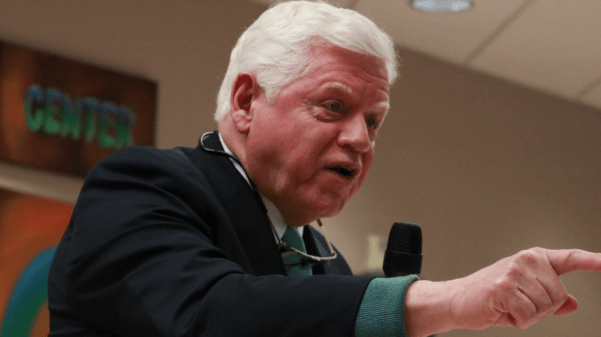
Rep. John Larson (D-CT) at Social Security expansion town hall in Las Vegas
After holding three public hearings on Social Security’s future, Congressman John Larson has taken his campaign to boost benefits on the road. The latest stop: Las Vegas, Nevada. Rep. Larson (D-CT) held a town hall yesterday at the city’s Doolittle Senior Center with Congressman Steve Horsford (D-NV), National Committee government relations and policy director Dan Adcock, and other advocates. Some 100 seniors gathered to listen and ask questions, just one day after the Social Security Trustees issued their annual report showing the program’s financial outlook improving since last year.
Congressman Larson seeks to build public support for this Social Security 2100 Act (cosponsored by Rep. Horsford), which would put the program on a sound financial footing for the rest of the century – while boosting benefits and providing retirees with tax relief.
The average Social Security retirement benefit in Nevada is $1,378 – or $16,500 per year, about $1,000 below the national average.
“So many Americans contribute to Social Security all their lives, yet so many of them retire into poverty. Most of them are women and the majority are women of color.” – Rep. John Larson, 4/23/19
“Social Security isn’t an ‘entitlement,’ as it’s often called. These are not government giveaways … This is something you’ve earned and deserve.” – Rep. Steve Horsford (D-NV), 4/23/19

Rep. Steve Horsford (D-NV) is a cosponsor of the Social Security 2100 Act
Rep. Horsford related a personal story to help illustrate how crucial Social Security benefits are to older Americans with fixed incomes. As the Nevada Current reported, “When he was nine weeks old, his grandmother had a stroke that put her in a coma for six months and left her paralyzed on her left side.”
“Here is my mother, still a teenager… taking care of a sick mother and a baby. My grandmother needed round the clock care and was put into a nursing home to get the care she needed. Social Security Disability and Medicaid made that possible.” – Rep. Steve Horsford, 4/23/19
Dan Adcock says that the audience appeared to be overwhelmingly supportive of Congressman Larson’s bill, and suspicious of conservative ideas regarding Social Security’s future. Moderator Debra A. Toney of the Nevada Health Centers asked Adcock about proposals to raise the retirement age.
“Regardless of whether you live to 50 or 100, raising the retirement age is a benefit cut. Raising the retirement age also disproportionately affects workers with physically demanding jobs who cannot continue working and claim benefits early. We believe that raising the retirement age is a bad idea – and that it is unnecessary for extending the solvency of Social Security. That’s why we endorse the Social Security 2100 Act.” – Dan Adcock, National Committee legislative director

National Committee legislative director Dan Adcock presents Rep. Horsford with NCPSSM’s signature boxing gloves
At the end of the town hall, Adcock presented Rep. Horsford with a pair of the National Committee’s signature red boxing gloves, signifying that the Congressman is a ‘Social Security champion.’ “These will help you in your fight for seniors in the U.S. Congress,” Adcock said.
Social Security’s Financial Health Improves, Trustees Say

Social Security’s financial health is on the upswing, according to today’s report from the Social Security Trustees. The system’s reserves are now projected to last until 2035 (a full year longer than last year’s report projected), with the government able to pay 80% of benefits after that time – but only if Congress does nothing to fortify Social Security’s finances. This year, Social Security will take in more than it pays out. As a result, the asset reserves of the combined trust funds will increase by $3 billion in 2018 to a total of $2.895 trillion. Here are some of the Trustees’ other key findings:
- Social Security’s projected actuarial deficit over the next 75 years has shrunk from last year’s projection – from 2.84% to 2.78%.
- The program’s $6.7 billion in administrative costs was a “very low” 0.7 of total expenditures.
- The combined Trust Fund asset reserves earned an effective annual interest of 2.9% in 2018.
“This year’s Trustees report shows that, contrary to conservative propaganda, Social Security is not ‘going bankrupt’ or ‘in peril.’ The system’s financial health has improved over last year, and Congress now has before it two landmark pieces of legislation that could put Social Security on a sound financial footing for the rest of the century — and provide seniors a modest benefit boost and tax relief.” – Max Richtman, National Committee president
The National Committee endorses Rep. John Larson’s Social Security 2100 Act and Senator Bernie Sanders’ Social Security Expansion Act. Both bills ask the wealthy to pay their fair share to strengthen Social Security, something overwhelming majorities of the American people support in poll after poll.
The Trustees of the Medicare program report that the federal senior health care program’s finances look about the same as they did in 2018. Medicare’s Part A trust fund will become depleted in 2026, at which time the system still could pay 89% of benefits. But, again, this is only if Congress takes no action to bolster Medicare’s finances.
“The National Committee supports legislation that would reduce Medicare’s costs – especially allowing the government to negotiate prescription drug prices with Big Pharma – while expanding seniors’ health benefits. Again, we call on the Trump administration and Congress to act swiftly to effectuate common sense solutions without jeopardizing the health and security of seniors. The 2019 Trustees report should take the wind out of the sails of conservatives who want to ‘reform’ Social Security and Medicare through benefit cuts.” – Max Richtman
Ruhle vs. Reality: MSNBC Segment Promotes Social Security Myths

In yet another example of mainstream journalists (perhaps unwittingly) echoing conservative talking points, MSNBC’s Stephanie Ruhle helped perpetuate a false narrative about Social Security on her April 12, 2019 MSNBC broadcast. During a segment entitled, “Saving Social Security could lie in the hands of college students,” Ruhle interviewed Former Senator Heidi Heitkamp and former Council of Economic Advisors chair Gary Cohn about a contest for college kids to come up with solutions for Social Security’s future. (Heitkamp and Cohn are the contest “judges.”)
From the very beginning, the segment was couched in a false sense of alarm – with a serious lack of context. Ruhle gravely summarized the Social Security Trustees’ analysis that the system will run out of reserves in 2034 (but only if Congress were to do NOTHING to address the shortfall in advance), accompanied by an on-screen banner reading SOCIAL SECURITY IN PERIL.
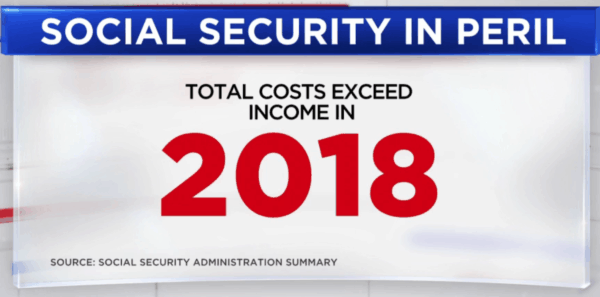
This framing started off a largely fact-free segment on a disingenuous note that colored the rest of the commentary: Social Security is in trouble. But college kids can come up with a bipartisan solution to save the day!
Here are some of the lowlights from the segment, and the realities that render them either wrong or ridiculous:
Ruhle: For the first time in Social Security’s history, costs exceeded income in 2018. This is a big deal. And as more people retire, the program seems to be at even greater risk.
Reality: Ruhle neglected to mention that there is a Social Security trust fund with $3 trillion in assets which provides the system a fiscal cushion. Even if Congress takes no action to address the projected depletion of the trust fund in 2034, Social Security still would be able to pay 79% of benefits. Social Security itself is not “at risk,” because workers will continue to pay into the system.
Ruhle: Politicians don’t want to talk about Social Security.
Reality: Politicians in both parties talk about Social Security all the time. Republicans want to cut benefits to pay for the Trump/GOP tax cuts. Democrats are proposing common sense legislation to boost benefits and keep the system solvent for the rest of the century. Ruhle may want to check out Rep. John Larson’s Social Security 2100 Act and Bernie Sanders’ Social Security Expansion Act. Congressman Larson just chaired his fourth public hearing on Social Security’s future since January. Politicians were definitely talking in that hearing room. Was Ruhle listening?
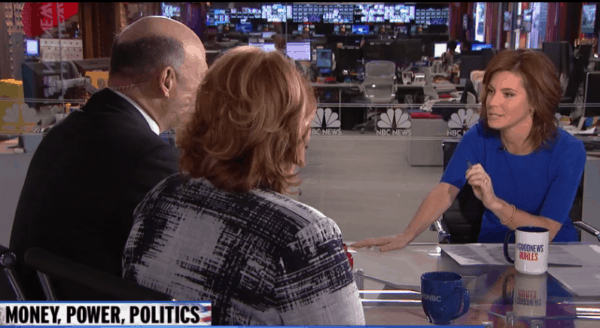
Gary Cohn, Heidi Heitkamp, and Stephanie Ruhle during misleading Social Security segment
Ruhle: None of the Democratic candidates have a solution to Social Security.
Reality: Most of the Democratic candidates running or likely to run for President in 2020 have already come out in favor of Social Security expansion, including Elizabeth Warren, Kamala Harris, Kirsten Gillibrand, Cory Booker, and Beto O’Rourke. In fact, Harris, Booker, and Gillibrand are cosponsors of Sanders’ bill.
Here’s Elizabeth Warren re-iterating the position of most Democrats on Capitol Hill – from Progressive to moderate:
“Social Security is a lifeline for seniors and Americans with disabilities. We won’t let it be cut by one cent — and instead we will fight to expand it… If this government really works for the people, it should protect and expand Social Security.”
Ruhle: We don’t hear Washington talking about a solution.
Reality: See above.
The segment then devolved into a largely bogus discussion of how college students don’t think Social Security is going to be there for them when they retire. Or, as Gary Cohn interpreted it, “They’re going to pay in, but they’re not going to collect.” As our president, Max Richtman, pointed out at one of Rep. Larson’s hearings, the main reason younger Americans may feel that way is the constant flood of “disinformation” from conservative circles. The entire MSNBC segment played into the tactic of “entitlement reformers” to bust the generational contract that has helped keep seniors out of poverty for 83 years.
No doubt, there is a legitimate ongoing debate about Social Security’s future, and there’s no reason college kids – who will some day collect benefits – shouldn’t be part of it. But debate about something as crucial as Americans’ earned benefits must be based on facts and conducted in context. For a network that prides itself on being factual, them’s the Ruhles.
Dems, Advocates Push Hard for Social Security Expansion
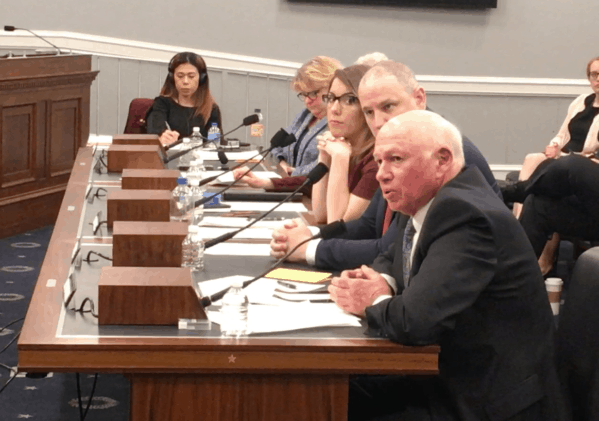
National Committee president Max Richtman pushes Social Security expansion at House hearing
Now that the Democrats have control of the U.S. House, Congress is actually holding hearings (under regular order, no less) on boosting Social Security – a topic the GOP-majority House eschewed. Congressman John Larson (D-CT) chaired a hearing of the House Social Security subcommittee Wednesday that made plain the stakes for current and future seniors – and the fundamental disagreement between the two parties about Social Security’s future.
“What the American want and deserve are solutions. The last time Congress seriously did something about Social Security, Ronald Reagan was President and Tip O’Neill was Speaker. We believe it’s long overdue for us to move forward on this issue.” – Rep. John Larson, 4/10/19
National Committee president Max Richtman joined a panel of witnesses including Diane Stone, director of the Newington, CT senior center from Rep. Larson’s home district; Shaun Castle, a veteran and Deputy Executive Director of Paralyzed Veterans of America; Steven Goss, Chief Actuary of the Social Security program; and Nancy Altman, President of Social Security Works.
Witnesses raised real-life examples of seniors living in the grey zone between true “economic security and poverty” who would be better off under Rep. Larson’s Social Security 2100 Act.
Richtman recognized Nettie Hailes, a National Committee volunteer in the audience who turned 91 on the day of the hearing. Hailes, whose husband was a Baptist pastor who helped organize Martin Luther King’s March on Washington, depends on Social Security for her income.
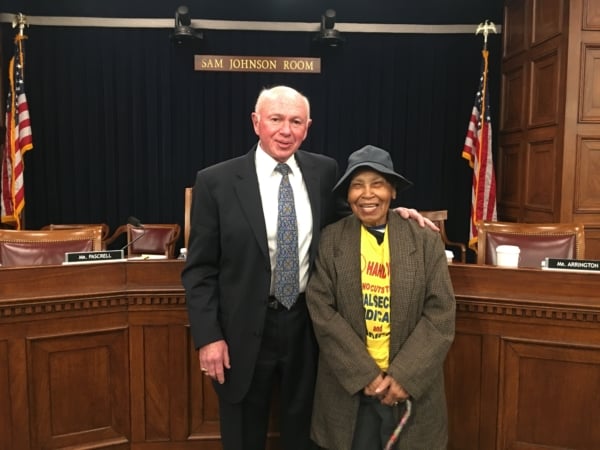
Max Richtman and National Committee volunteer Nettie Hailes
“After raising four children and working in real estate, Nettie claimed Social Security benefits at age 65. In addition to her own Social Security benefits, Nettie began receiving a survivor benefit after husband’s passing. She manages her money wisely to pay for her medical expenses, upkeep on her home and property taxes. She is proud to stay within her means but says it’s tough to try and keep up because the cost-of-living is so high.” – NCPSSM President Max Richtman, 4/10/19
Richtman said that the 2% across-the-board benefit increase in Congressman Larson’ bill, while modest, could make a big difference for seniors like Nettie. A two-percent boost would equal about $300 annually for the average retiree. So would the improved cost-of-living (COLA) formula in Larson’s legislation – the Consumer Price Index for the Elderly (CPI-E), to help Nettie and other seniors keep pace with inflation.
“This change in the formula for COLAs would effect millions of beneficiaries. It would allow Social Security benefits to keep up with inflation as it really impacts older people. The current formula is flawed. This legislation corrects that.” – NCPSSM President Max Richtman, 4/10/19
Congressman Larson proposes to pay for enhanced Social Security benefits by adjusting the payroll tax income cap so that earners making more than $400,000 per year would still contribute to Social Security like everyone else – and by raising payroll taxes by 1.2% over 24 years (the equivalent of 50 cents more per week for the average worker).
“It’s an insurance premium, not a tax. That’s why it’s called FICA (Federal Insurance Contribution Act). Is there any other ‘tax’ where you get disability, spousal, and pension benefits?” – Rep. John Larson, 4/10/19
Republicans on the subcommittee voiced general support for Social Security, but rejected any revenue-side solutions to improve benefits or to keep the system solvent. (Without raising additional revenue, the only other solution to Social Security’s projected shortfalls is to cut benefits – which the National Committee and most Democrats roundly reject.)
Democrats reminded Republicans that seniors cannot afford benefit cuts now or in the future, especially with employer-provided pensions disappearing and at least half of Americans not earning enough to save for retirement.
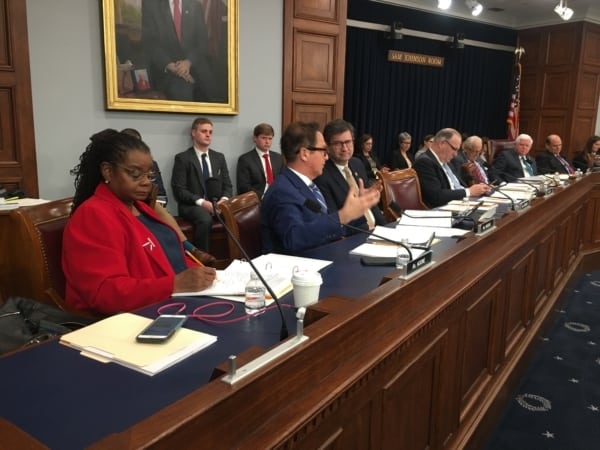
House Social Security subcommittee Democrats: We can afford to give seniors a benefit boost.
As Richtman pointed out during an exchange with Rep. Dan Kildee (D-MI), boosting Social Security benefits helps not only seniors – but the entire economy.
REP. KILDEE: Do social security beneficiaries put their earnings away for the future – or do they spend that money?
MAX RICHTMAN: The spend it and the money goes right into back into the economy. There’s a multiplier effect. Every dollar spent produces two dollars in economic stimulus.
REP. KILDEE: So, if we were to increase [benefits], that increase is going to go right back into the American economy and have a stimulus effect.
Social Security’s chief actuary, Steven Goss, affirmed that Congressman Larson’s bill would keep the system on a sound financial footing for at least the next 75 years. “The Social Security 2100 bill is the only one that does that,” he said, explaining that the legislation not only makes up for the shortfall in projected revenue, but includes enough for the modest benefit boost and some “cushion.”
Richtman testified that Larson’s legislation should help “put to rest” the “steady drumbeat of disinformation” from conservatives that Social Security is “going bankrupt” or won’t be around for future generations. “It will show clearly the program is sound and will be there for the rest of the century,” he said.
***************************************************************************************
For more on Wednesday’s hearing and Boosting Social Security, watch our Facebook Live broadcast from Capitol Hill
Equal Pay Day Brings Home Long-term Costs of Pay Inequality

National Equal Pay Day 2019 reminds us that gender pay equity is crucial not only for social justice, but for women’s retirement security. When women earn less than men (currently, only 80 cents on the dollar), they cannot afford to save sufficient money for retirement – and their Social Security benefits are lower.
In 2016, the average annual Social Security income received by women 65 years and older was $13,891, compared to $17,663 for men. – National Committee Social Security Fact Sheet
Women take more time off work to care for family members, but don’t get credit for it in their Social Security earnings history. On average, women outlive men by five years – forcing them to stretch their retirement dollars over a longer span of time. That’s one reason why 11% of senior women live in poverty – an unacceptable number in the wealthiest country on earth.
Equal Pay Day marks the calendar date when the average woman has earned as much as the average man did the previous year.
“Because women earn less, on average, than men, they must work longer for the same amount of pay. The wage gap is even greater for most women of color.” – National Committee on Pay Equity
According to the National Partnership for Women and Families, African-American women make 64 cents on the dollar of what non-Hispanic white men earn. The figure drops to 55 cents on the dollar for Latinas. Not surprisingly, average Social Security benefits for black women are 25% lower than men’s, while Latinas’ are 31% lower.
Though the gender pay gap has closed by 3 percentage points since 2012, America has a long way to go toward wage equality. Among industrialized nations, the country’s pay inequity level consistently ranks in the top five. The wage gap is attributable to various forms of gender discrimination – ranging from biases about women’s performance in the workplace to the fact that men are likely to hold higher-ranking, higher paying positions.
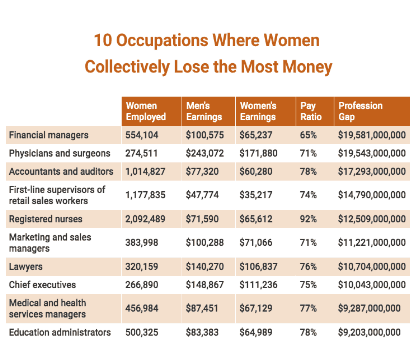
Source: American Association of University Women
Given that society has made scant headway on this issue in recent years, it’s clear that women need stronger federal protections against wage inequality. The National Committee to Preserve Social Security and Medicare fully endorses the Paycheck Fairness Act, introduced by Senator Patty Murray (D-WA) and Rep. Rosa DeLauro (D-CT). Among other things, it would put an end to pay secrecy, strengthen workers’ ability to challenge discrimination, and bring equal pay law into line with other civil rights laws.
“This landmark legislation aims to prevent wage discrimination from happening in the first place. It will help women and their families now – and in later life when too many women dangle on the precipice of poverty.” – National Committee president and CEO Max Richtman
*****************************************************************************************
For more information on pay inequality and women’s retirement security, visit Eleanor’s Hope.