


The right-wing barrage of anti-Social Security propaganda continues. In fact, we’re finding ourselves having to shoot down at least one misleading (or misguided) opinion piece every month. Today’s response was provoked by a recent column in Fortune: “Social Security has 6 years left. The fix that sounds cruelest may be the smartest.”
Let’s start with the headline. Social Security does not have six years left. The program will go on indefinitely as long as people are working and paying into the system. It’s accurate to say that Social Security’s trust fund reserves will become depleted in some six years — in the unlikely event that Congress takes no pre-emptive action.
The Fortune piece, written by business editor Nick Lichtenberg, leans on a new study by the Penn Wharton Budget Model (PWBM), and argues that aggressive benefit cuts — including raising the retirement age to 69 — are the best cure for Social Security’s financial ills.
Lichtenberg acknowledges that public opinion is strongly in favor of revenue side solutions like raising (or even scrapping) the payroll tax cap – so that the wealthy pay their fair share. He even goes as far to call benefit cuts “politically radioactive.” How silly of the public to prefer solutions that favor the average worker over the country’s financial elites!
Despite this, the author insists that “dynamic economic modeling” shows aggressive cuts will produce the most economic growth, as though the resulting gains will inevitably find their way back to seniors. This framing ignores the fact that Social Security contributes $2.6 trillion to the economy on an annual basis and supports over 12 million jobs.
The Wharton model that Lichtenberg loves contains five options, from tax‑heavy (Option A) to cuts‑heavy (Option E). Of those, Lichtenberg all but endorses Option E: No new taxes, deeper benefit‑formula reductions, and a Social Security full retirement age raised to 69.
Dan Adcock, Director of Government Relations and Policy at NCPSSM, says Option E is a non-starter for Social Security advocates:
“Option E is the worst. Raising the retirement age is a benefit cut, plain and simple. Not everyone is living longer, and it ignores the realities of people who retire early or work in physically demanding jobs. Claiming benefits at age 62 already means a 32 percent cut in benefits; raising the full retirement age to 69 would push that reduction up to nearly two‑thirds of a full benefit.” – Dan Adcock, NCPSSM

Dan Adcock, NCPSSM’s Director of Government Relations and Policy
The idea that everyone can simply “live longer and work longer” is a myth. Physical laborers exit the workforce earlier than their white collar counterparts. Some marginalized groups are experiencing declining age expectancies. Many people in their 60s already struggle to find or keep employment, thanks to layoffs and age discrimination.
In what might be the most laughable argument of the whole piece, Lichtenberg asserts that smaller Social Security checks will create an “incentive to save.”
That fairy tale only works if you assume most households can ramp up savings at will. In reality, only about a third of Americans are close to saving enough for retirement. The rest live paycheck to paycheck, grappling with the rising costs of housing, health care, and student debt.
Cutting Social Security benefits will not turn America into a nation of savers, and will certainly not reverse skyrocketing costs of living. Instead, it will push more seniors into poverty, which will deepen their reliance on SNAP, Medicaid, and other safety‑net programs.
“If Social Security benefits are gutted, it will only shift the burden onto other parts of government like SNAP and Medicaid, which means taxpayers will still be on the hook — just in a different, more damaging way.” – Dan Adcock, NCPSSM
Of course, Trump and the Republicans in Congress have already cut those safety net programs by more than $1 trillion.
Meanwhile, the Wharton study shows that slightly adjusting the payroll wage cap would preserve trust fund surpluses until 2058! But Lichtenberg dismisses this as the “wrong” move, arguing that Option A does not deliver as much ‘economic growth’ as deep cuts. (Again, cutting benefits would diminish the stimulus effect of Social Security on the economy at large.)
Democratic lawmakers (including Senator Sheldon Whitehouse and Congressman Brendan Boyle, Senator Elizabeth Warren, Representative John Larson, and others) already have proposed lifting the payroll wage cap to bring more revenue into the system – without cutting benefits. Senator Bernie Sanders (I-VT) and Representative John Larson (D-CT), for example, have both offered bills that would apply the payroll tax to all wages above $400,000.
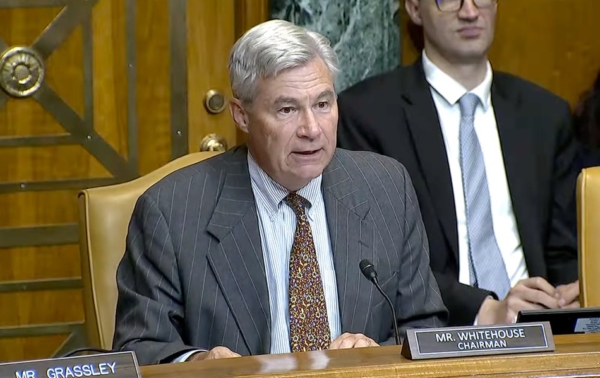
Senator Sheldon Whitehouse (D-RI) has a bill to adjust the Social Security payroll wage cap
The Fortune piece dismisses Option A as politically expedient but economically wrong. But it is morally wrong – or, to borrow from the title of the Fortune piece, downright cruel – to cut the benefits of seniors on fixed incomes in order to spare the wealthy from contributing their fair share.
******************
Read our CEO Max Richtman’s recent Letter to the Editor of the Washington Post HERE.
Listen to our podcast HERE