- Published On: October 23rd, 2019Categories: Congress, Democrats, Medicare, Prescription Drug Prices, Republicans

For 16 years, the National Committee and other seniors’ advocates have been pressuring Congress to pass legislation empowering Medicare to negotiate prescription drug prices with Big Pharma. That goal finally appears within reach. Speaker Nancy Pelosi’s Lower Drug Costs Now Act (H.R. 3) will get a floor vote by the end of this month, according to several news reports. The bill was approved by the House Ways and Means Committee yesterday, teeing up a vote by the full House.
“After years of Congressional inaction, we’re moving legislation to lower drug prices and save American families money. H.R. 3 levels the playing field for U.S. consumers who, on average, pay four times more than patients in other countries for the exact same drugs.” – Rep. Richard Neal (D-MA), House Ways and Committee chairman
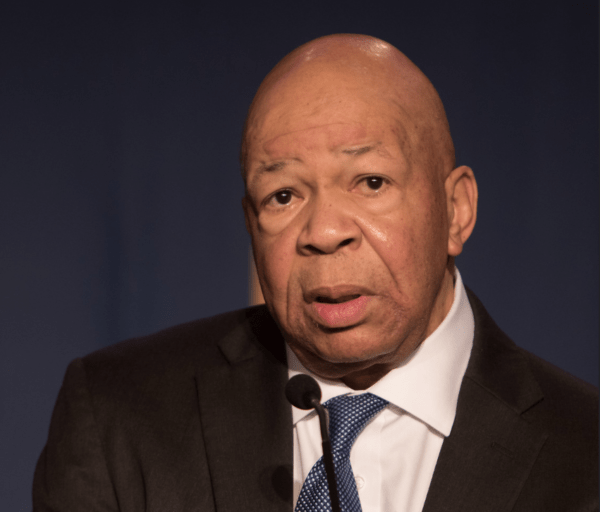
On Tuesday, House Ways and Means Committee chair Richard Neal (D-MA) announced that the bill would be re-named in honor of Rep. Elijah Cummings, a champion for seniors, who passed away last week.
The National Committee has endorsed the bill as an “important step toward lowering prescription drug costs for seniors.” The legislation not only authorizes Medicare to negotiate prices, but includes punitive measures for pharmaceutical companies who don’t play ball – and significantly reduces beneficiaries’ drug expenses. The bill features:
*A substantial penalty (starting at 65% of the gross sales of the drug) if a drugmaker refuses to negotiate or doesn’t reach an agreement on price.
*A $2,000 cap on seniors’ Medicare out-of-pocket costs for prescription drug spending.
*An inflation cap on drug reimbursement to curb excessive drug price escalation.
The Congressional Budget Office estimates that the bill would save Medicare $345 billion over seven years – money that Speaker Pelosi says could be put toward (among other things) expanding benefits to include dental, vision, and hearing coverage.
Speaker Pelosi says the bill represents “bold action to level the playing field” for Medicare patients.
Progressives in the committee markups won concessions to better reflect their vision. Amendments were added to increase the minimum number of drugs Medicare must negotiate each year from 25 to 35 — and to require that a new drug must have at least two generic competitors before being excluded from price negotiations, instead of one. The National Committee lobbied legislators to pass both amendments.
“Typically, the entry of one generic competitor produces only a slight reduction in prices. It is the entry of a second generic competitor that really drives down a drug’s cost – to nearly half the brand name price.” – National Committee letter to Speaker Pelosi, 10/15/19
Many Republicans complain that Pelosi’s bill interferes with the free market — and that it amounts to a federal “takeover” of prescription drug pricing. Democrats counter that the free market has clearly failed to produce affordable drug prices, with cash-strapped seniors skipping medications or cutting pills in half. They also point out that price negotiation is an important facet of free markets.
With Democrats holding a 234-197 majority in the U.S. House, The Lower Drug Costs Now Act is expected to pass when it comes to the floor later this month. On the other side of the Capitol, the Senate Finance Committee has approved a bipartisan drug pricing bill introduced by Sen. Ron Wyden (D-OR) and Sen. Charles Grassley (R-IA). The Grassley-Wyden bill features reasonable measures to lower drug prices, but does not include price negotiation. Some Senate Republicans have already come out against Grassley-Wyden. Predictably, Big Pharma opposes both bills – House and Senate – and spent $6.2 million on lobbying in the third quarter of 2019, a quarter million dollars more than the same period last year.
Related Posts
- Published On: October 17th, 2019Categories: Congress, Max Richtman, Medicare, Social Security
Rep. Elijah Cummings (D-MD), 1951-2019
America’s seniors have lost a true champion with the passing of Rep. Elijah Cummings (D-MD) at the age of 68. The Congressman, who was chairman of the House Oversight Committee, forcefully and eloquently advocated for Social Security, Medicare, Medicaid and lowering prescription drug prices. His staunch support of seniors’ priorities repeatedly earned Rep. Cummings a 100% rating from the National Committee to Preserve Social Security and Medicare. He served in Congress for more than twenty years, representing a diverse constituency in Baltimore and its suburbs.
“We mourn the passing of a great leader for all people. Congressman Elijah E. Cummings maintained a deep understanding of the complexities of aging and knew that social policy programs like Medicare, Medicaid and Social Security were not only safety nets for individuals, but they also strengthened families and communities.” – Max Richtman, President and CEO of the National Committee to Preserve Social Security and Medicare.
During an era when Social Security has come under sustained attack from conservatives, Rep. Cummings unabashedly fought for strengthening and expanding the program. He cosponsored Rep. John Larson’s Social Security 2100 Act, and opposed the closures of Social Security Administration field offices in underserved neighborhoods, including one in the city of Baltimore.
“I believe that Social Security is a binding promise between government and its citizens, and I oppose any effort to reduce benefits. Social Security is not just a cushion, it is the single lifeline keeping [seniors] out of poverty… particularly low-wage and manual laborers who may be in poorer physical health.” – Rep. Elijah Cummings
A dedicated advocate for affordable and accessible health care for all Americans, Congressman Cummings championed the Affordable Care Act and fought attempts in Congress to repeal it. He made lowering prescription drug prices a priority, as well, cosponsoring the Affordable and Safe Prescription Drug Importation Act and the Medicare Price Negotiation Act. As House Oversight Committee chair, Congressman Cummings launched an investigation “to determine why drug companies—including insulin makers—are increasing prices so dramatically and what they are doing with the proceeds.”
Rep. Cummings with colleague Rep. John Sarbanes (Left) in 2017
Today, colleagues and constituents remember Rep. Cummings as a compassionate, engaged, and eloquent leader who will not be easy to replace.
“Congressman Cummings voted with his head and his heart on issues of concern to millions of our organization’s members… We will always be grateful to this humble, hardworking and dedicated public servant and will deeply miss his passionate support for a better quality of life for older Americans.” – Max Richtman, 10/17/19
- Published On: October 16th, 2019Categories: Democrats, Election 2020, Rep. John Larson, Senator Bernie Sanders, Social Security
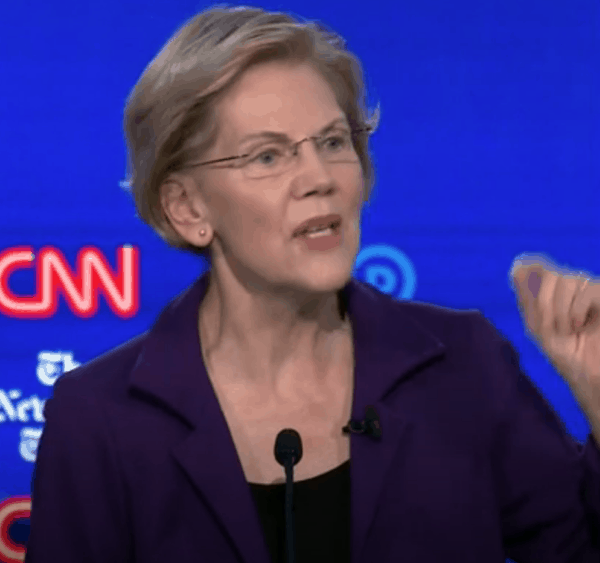
Sen. Elizabeth Warren: “After a lifetime of hard work, people are entitled to retire with dignity.”
Major kudos to Elizabeth Warren for being the first candidate to mention Social Security on the 2020 Democratic primary debate stage. The moderators of last night’s CNN/New York Times debate failed to ask a single question about Social Security, but Senator Warren raised the issue in response to the topic of Universal Basic Income.
“I understand that what we’re all looking for is how we strengthen America’s middle class. And actually, I think the thing closest to the universal basic income is Social Security. It’s one of the reasons that I’ve put forward a plan to extend the solvency of Social Security by decades and add $200 to the payment of every person who receives Social Security right now and every person who receives disability insurance…”
Senator Warren unveiled her Social Security proposal last month. It tracks pretty closely with Rep. John Larson’s Social Security 2100 Act and Senator Bernie Sanders’ Social Security Expansion Act, though Sanders did not mention his own proposal in last night’s debate.
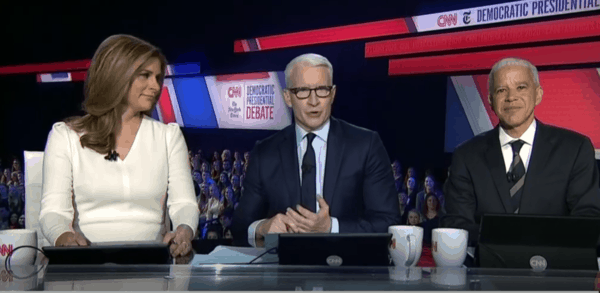
In fact, none of the other candidates took the time to follow-up on Senator Warren’s Social Security comments, nor did the moderators. National Committee president Max Richtman had implored moderators Anderson Cooper, Erin Burnett, and Mark Lacey to include a question about Social Security in last night’s debate, writing letters to all three in advance. Last week, Richtman argued in the online publication, Common Dreams:
“How long do seniors have to wait until they hear the Democratic presidential candidates’ positions on Social Security during a primary debate? Older Americans are the country’s largest voting bloc, but during the first four Democratic presidential debates, the moderators didn’t ask even one question about Social Security. This makes no sense.” – Max Richtman, National Committee President and CEO, 10/10/19
Last night’s debate moderators did not ask candidates any questions about Social Security
In his letters, Richtman suggested that the debate moderators ask a question about how the candidates would keep Social Security financially sound, with the trust fund facing insolvency in 2035. Both Warren’s and Sanders’ plans fix that problem while modestly boosting benefits, as does Rep. Larson’s.
What’s more, some Democratic candidates do address Social Security on the campaign trail. Joe Biden told a seniors’ forum in Iowa that “we should be increasing, not decreasing, Social Security.” Beto O’Rourke, Kamala Harris, Pete Buttigieg and Corey Booker have all advocated boosting and strengthening the program. But except for one mention by Senator Warren last night, viewers of the Democratic debates this primary campaign season could be forgiven for not knowing the candidates’ positions on Americans’ earned benefits.
The next Democratic debate is scheduled for November 20th in Atlanta, hosted by MSNBC and the Washington Post. Let’s hope the moderators of that debate recognize the importance of Social Security to millions of Americans and will include a question about how to safeguard the program’s future. As Senator Warren said last night, “After a lifetime of hard work, people are entitled to retire with dignity.” Debate viewers deserve to know how the candidates plan to uphold that promise.
- Published On: October 11th, 2019Categories: Congress, Don't Cut Pills Cut Profits, Medicare, Prescription Drug Prices
Rep. Gwen Moore (D-WI) speaks to seniors at National Committee Rx town hall in Milwaukee
Today marked an important step in the National Committee’s Don’t Cut Pills, Cut Profits campaign to educate and empower voters to help reduce prescription drug prices. Seniors in the Milwaukee, Wisconsin area joined elected leaders and experts for a town hall this morning on the skyrocketing cost of drugs. The town hall featured Rep. Gwen Moore (D-WI), Wisconsin Lt. Governor Mandela Barnes, Wisconsin State Senator Tim Carpenter, and a panel of experts from the National Committee and the event’s cosponsor, AARP.
Attendees at today’s town hall shared stories about hardships caused by soaring drug prices:
“I purchase my prescriptions from a Canadian pharmacy because costs are considerably less and generic alternatives are available that can’t be purchased in the United States.”
“I have a chronic autoimmune disease. One of my meds costs about $4,000 a month.”
“My insulin drug cost has gone from $72 a month to $600 a month. I’m no longer able to purchase the prescribed brand that my doctor ordered.”
“Our daughter’s caregiver couldn’t afford her medication for a condition she had. She died as a result.”
These kinds of stories are painfully common, especially among seniors living on fixed incomes. The median annual income for Medicare beneficiaries is only $26,200. Meanwhile, the price of the most commonly prescribed medications for seniors increased ten times the rate of inflation between 2013 and 2018. According to AARP, the annual average cost of prescription drugs overall increased nearly 60% between 2012-2017.
Today’s prescription drug pricing town hall was moderated by National Committee president and CEO Max Richtman, who wrote in the Friday edition of the Milwaukee Courier:
“As seniors struggle to pay for life-saving medications, Big Pharma has been raking in record profits. This is unacceptable in the world’s wealthiest country. But there is something that older Wisconsinites can do about it: become educated about the forces behind rising drug prices – and empowered to help bring those prices down to earth for the sake of Americans of all ages.” – Max Richtman, Milwaukee Courier, 10/11/19
National Committee President & CEO Max Richtman at today’s Milwaukee town hall
The National Committee supports legislation to lower prescription prices, including the bill put forward by the House Democratic leadership that would allow Medicare to negotiate drug costs with pharmaceutical companies. At this morning’s town hall, Congresswoman Moore took the drug industry to task for labeling such measures “socialism,” pointing out that the rest of the federal government (including the military) negotiates prices with businesses, why not Medicare? Price negotiation, she said, is fundamental to capitalism.
The “Don’t Cut Pills, Cut Profits” campaign is committed to ending prescription price gouging by holding drug-makers and elected leaders accountable, with the help of millions of seniors around the country. The campaign includes town halls, voter education, petition drives, and outreach to Members of Congress to vote for legislation that will reduce drug costs. The next town halls will be held in Portland, Oregon on November 8th and Lansing, Michigan on December 9th.
- Published On: October 10th, 2019Categories: COLAs, Congress, GOP, Prescription Drug Prices, Social Security, Tax Cuts, Trump
The scant 1.6% Social Security cost-of-living adjustment (COLA) for 2020 is another big disappointment for America’s seniors. The paltry new COLA will yield a $24 per month increase for the average beneficiary. With Medicare Part B premiums predicted to rise by about $8 next year, the net cost-of-living adjustment for most seniors will be only $16 per month. The new COLA inches-up the average monthly retirement benefit to $1,503 — a mere $288 yearly raise for seniors living on fixed incomes.
“It’s ironic that as billionaires and big corporations continue to profit from the $1.5 trillion in Trump/GOP tax cuts, America’s seniors are asked to get by with a meager $24 monthly raise. The negligible 2020 COLA illustrates why seniors need a more accurate formula for calculating the impact of inflation on their Social Security benefits. For years, we have urged the government to adopt the CPI-E (Consumer Price Index for the Elderly), which reflects the spending priorities of seniors, including health care, as opposed to the current formula based on younger urban wage earners’ expenses.” – Max Richtman, president and CEO of the National Committee to Preserve Social Security and Medicare.
If the CPI-E were adopted, beneficiaries would see a 6% overall increase in benefits over 20 years compared to the current formula, which yielded a zero cost-of-living adjustment three times during the past decade — and a mere 0.3% in 2017.
Social Security Cost-of-Living Adjustments (COLAs) 2010-2019
2010 0.0% 2015 1.7%
2011 0.0% 2016 0.0%
2012 3.6% 2017 0.3%
2013 1.7% 2018 2.0%
2014 1.5% 2019 2.8%
Meanwhile, health care costs are projected to rise 6% in 2020 The prices of the most commonly prescribed drugs for seniors on Medicare increased ten times the rate of inflation from 2013-2018. The cost of senior living facilities is growing at 3% annually – which adds up quickly over time.
“COLAs are out of sync with seniors’ actual expenses. Retirees have been living on very tight cost-of-living adjustments for a number of years now, which forces them to make hard decisions about their monthly budgets.” – Webster Phillips, Senior Legislative Representative, National Committee to Preserve Social Security and Medicare
With roughly half of America’s seniors relying on Social Security for at least 50% of their income, and 1 in 4 depending on the program for at least 90% of their income, the 2020 COLA does not go very far toward paying the bills. A net increase of $16 per month probably won’t cover typical expenses, such as the cost of a single prescription co-pay, a month’s medical supplies, or transportation to a doctor’s appointment.
According to the most recent Medicare Trustees’ report, the basic Medicare Part B premium will increase by about $8.80 a month to $144.30 per month in 2020. Wealthier earners pay higher Medicare Part B premiums.