- Published On: December 5th, 2019Categories: Congress, Democrats, Don't Cut Pills Cut Profits, Medicare, Prescription Drug Prices

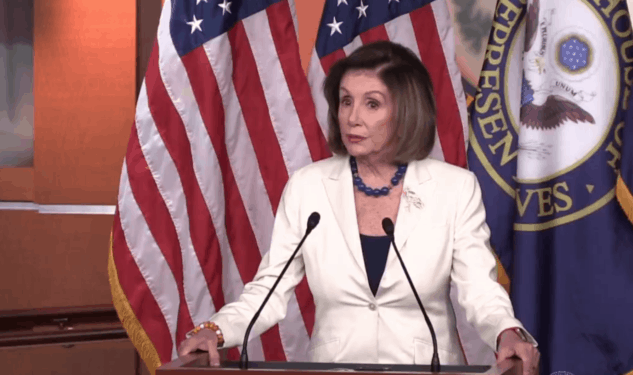
Speaker Nancy Pelosi says House will vote on Lower Drug Costs Now Act next week
Historic legislation to reduce prescription drug prices will come up for a vote in the U.S. House next week. Speaker Nancy Pelosi announced today that the Elijah E. Cummings Lower Drug Costs Now Act will reach the House floor as early as Tuesday. The bill, otherwise known as H.R. 3, would empower the Secretary of Health and Human Services to negotiate lower drug prices with Big Pharma on behalf of the millions of Americans in the Medicare program. The legislation represents the biggest change to Medicare since its inception in 1965.
“We are going to give Medicare the power to negotiate lower drug prices, and make those prices available to Americans with private insurance as well as Medicare beneficiaries. American seniors and families shouldn’t have to pay more for their medicines than what Big Pharma charges in other countries for the same drugs.” – Speaker Nancy Pelosi, 12/5/19
Through its “Don’t Cut Pills, Cut Profits” campaign, the National Committee has been fighting to lower drug prices, which have become a crushing financial burden for retirees living on fixed incomes – and working Americans at large. Soaring prescription prices contribute to Americans’ health insecurity, help drive the middle and working classes into medical bankruptcy, and compel them to forgo necessary medications.
An analysis by AARP last August revealed that nearly a third of pre-Medicare age adults are rationing pills, skipping doses, or simply not filling necessary prescriptions due to skyrocketing costs. Eight in ten Americans say drug prices are too high, with a majority blaming pharmaceutical company profits for unaffordable medications. A 2019 Kaiser Family Foundation study found that more than 80% of Americans (across party lines) favor aggressive government intervention to lower prices. Eight-six percent of those surveyed supported allowing Medicare to negotiate directly with drug makers – the very centerpiece of H.R. 3.
The bill includes:
-
A $2,000 cap on seniors’ Medicare out-of-pocket costs for prescription drug spending
-
A mechanism for the Medicare program to negotiate drug prices with manufacturers with a strong enforcement penalty to compel manufacturers to offer fair prices
-
An inflation cap on drug reimbursement to curb excessive and unwarranted drug price escalation
The House is expected to pass H.R. 3. On the Senate side, a bipartisan bill to reduce drug prices introduced by Senators Ron Wyden (D-OR) and Charles Grassley (R-IA) has been passed out of committee. The Grassley-Wyden bill – which is undergoing changes to win wider support in the Senate – contains provisions similar to those in H.R 3, but does not include Medicare price negotiation.
It’s uncertain whether Grassley-Wyden will reach the Senate floor. If the bill does pass by the Senate, a conference committee would have to reconcile the differences between Grassley-Wyden and the House legislation. One thing is certain: bipartisan majorities of Americans expect their elected leaders to take forceful action to relieve the pain of high drug prices, and will be rightfully angry if they don’t.
*******************************************************************
For more on this topic, watch “Behind the Headlines” on Facebook Live.
-
- Published On: November 27th, 2019Categories: Medicare, Medicare Advantage, Medicare Drug Coverage and Costs, Medicare Enrollments, President Trump
With a little more than a week left of the 2020 Medicare open enrollment season, the Trump administration continues drawing fire for its revamped online tools. On Monday, ProPublica published a scathing report highlighting misleading and inaccurate information on the Medicare Plan Finder. Many of the problems involve prescription drug plans, making it harder for seniors to make optimum choices that take into account not only premium prices, but out-of-pocket costs – which can run in the thousands of dollars, if not more.
One Medicare consultant conducted a test on the Plan Finder tool as if she were an enrollee, and found two versions of the same blood pressure medication on a single plan. One of the medications was covered by the plan, the other was not. The difference in cost was a whopping $2,700 per month. That is only one of myriad errors that can confuse beneficiaries and increase their costs.
“Advocates for seniors worry that the full weight of the tool’s inaccuracies will not be felt until the 2020 coverage year begins and seniors head to pharmacies to fill prescriptions or show up for medical appointments. For many Medicare participants, selections made during open enrollment are irreversible.” – ProPublica, 11/25/19
The Plan Finder is causing confusion across the country. The Associated Press reported Tuesday that Delaware’s insurance commissioner took the rare step of issuing a consumer alert to warn beneficiaries about the tool’s inadequacies.
“The tool is supposed to help find and compare Medicare coverage options, but (it) focuses on premium costs that ‘deflect focus from higher personal costs.’ The tool also shows plans that don’t cover certain medications if residents enter multiple prescriptions… (and) organizes options by lowest premium cost instead of lowest annual costs.” AP/WBOC-TV, 11/26/17
The Centers for Medicare and Medicaid Services (CMS) re-designed the Plan Finder for the first time since 2005, citing necessary software and functional upgrades. CMS spent $11 million to revamp the tool, which consumers complain is not working as it should – and may be, in fact, working against the best interests of beneficiaries. CMS also says that it’s updating the tool as complaints come in.
The rollout of any large, new online tool can be problematic. The Medicare Plan Finder is not the first to have bugs. But digging deeper, some of these issues seem to stem less from expected technical glitches and more from a certain ideological bias.
Since at least 2018, the Trump administration has been tilting the playing field toward private Medicare Advantage plans over traditional Medicare. In both print and online materials, CMS presents enrollee information in a way that makes Medicare Advantage seem like a better deal. As David Lipschutz of the Center for Medicare Advocacy noted, CMS enrollment materials have characterized Medicare Advantage as “less expensive by default” and listed “prior authorizations” for certain types of care as a “benefit,” rather than an impediment, for patients.
While Medicare Advantage plans can have lower premiums, they offer a limited network of physicians and other providers. Claims can be denied with limited opportunity for appeal. Let’s not forget those troublesome prior authorizations that come with many managed care plans. What’s more, private plans often change their pricing and coverage in ways that are hard for consumers to track – even harder if enrollment materials are inaccurate.
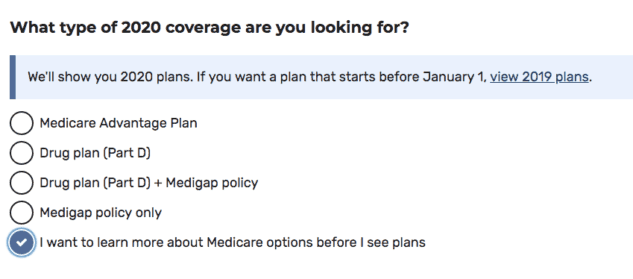
The online Medicare Plan Finder does not even list traditional Medicare as an option at the start of this questionnaire
In the face of the Trump administration’s apparent bias toward private Medicare plans, the National Committee and other seniors’ advocates are sounding the alarm:
“We have called upon the administration to level the playing field between traditional Medicare and MA plans. Instead, the President issued an executive order in October effectively doubling-down on that bias. The executive order requires federal agencies to examine regulations and practices to make sure that traditional ‘Medicare is not advantaged or promoted over [Medicare Advantage] with respect to its administration.’ In other words, the executive order aims to solve the exact opposite problem of the one that really exists.” – Max Richtman, National Committee President and CEO, 11/25/19
The National Committee has teamed up with the Center for Medicare Advocacy to provide the public with objective, accurate information about enrollment options. The Medicare Fully Informed Project offers enrollees a variety of educational tools. Unlike the administration, our goal is not to steer enrollees toward one program or the other, but to make sure they are positioned to make the best possible choices for their own health.
- Published On: November 12th, 2019Categories: Max Richtman, Medicare, Prescription Drug Prices
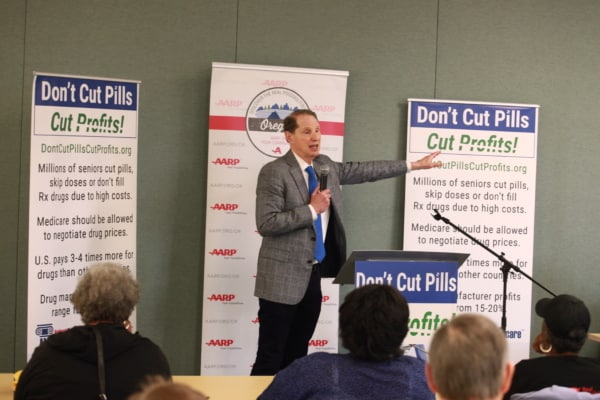
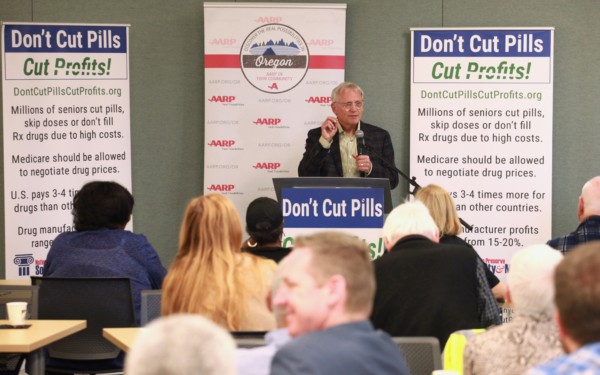
Sen. Ron Wyden at National Committee’s Rx Drug Pricing Town Hall in Portland
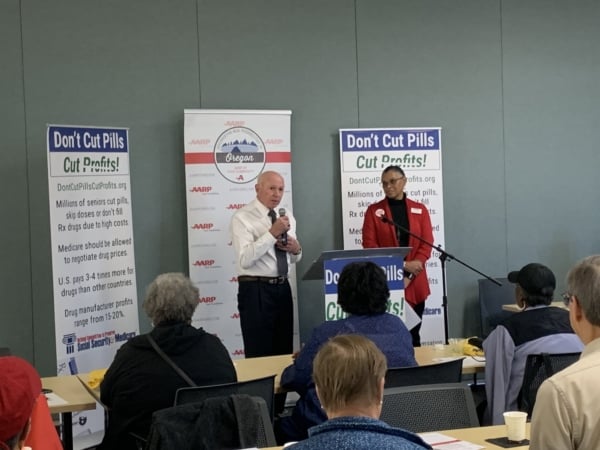
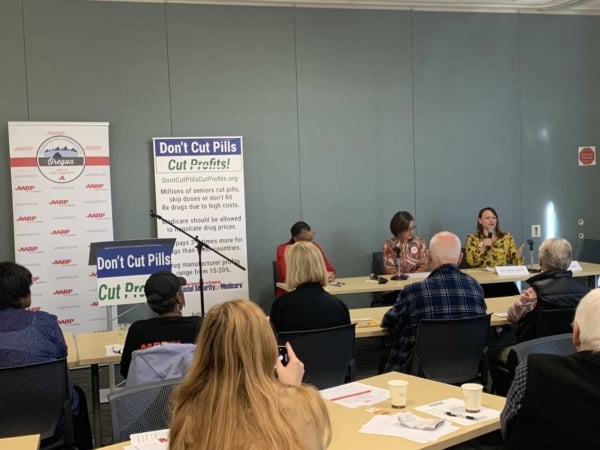
Sen. Ron Wyden (D-OR) headlined a spirited town hall on prescription drug pricing Friday in Portland as part of the National Committee’s “Don’t Cut Pills, Cut Profits” campaign. A capacity crowd of local seniors attended the event at Portland Community College, featuring Senator Wyden, Congressman Earl Blumenauer (D-OR), Oregon state reps. Andrea Salinas and Rachel Prusak, and policy experts from the National Committee and AARP Oregon, which cosponsored the event. The town hall was moderated by National Committee president and CEO Max Richtman.
“Drug prices and out-of-pocket costs paid by seniors have soared, forcing some older Americans to go without needed medications, cut pills and skip doses – or even choose between paying for medicine and groceries. Fortunately, the elected leaders at this town hall are working hard to right this wrong.” – Max Richtman, 11/8/19
NCPSSM president Max Richtman moderates Portland town hall on Prescription Drug Pricing
The town hall coincides with intensifying efforts in Congress to pass meaningful drug price reduction legislation. Sen. Wyden, the ranking member on the Senate Finance Committee, co-authored a bipartisan bill that would combat prescription price gouging by Big Pharma. Rep. Blumenauer is a key supporter of legislation in the House (H.R. 3) – backed by Democratic leadership but opposed by Republicans – to allow Medicare to negotiate the price of drugs with pharmaceutical companies (among other provisions).
Sen. Wyden conceded that the House legislation goes further than his bill in the Senate, the Prescription Drug Pricing Reduction Act, which he and Republican Senator Charles Grassley (R-IA) introduced last summer. “It’s not the bill I would have written, folks. But it’s a good start,” Wyden told the town hall audience.
Grassley-Wyden would cap drug prices in Medicare Part D according to consumer inflation levels, slapping penalties on drug makers who fail to comply. Sen. Wyden calls it “the first ever legislated cap on prescription price gouging.” According to the Congressional Budget Office, the bill would save Medicare beneficiaries $27 billion in out-of-pocket drug costs.
The bipartisan Senate bill also imposes a cap on out-of-pocket costs for Medicare Part D patients, which Sen. Wyden called a “peace of mind provision.”
“This ‘peace of mind provision’ means you won’t lose your home over drug prices. We set a cap on the annual amount you pay for prescription drugs, somewhere in the vicinity of $2,000. No one’s going to lose their home because of the price of medicine.” – Sen. Ron Wyden at the National Committee town hall, 10/8/19
Congressman Blumenauer told seniors at the town hall that even if Grassley-Wyden and the House bill do not pass during this session of Congress, they lay down major markers in the fight against Big Pharma price gouging. “We are keeping this issue alive, building momentum, and putting the heat on politicians to be accountable for these policies,” he said.
“Let’s call Big Pharma’s bluff,” says Rep. Earl Blumenauer (D-OR)
Rep. Blumenauer also shot down Big Pharma’s claims that price reductions would harm the research and development of new medicines. The pharmaceutical industry spends billions each year on marketing and advertising that could be put into R&D, much of which is funded by the federal government.
“Let’s call Big Pharma’s bluff: they don’t have to pick the pockets of American consumers in order to have research. We pay the highest prescription drug prices in the world. Half of the prescriptions written are never filled or completely taken… If we’re able to bring the prices down so that people could afford their prescriptions, they’d be in better health.” – Rep. Earl Blumenauer at the National Committee town hall, 10/8/19
According to AARP, the annual average cost of prescription drugs overall increased nearly 60% between 2012-2017, while Oregonians’ income increased only 14.8%. In 2017, nearly one quarter of the state’s residents rationed pills or skipped medications altogether. Oregon seniors who have suffered the consequences of soaring drug prices shared their stories at the Portland town hall.
“Because of the high price of prescription drugs, I am afraid of a lien being placed on our family home.” – Shirley M., Portland, OR
“I chose the provider who charges the least amount of money, and still had to refuse a medication my doctor prescribed because of cost.” – Rose B., Milwaukie, OR
“I am a diabetic and struggle to afford insulin.” – Maryanne W., Aloha, OR
Senator Wyden railed against the skyrocketing cost of insulin during the town hall:
“Insulin is taken by thousands and thousands of Oregonians. The prices have gone up in recent years thirteen-fold and the drug is not 13 times better! It’s basically the same drug as insulin has been for decades. Why does this go on? Because the drug companies can get away with it!” – Sen. Ron Wyden, National Committee town hall, 11/8/19
Oregon lawmakers Salinas and Prusak called the audience’s attention to measures in the legislature to combat rising drug prices on the state level. Last year, Oregon passed a transparency law requiring drug-makers and health insurance companies to report price increases to the state’s Department of Consumer and Business Services.
“It’s ridiculous that people have to ration their prescription drugs.” – Ore. Rep Rachel Prusak (right)
In addition to Senator Wyden, Rep. Blumenauer, and the two state legislators, the town hall featured AARP Oregon Director Ruby Haughton-Pitts, AARP N/NE Portland Chapter President Judy Knawls Boyer, AARP Manager of Federal and State Voter Engagement Khelan Bhatia, and National Committee policy advisor Lisa Swirsky.
“The town hall was an unqualified success,” says National Committee legislative director Dan Adcock. “The audience was engaged and interested. There were good questions and compelling stories. People were glad to hear the latest on prescription drug pricing from key players on Capitol Hill and their own state legislators.”
************************************************************************************************
The National Committee’s Don’t Cut Pills, Cut Profits campaign educates and empowers older Americans to help exert pressure on elected leaders to reduce prescription drug prices. The Portland town hall was preceded by an event in Milwaukee, Wisconsin on October 11th and will be followed by another in Lansing, Michigan on December 9th.
- Published On: November 7th, 2019Categories: Medicare, Prescription Drug Prices
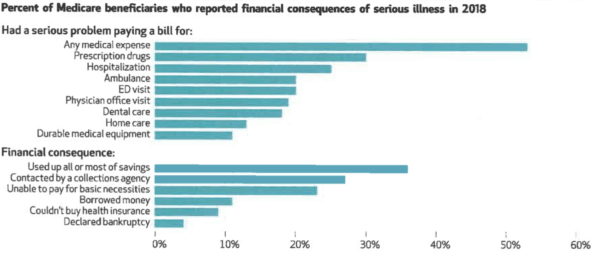
The National Committee has been beating the drum about seniors’ rising health care costs for several years. Now, a new study from Health Affairs confirms that seriously ill seniors face especially daunting financial hardships. According to the study, 53% of seriously ill Medicare patients are experiencing grave difficulty paying their medical bills, with unaffordable prescription drug costs posing the biggest challenge.
“The perception that Medicare works well for most beneficiaries obscures the financial exposure that is concentrated among the seriously ill. High-need Medicare beneficiaries may be especially vulnerable, since patients in the top 5% of spending account for more than half of out-of-pocket spending.” – Health Affairs, November, 2019
The study indicates that these financial burdens are taking a serious toll on seniors and their families. One quarter of respondents said that costs were a “major burden,” and 60% reported that family members and friends had helped out with health care costs “a lot.” When asked which medical costs posed the largest burden, 30% responded “prescription drugs,” second only to “any medical expense.”
Source: Health Affairs
Older Americans have been particularly hard hit at the pharmacy counter in recent years. Prices for the 20 most-prescribed drugs for seniors increased approximately ten times the rate of inflation between 2013-2018. One million Medicare beneficiaries paid nearly $3,200 in out-of-pocket drug costs in 2016. Increased cost sharing for prescription drugs has forced seniors to forgo needed medications, cut pills, and skip doses – or choose between medicine and groceries.
The National Committee is in the midst of a campaign to reduce seniors’ prescription drug costs, entitled “Don’t Cut Pills, Cut Profits.” The campaign includes town halls in select American cities. The first one took place in Milwaukee in October; the second happens Friday in Portland, Oregon. A third town hall will take place in Lansing, Michigan on December 9th. At each town hall, local seniors have the opportunity to dialogue with elected leaders, in order to become educated and empowered to lower prescription prices.
Attendees of these town halls have shared heartbreaking stories about soaring drug costs.
“The inhalers for my lung cancer cost $200 a month. We pay $270 a month for Medicare. My husband cuts his pills.”
“A medicine that helps me with chronic pain is unaffordable. It’s only $170 a month, but on a Social Security income, I can’t pay for it.”
“My medication costs put a major strain on my monthly Social Security checks.”
Crushing medical costs have negative consequences for seniors’ physical and financial health, according to the new study. More than one third of respondents said they had exhausted “all or most” of their savings to pay medical bills. Twenty-seven percent indicated they had been contacted by a collection agency. Nearly one-quarter of the seniors surveyed said they were not able to pay for essentials such as food, utility bills, and housing.
To mitigate the financial strain on seniors, the National Committee advocates catastrophic caps on out-of-pocket costs for Medicare Part B and Part D beneficiaries, improved supplemental Medigap coverage, and the passage of legislation to allow Medicare to negotiate drug prices with Big Pharma, which would produce some $345 billion in cost savings over seven years. These represent reasonable, common sense solutions to stop seniors from going broke because of soaring health care costs in the world’s wealthiest nation.
- Published On: October 31st, 2019Categories: Democrats, entitlement reform, Republicans, Social Security
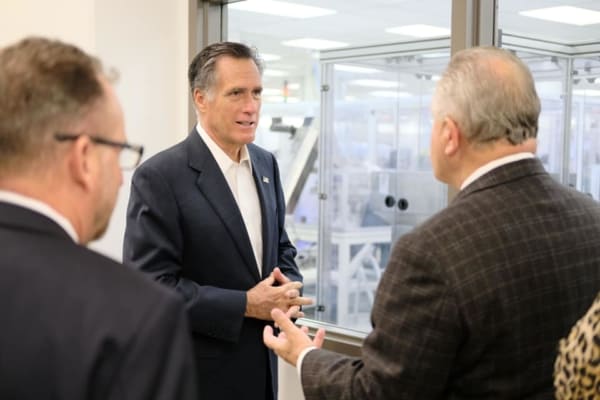
Sen. Mitt Romney (R-UT) proposes “rescue committee” for Social Security trust fund
On Tuesday, Senator Mitt Romney (R-UT) unveiled legislation that would put the future of Social Security in the hands of a special committee, claiming that “if you ever want to see a balanced budget, if you ever want to get out of debt, you have to deal with these trust funds.” National Committee president and CEO Max Richtman pushed back on Romney’s proposal yesterday as yet another attempt at “entitlement reform” that would hurt seniors.
“The last thing seniors need is for Mitt Romney to get his hands on Social Security. The Utah Senator intends to introduce a bill establishing a ‘Rescue Committee’ which would write legislation to keep the Social Security trust fund solvent for 75 years. We need only look to recent history to determine what Romney has in mind. During his failed 2012 presidential campaign, Romney proposed to raise the Social Security retirement age and slow the growth of benefits for some retirees. Romney’s 2012 running mate, Paul Ryan, fought to privatize Social Security throughout his two decades on Capitol Hill. Fortunately, Americans rejected Romney and Ryan’s bleak vision for Social Security’s future.
Like an earlier, failed proposal in the 115th Congress to establish a special Social Security commission, Senator Romney’s ‘rescue committee’ would set up a process that puts benefits at risk, forcing millions of older Americans onto a pathway toward poverty.
The Senator’s bill also ignores legislation already introduced by Democrats that doesn’t ask seniors to bear the cost of strengthening Social Security’s finances. Rep. John Larson’s Social Security 2100 Act would keep the program financially sound for more than 75 years without raising the retirement age or cutting benefits. It even includes a modest benefit boost. Bernie Sanders (I-VT) has introduced a similar bill in the Senate. As for Romney’s latest “entitlement reform” plan, we’ve seen this pitch before – and seniors aren’t buying it.” – Max Richtman, President and CEO of the National Committee to Preserve Social Security and Medicare