


Trump Re-Ignites Attacks on Affordable Care Act, Rallies Democrats

President Trump is at it again. Two years after promising Americans “something terrific” to replace Obamacare – and failing – the administration has renewed calls for its repeal. On Monday, the Department of Justice announced its full support of a federal judge’s decision that would eradicate the entire Affordable Care Act. (The decision is not in force and the case is under appeal). Then, on Tuesday, the president rewarmed his pre-repeal claims that the GOP should be “the party of health care” – catching Republican lawmakers off guard.
“If Trump had told GOP senators of his plans, they say they would have sought to convince him not to throw their party back into a war over health care — the issue Democrats believe was instrumental to their takeover of the House in last year’s midterms.” – The Hill, 3/27/19
Didn’t the White House learn its lesson in 2017 when Republicans tried to ram several ACA repeal bills through Congress, only to fail miserably? The GOP found itself bereft of ideas for actually replacing Obamacare with “something terrific” once they gained control of the White House – after voting more than 60 times to repeal the ACA during the Obama presidency.
Since we haven’t written as much about Obamacare since the GOP repeal effort went down in flames in 2017, let’s recall what’s at stake:
“The ACA touches every part of the health care system — from how Medicare pays doctors to the Medicaid expansion that has covered millions of low income people.” – National Public Radio, 3/26/19.
For older Americans, the Affordable Care Act mitigated the age rating system that allowed insurers to charge them five times as much as younger people. It extended the financial solvency of Medicare and provided for annual wellness visits at no cost to the patient. Obamacare expanded the Medicaid program so that more Americans – including ‘near seniors’ aged 50-64 – were covered.
After the Republicans’ ‘repeal and replace’ efforts failed, the Trump administration committed itself to undermining the Affordable Care Act in myriad other ways, including withholding subsidies, purposely under-promoting the annual open enrollment period, and campaigning for the Trump/GOP tax scheme, which zeroed out the penalty for not obtaining coverage. It was that last act of sabotage upon which the federal judge in Texas ruled that the entire law should be overturned.
United against President Trump’s efforts to destroy the Affordable Care Act, Congressional Democrats have pledged to strengthen it through new legislation. Speaker Nancy Pelosi unveiled a bill on Tuesday to “lower health insurance premiums, strengthen protections for people with pre-existing medical conditions, and ban the sale of what Democrats call junk insurance,” reports the New York Times.
But with the GOP in control of the Senate and Obamacare’s most virulent opponent sitting in the White House, the Affordable Care Act that helps so many millions of America obtain health coverage will remain under constant threat.
House Dems Hold First Hearings on Social Security Expansion
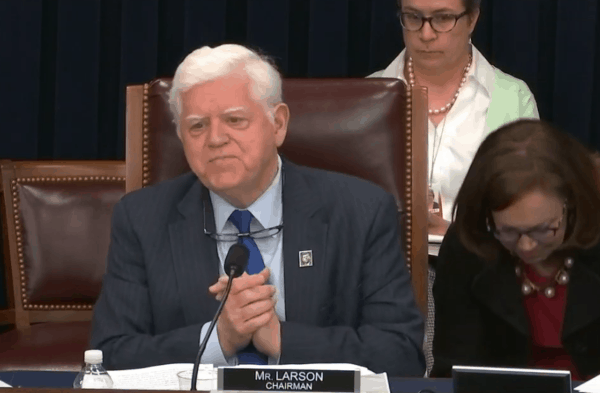
For the first time in recent memory, the U.S. House has begun holding hearings on the issue of expanding Social Security. On Wednesday, the newly-minted chairman of the House Ways and Means Social Security subcommittee, Rep. John Larson (D-CT), convened a hearing entitled, “Protecting and Improving Social Security: Benefit Enhancements.” The purpose, said Larson, is to “shine a bright light on all of the proposals to secure Social Security that will help the American people.”
Max Richtman, president of the National Committee to Preserve Social Security and Medicare, was the lead-off witness.
“Since the program’s creation 84 years ago, Social Security has been – and is – an enormously successful program which is essential to the retirement security of the vast majority of Americans. While (the) benefits are modest, Social Security is still the single largest source of income for retired Americans. To ensure the program’s continued success, it is vitally important that long-term solvency be restored, and that Social Security benefits be improved to meet the needs of all Americans.” – Max Richtman, testimony before the House Ways and Means Social Security Subcommittee, 3/13/19
Richtman re-iterated the National Committee’s support for Congressman Larson’s Social Security 2100 Act, which restores the program’s long-term solvency and boosts benefits.
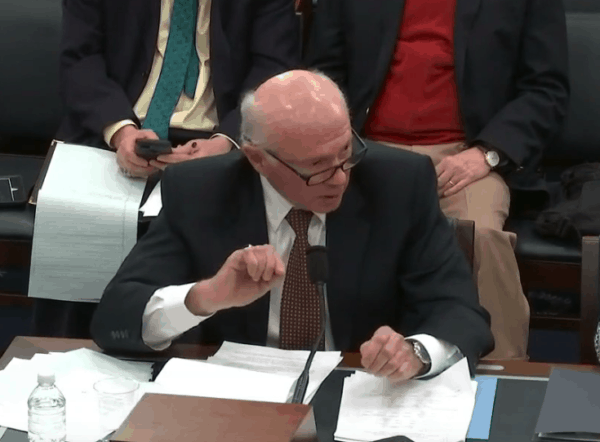
National Committee president Max Richtman testifies before House Social Security subcommittee
Advocates from other organizations joined Richtman at the witness table, including Bette Marafino, president of the Connecticut Alliance of Retired Americans (from Larson’s home state). Marafino related poignant stories of Connecticut residents who would fall into poverty without Social Security. She recalled how her own grandmother was “glad to receive my grandfather’s Social Security check, because it literally kept her out of the poor house.”
“The traditional three-legged stool of pension, personal savings, and social security is deteriorating. The ‘pension’ leg of stool has been disappearing, eroding retirement security and making Social Security even more important. Along with the high cost of prescription drugs putting pressure on seniors’ finances, (these factors make) the need to increase Social Security benefits urgent.” – Betty Marafino, president, Connecticut Alliance of Retired Americans, 3/13/19
Abigail Zapote, Director of Latinos for a Secure Retirement, told the subcommittee that boosting benefits is crucial to the Latino population, whose average Social Security checks are lower than other Americans’.
Joan Entmacher, Senior fellow at the National Academy of Social Insurance (NASI), testified that Social Security expansion would help address the inherent disadvantages that women face in retirement. She pointed out that the average retirement benefit for women is only 80% of men’s, making women even more reliant on Social Security.
Entmacher advocated the creation of caregiver credits for people (the majority of whom are women) who take time off of work to care for family members, so that their future retirement benefits are boosted. Congressman Larson’s bill does not include caregiver credits, but legislation to be re-introduced this year by Rep. Nita Lowey (R-NY) would provide more than $20,000 in annual credits to full-time family caregivers, which the National Committee also supports.
Republicans on the subcommittee, now in the minority for the first time in 8 years, appeared less combative than in the past.
“This was a richer dialogue about the philosophical differences about Social Security than we’ve had in a long time,” observed National Committee legislative director, Dan Adcock. “There was a quest to figure out what each side could live with.”
On the other hand, Republicans seemed to reject any benefit enhancements paid for by new revenues. (The Larson bill would adjust the payroll tax cap so that the wealthy pay their fair share, and raises the payroll tax by a modest 1.2% over more than 20 years.)
“The Republicans say they love the program, but they don’t want to pay for it. Instead, they would address Social Security’s solvency through large benefit cuts.” – Dan Adcock, NCPSSM Director of Government Relations and Policy
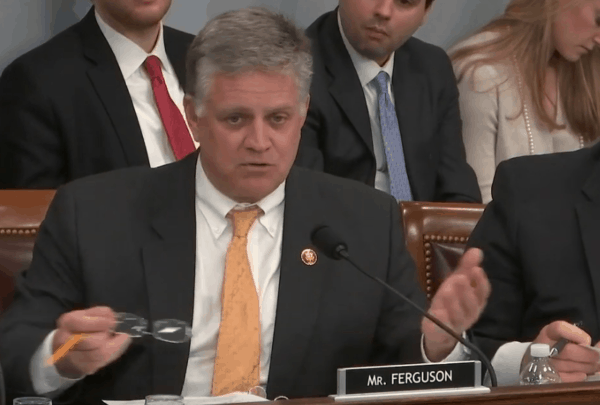
Rep. Drew Ferguson (R-GA) questions Max Richtman on GOP bill that would cut Social Security benefits
In fact, subcommittee Republicans harkened back to legislation offered by former chairman Sam Johnson (R-TX) which would have cut Social Security benefits by a whopping 30%. Congressman Drew Ferguson (R-GA) asked Max Richtman what part of the Johnson bill the National Committee could support.
“Nothing,” replied Richtman.
Trump 2020 Budget Shortchanges Seniors
They say that a White House budget is merely a messaging document – especially in an era of divided government. In that case, the Trump administration has sent a grim message to America’s seniors in its 2020 spending proposal. It goes something like this: older Americans living on fixed incomes – especially the elderly poor – must get by with less.
“President Trump’s 2020 budget proposal shortchanges seniors, plain and simple. In combination with 2017’s tax cuts for the wealthy and the administration’s failure to allow Medicare to negotiate with Big Pharma, the Trump budget shows that this administration is not plugged-in to the realities of being elderly in America.” – Max Richtman, National Committee president
Among other things, the White House budget cuts $25 billion from Social Security Disability Insurance, $845 billion from Medicare – and $1.5 trillion from Medicaid. This is from a President who promised “not to touch” older Americans’ earned benefits. The administration proposes to cut the Social Security Administration’s operating budget by about 1%, at a time when the agency is just beginning to recover from past spending cuts that hobbled customer service. In addition, the Trump budget flat-lines or eliminates federal grants for several programs that help lower-income seniors – including Meals on Wheels and home heating assistance:
Federal Block Grant Programs that Help Fund Older Americans Act Programs
Community Services Block Grant (CSBG) (HHS) Eliminated
Social Service Block Grant (SSBG) (HHS) Eliminated
Community Development Block Grant (CDBG) (HUD) Eliminated
Low Income Home Energy Assistance Program (HHS) Eliminated
The White House offers up these cold-hearted cuts while proposing to hike the Pentagon budget by 4% and demanding $8.6 billion for Trump’s border wall. Democratic leaders in Congress proclaimed the Trump budget dead on arrival, with good reason.
“President Trump’s budget once again lays out an irresponsible and cynical vision for our country, without any regard for its human cost. It lacks foresight and would leave our nation unable to meet our obligations to the American people.” – Rep. John Yarmuth, (D) House Budget Committee chairman
“Donald Trump promised the American people that he would be a different type of Republican, that he would be a champion of the working American and that he would not cut Social Security, Medicare and Medicaid. But his budget does the exact opposite of what he promised the American people.” – Sen. Bernie Sanders, (I-VT)
Fortunately, momentum is building on Capitol Hill to boost – rather than cut – earned benefits. Senator Sanders and Rep. John Larson have introduced bills to expand Social Security. Rep. Debbie Dingell and Rep. Lucille Roybal-Allard put forth legislation that would improve Medicare benefits, including dental, vision and hearing coverage. The Democratic majority in the House will work to protect Medicaid from cuts threatened by the White House and GOP, including the program’s expansion under the Affordable Care Act (ACA). (The Trump budget would repeal the ACA and eliminate Medicaid expansion.)
If the prevailing political winds are blowing in the direction of expanded benefits and away from cruel cuts, why worry about a White House budget that has no chance of enactment? The 2020 Trump spending proposal serves as a warning of what the administration would do if it were not for the firewall known as the Democratic-led House of Representatives. These draconian ideas – though rejected by voters in the 2018 mid-terms – remain in the conservative political bloodstream, requiring continued advocacy on the part of seniors and their champions in Congress.
The Washington Post is Wrong on Social Security

The Washington Post editorial board is still drinking the conservative Kool-Aid when it comes to Social Security. In an editorial on Friday, the Post came out against Congressman John Larson’s Social Security 2100 Act, an eminently reasonable bill to boost retirees’ benefits and keep the system solvent for the next 75 years – co-sponsored by more than 200 House Democrats.
The Post argues that the nation essentially cannot afford to give seniors – two thirds of whom rely on Social Security for at least half of their income – a modest pay raise. The editorial board goes on to argue that providing retirees a modest financial boost would divert revenue from programs for children, who are more likely to be poor than seniors. This is a standard conservative ploy to pit the generations against each other, even though Social Security is a contract between the generations that has provided financial security for millions of Americans of all ages. In fact, 4 million children received Social Security benefits in 2018.
The Post editorial is so wrong-headed that we thought it worth breaking it down piece-by-piece.
“Social Security is not broken — and does not require a radical overhaul.”
We agree. But Congressman Larson’s bill does not represent a “radical overhaul.” It provides for a modest expansion of benefits and strengthens Social Security’s finances. A radical overhaul would entail slashing benefits, raising the retirement age to 70, and privatizing Social Security – all of which have been proposed by conservative ‘entitlement reformers.’
“The poverty rate for elderly Americans in 2017 was 9.2 percent.”
That’s true, but without Social Security, some 40% of seniors would slip into poverty. Beneficiaries living above the poverty line are not exactly flush with cash. The average retirement benefit is $1,461 per month – or slightly less than $18,000 a year. Millions of seniors are struggling to make ends meet, forced to choose between paying for groceries, prescription drugs, or utility bills. Retirees on fixed incomes cannot afford the kind of benefit cuts that the Post embraces.
“Consumers’ confidence in the adequacy of future retirement income is at a 20-year high.”
That confidence may be misplaced. Americans’ retirement savings are at historic lows. Pensions – a foundation of the 20th century middle class – are disappearing. Less than half of workers have an employer-provided retirement plan, and 401Ks are subject to the volatility of the stock market (see the 2008 financial crash). If anything, future retirees will have a harder time saving for old age than today’s seniors.
“Social Security spending is a major factor in the United States’ structural budget problem.”
Actually, it’s not. Social Security is – and always has been – self-funded by workers’ payroll contributions, with the surplus in a trust fund invested in treasury bonds. The program is a separate from general revenue and does not contribute a penny to the debt.
“Laudably, [Congressman Larson’s] plan tackles two important goals: long-term solvency and the lingering problem of old-age poverty. Less laudably, it does so while diverting scarce resources toward a vast majority of Social Security recipients who are not only not poor but, in many cases, perfectly comfortable.
Well, sorry, but that’s how social insurance works. Everyone pays in and everyone gets a benefit. However, the benefit structure is progressive, so that the poorest beneficiaries get the highest percentage benefit and the wealthier get less.
We are all for making the overall tax system more progressive than it already is, including by taxing high earners, as the Social Security 2100 Act would do. You can tap “the rich” only so many times, however.
Really? Asking the wealthy to pay into Social Security at the same rate as everyone else is not “tapping the rich.” It’s simply fair. If the wealthy contribute, they receive their earned benefits like everyone else. But high earners stop contributing to Social Security on all wages above $132,900 per year. In fact, millionaires stopped paying into Social Security for the entire year last Monday – President’s Day. President Trump, if he actually pays taxes and earns as much as he claims, would have finished contributing on January 1st. Congressman Larson’s bill would reimpose payroll taxes after $400,000 in income, gradually eliminating the wage cap altogether.
“[Instead of increasing Social Security revenue], the priority should be to use the money for children, who are almost twice as likely to be poor as senior citizens.”
With this argument, the Post employs a time-honored trick by conservatives to divide the generations. Can’t a just and equitable nation – the wealthiest on earth – provide a safety net for children and seniors? It’s telling that the Post editorial does not even mention the Trump/GOP tax cuts, which gave away more than $2 trillion in federal revenues to billionaires and big corporations. That’s $2 trillion in lost revenue, some of which could have been used to expand help for the poor and vulnerable, including children. (Incidentally, the Post’s parent company, Amazon, paid zero dollars in federal taxes last year.) If we have our priorities straight, we can afford to fund children’s programs and preserve seniors’ retirement security.
“The [Progressive Price Indexing] plan would retain Social Security’s current benefit formula for the 30 percent of workers with the lowest lifetime earnings, while reducing the growth rate of initial benefits for the top 70 percent.”
Here, the Post endorses a conservative proposal known as Progressive Price Indexing – hatched more than fifteen years ago by a member of George W. Bush’s Social Security advisory commission. (Note: President Bush tried – and failed – to privatize Social Security in 2005.) Even the libertarian CATO Institute found fault with Progressive Price Indexing:
“[The proposal would] slow the growth in future Social Security benefits for middle and upper-income retirees by changing the benefit formula from wage indexing to price indexing. Critics charge that such a change will weaken Social Security’s foundations while hitting the middle class hardest.” – CATO Institute, 5/23/05
Indeed. Why cut benefits for the top 70% of wage earners? That’s more than two-thirds of all beneficiaries! Many members of this 70% cannot afford a benefit cut. Some are already struggling to get by. As retirees, they are susceptible to the vagaries of old age – chronic illness, disability, and the loss of the ability to live independently. If their benefits are cut, they may not be able to afford prescription drugs, groceries, transportation and elder care – including assisted living and home- and-community-based care.
What’s more, these 70% worked hard and paid into Social Security for most of their lives. The scheme the Post embraces would break the link between lifetime earnings and benefits. That bond defines Social Security as a social insurance program that is fair across the generations.
Fortunately, the public at large does not support the Post’s conclusions. Poll after poll shows that voters across party lines want to see Social Security expanded, not cut. Large majorities support lifting the payroll wage cap so that the wealthy pay their fair share. Congressman Larson’s bill does both, while maintaining Social Security’ financial stability through the end of the century. Unlike the Washington Post, most Americans have refused to drink the Kool-Aid. Advocates for boosting Social Security are on the move, and the public is solidly behind them.
New CMS Projections on Medicare Spending Warrant Scrutiny

According to a federal report issued yesterday by the Centers for Medicare and Medicaid Services (CMS), government is expected to cover 47% of the country’s health care costs by 2027. The current figure is 45 percent, according to the Associated Press.
“Rising prices for health care goods and services are expected to account for nearly half the spending growth, said the report, with the rest driven by a mix of factors, including an aging population… ‘The baby boom generation is expected to shift from private health insurance coverage to Medicare coverage during the projection period,’ said an author of the report.” – Associated Press, 2/20/19
However, as today’s Washington Post points out, the rise in government spending on health care should not come as a surprise given the continued aging of America:
“The number of people covered through Medicare — and spending on the federal insurance program for older and disabled Americans — is expected to grow more rapidly than private insurance… eating up a larger chunk of health spending.” – Washington Post, 2/21/19
In fact, argues one health care analyst, only an alien would truly be shocked at the latest projections from CMS:
“To the extent that a Martian landed and saw how much of the American health care system is funded by the government, it’s been about 50 percent for some time,” – Paul Hughes-Cromwick, economist at the nonprofit research organization, Altarum
Others are flat-out skeptical about the CMS projections, including President Obama’s former budget chief, Peter Orszag:
“They have predicted an imminent acceleration of health-care costs repeatedly over the last few years,” he said. “It hasn’t happened, and there’s no reason to expect it’s about to.” – Washington Post, 2/21/19
Even if these projections are on the money, they can be somewhat misleading out of context. While overall government spending on health care may rise in the future due mainly to the nation’s changing demographics, federally-run programs like Medicare remain the most cost-effective means of providing care.
A new report from the Urban Institute found that Medicare spending per beneficiary between 2006-2017 was “equal or less” to the increase in per capita GDP. On the other hand, private insurers spent two percentage points more per capita during the same period. Translation: Medicare spends more efficiently on health care than private insurers do. Even if overall government health care spending rises because of an increasingly aging population, Medicare costs less per person.
In this graph from the Urban Institute report, the brown bars represent spending per enrollee:
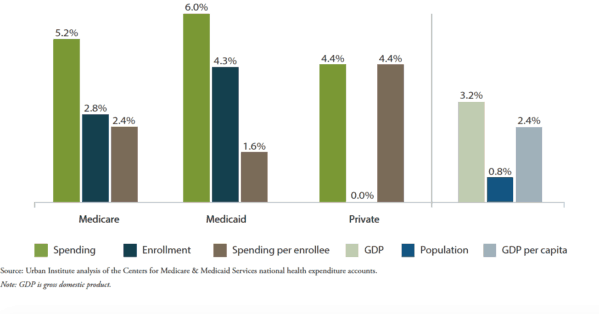
“Overall, Medicare and Medicaid are doing a good job of keeping per capita costs under control, and the continuation of recent policies is critical to sustain this control… The authors conclude that [both programs] have successfully moderated growth in spending per enrollee… and do not require major restructuring to lower national health spending.” – Urban Institute Report
The report’s conclusion refutes conservative proposals to cut Medicare, especially when there are more equitable, common sense, and non-Draconian measures available to lower costs. The new Democratic majority in Congress is already examining potential solutions – including allowing Medicare to negotiate drug prices directly with Big Pharma. Meanwhile, Medicare ‘reformers’ should take note of this other nugget in the Urban Institute report: “The larger cost containment problems the nation faces are in the private insurance market.”