- Published On: September 30th, 2022Categories: Congress, Democrats, Social Security, Social Security Administration (SSA)

Congress passed a continuing resolution Friday to keep the government funded until December 16th. It contains additional money for the beleaguered Social Security Administration, which services the 66 million Americans receiving Social Security and people applying for benefits. NCPSSM president and CEO Max Richtman issued the following statement today in response to the Congressional action:::
“Congress is handing the Social Security Administration a modest financial lifeline, but the extra money may only help the agency to tread water. The Continuing Resolution (CR) to keep the government temporarily funded boosts spending for the Social Security Administration (SSA), an agency that has been chronically under-funded while striving to improve customer service to the public. Under the CR, SSA will receive an additional $400 million for FY 2023. We applaud Congressional Democrats for inserting this funding increase into the bill when spending for most other agencies remains temporarily frozen.
The increased funding should help SSA cope with its long-standing customer service backlog, which was greatly exacerbated by the pandemic. Customers have been subjected to long hold times on the SSA toll-free phone line, extensive delays awaiting disability claims hearings, and – since the re-opening of field offices last summer – waiting in line at some locations for hours in the heat. With the new level of funding, those problems likely will not get worse, but they may not significantly improve.
SSA requested twice as much funding for the CR ($800 million) and Congress shouldapprove that level when an Omnibus Appropriations bill for the reminder of FY 2023 is enacted. We will work with Social Security champions in Congress and other advocacy groups to secure SSA the funding it truly needs to improve customer service. American workers whose wages finance the Social Security program expect Congress to fully fund SSA so it can properly serve the public.” – Max Richtman, President and CEO, National Committee to Preserve Social Security and Medicare, 9/30/22
Last May, the House Ways and Means Social Security subcommittee held a hearing on customer service issues at SSA. Witness after witness (including NCPSSM President Max Richtman) testified that the agency is in dire need of additional resources in order to properly serve the public. While witnesses praised SSA employees for doing their best to provide the public with customer service during the pandemic, they painted a picture of an underfunded and overworked agency in desperate need of Congressional action.
Rebecca Vallas of the Century Foundation advocacy group told lawmakers at the hearing, “A decade-plus history of congress underfunding SSA’s already incredibly lean operating budget, worsened by the pandemic, has spurred several urgent crises in the agency’s customer service…The casualties are your constituents.”
Among the most pressing problems that have plagued SSA customer service are long hold times, disconnects, and busy signals on the agency’s toll-free phone line and excessive delays in Social Security Disability Insurance (SSDI) hearings. (Over 100,000 claimants have died waiting for their cases to be adjudicated.). In April, SSA was able to re-open most of its field offices after being shuttered for almost two years during the COVID pandemic.
“We are doing what we can with current staff and funding. The demand for service is high; we are losing staff; and morale is low,” testified Peggy Murphy, Director of the Social Security field office in Great Falls, Montana. “SSA is at a critical juncture as we face the future.”
In August, Lorie Konish of CNBC reported:
People who face long waits for service at the Social Security Administration’s field offices have had to contend with one more complication this summer — intense heat. “Although most SSA field offices can assist visitors, in some locations people have been standing outside in the heat for hours at a time, without the guarantee of getting their needs met,” wrote Reps. Richard Neal, D-Mass., and Kevin Brady, R-Texas, in a letter addressed to Kilolo Kijakazi, acting commissioner of the Social Security Administration. – CNBC, 8/17/22
“To avoid waiting in line, I strongly encourage people who can to use our online services at www.socialsecurity.gov, call us and schedule appointments in advance rather than walking in without an appointment,” said SSA Commissioner Kilolo Kijakazi in a statement. “Phone appointments can save you a trip to a busy office.” SSA also outlined several steps it was taking to reduce wait times at field offices.
- Published On: September 20th, 2022Categories: Congress, Democrats, Rep. John Larson, Republicans, Social Security
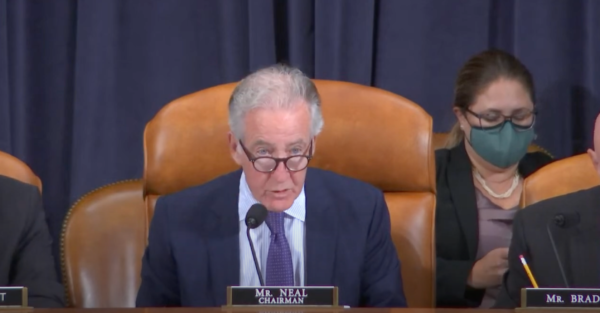
Chairman Richard Neal presides as House Ways & Means Committee advances Social Security legislation
A bill to repeal two largely unpopular rules affecting some public sector workers’ ability to collect Social Security benefits was reported out of the House Ways & Means Committee today. The Social Security Fairness Act was introduced by Rep. Rodney Davis (R-IL), and currently has more than 290 cosponsors from both parties.
The bill would eliminate the Windfall Elimination Provision (WEP), which in some instances reduces Social Security benefits for individuals who also receive a pension or disability benefit from an employer who did not withhold Social Security taxes. It would also repeal the Government Pension Offset (GPO), which can reduce survivors’ benefits for spouses, widows, and widowers who receive their own government pensions.
“This bill aims to address longstanding problems of WEP and GPO. While well intentioned, these provisions penalize many hard-working public servants and their family members. After serving their communities for years, teachers, firefighters, police officers, and other public employees in certain states are hit with an unwelcome surprise after retiring, a reduction in their Social Security benefits due to WEP and GPO.” – Rep. Richard Neal (D-MA), Chair of the House Ways & Means Committee
The National Committee to Preserve Social Security and Medicare supports enactment of Rep. Davis’ bill, but prefers that WEP and GPO be addressed as part of broader Social Security reform, preferably via Rep. John Larson’s Social Security 2100: A Sacred Trust legislation.
Rep. Larson’s bill not only would repeal WEP and GPO, but boost Social Security benefits across the board and extend the solvency of the trust fund. And, unlike the Social Security Fairness Act, the elimination of WEP and GPO are paid for in Larson’s legislation. Rep. Davis’ bill does not have a funding mechanism and actually would accelerate the projected depletion of the Social Security trust fund.
House leadership has so far prevented Social Security 2100 Act from going through committee mark-up and proceeding to the floor for a vote, prompting Rep. Larson to offer his bill as a substitute for Rep. Davis’ legislation during today’s committee meeting. Congressman Larson withdrew his amendment shortly afterward, knowing that it was going to be ruled “not germane” to the committee’s business at hand. But it did give him an opportunity to make an impassioned plea for the House to take up his own bill – benefitting all 65 million Americans on Social Security and not just the 2.7 million affected by WEP and GPO – before the 117th Congress is gaveled to a close.
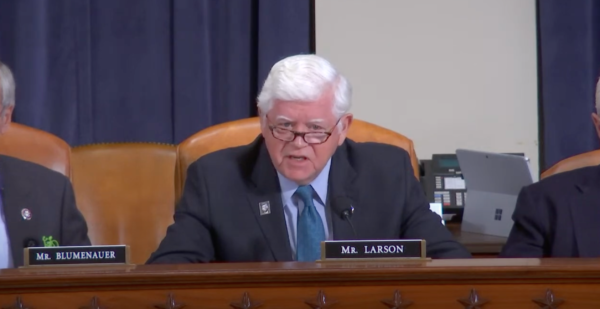
“The group that’s hit hardest by inflation and pandemic are the seniors of this great nation. For 51 years Congress has kicked the can down the road without improving benefits. Repealing WEP and GPO are part of my bill — they are paid for. Seniors on fixed incomes need us to not only talk the talk, but walk the walk. We need to vote on (my bill) instead of kicking the can down the road.” – Rep. John Larson, 9/20/22
Dan Adcock, NCPSSM’s Director of Government Relations and Policy, says that the National Committee will continue to work with Rep. Larson to urge House leadership to take up Social Security 2100. But, he says, “the chances that bill will be considered by the full House grow dimmer as the number of days on the legislative calendar for the 117th Congress dwindles.”
Meanwhile, Adcock says, although Rep. Davis’ Social Security Fairness Act was advanced out of the Ways and Means Committee (albeit ‘without recommendation’), its fate is uncertain. “Given that Rep. Davis’ bill is not paid for and violates the Congressional PAYGO rule, it is unlikely that the bill will be considered by the House during this Congress.”
Rep. John Larson makes an impassioned plea for his Social Security 2100 Act. “Let’s not kick the can down the road any longer.”
If, as looks increasingly likely, neither Davis’ or Larson’s bills come up for a vote, another session of the U.S. Congress will have gone by without real improvements to Social Security, which current and future seniors most definitely need in order to retire with financial security and dignity. It will be up to voters this November to elect more members of Congress who will do what it takes to pass meaningful legislation to boost Social Security.
Related Posts
- Published On: September 14th, 2022Categories: Congress, Democrats, Joe Biden, Max Richtman, Medicare, Prescription Drug Prices
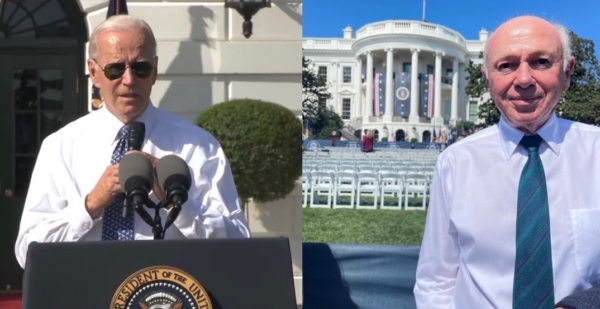
National Committee President Max Richtman and other advocates joined President Biden at the White House on Tuesday for a celebration of the new law reducing prescription drug costs for Medicare beneficiaries, the Inflation Reduction Act. The event, held on the South Lawn, was attended by members of Congress, administration officials, and representatives of seniors’ groups including AARP, the Center for Medicare Advocacy, and the seniors’ council of the Democratic National Committee.
“We have been fighting to lower prescription drug prices for a long time. And even though the new law doesn’t include everything we’d hoped for, this is a significant victory for seniors. To see the Inflation Reduction Act signed into law and then to be invited to participate in this celebration today is truly remarkable.” – Max Richtman, NCPSSM President and CEO, 9/13/22
President Biden touted the hardest-fought provision in the law, the ability for Medicare to negotiate prescription drug prices with drugmakers. The pharmaceutical industry spent millions of dollars trying to defeat that measure, but ultimately failed.
“For years, Big Pharma blocked Medicare from negotiating lower drug prices. But not this year. This year, the American people won, and Big Pharma lost.” – President Biden, 9/13/22
The President credited “brave allies in Congress… and so many determined advocates and activists across the country” for standing up to Big Pharma and pushing the law across the finish line.
The list of lawmakers at the White House event included Senator Joe Manchin (D-WV), who withdrew his support for an earlier iteration of the law but finally conceded to more modest reforms in the Inflation Reduction Act. Majority Leader Chuck Schumer (D-NY) pushed the bill through the Senate via the budget reconciliation process on a 50-50 vote, with Vice President Harris breaking the tie. The House passed the bill on August 12th and sent it to President Biden for signature. Not a single Republican in either house of Congress supported the bill to lower prescription drug costs.
“I want to thank President Biden. We would never, never have gotten the Inflation Reduction Act done without his steady hand. For over a year-and-a-half, he dared us to dream big, pushed us to aim high, and urged us to never let go of our promise to the American people.” – Senate Majority Leader Chuck Schumer, 9/13/22
Under the Inflation Reduction Act, Medicare will begin negotiating the prices of ten of the most expensive prescription drugs in 2024. The negotiated prices will take effect two years later, in 2026. According to Reuters, those drugs “will be chosen from among some of the 50 medicines responsible for the highest Medicare spending that have no cheaper generic or biosimilar alternatives.” By 2029, the number of drugs subject to negotiation will double.
The new law also caps out-of-pocket drug costs for Medicare beneficiaries at $2,000 per year. “That will mean tremendous savings to millions of seniors who have been forced to pay significantly more out of their own pockets up until now,” Richtman points out. “Equally important is the provision in the new law that limits beneficiaries’ costs for insulin to $35 per month. Right now, that figure can easily reach $1,000 or more every month.”
Thanks to the Inflation Reduction Act, Big Pharma can no longer hike drug prices at will without repercussions. “Price increases on drugs will be limited to below the rate of inflation,” reports US News. “Price increases for half of all drugs covered by Medicare outpaced inflation from 2019 to 2020.” Some of those price jumps were more than 7.5% in a single year.
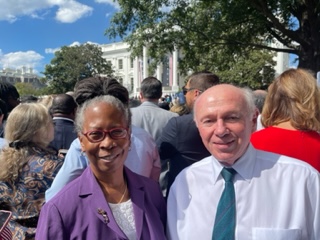
Social Security Commissioner Kilolo Kijakazi and NCPSSM President Max Richtman at the White House
President Biden and Congressional Democrats are hoping that the Inflation Reduction Act will show that the party can fulfill its campaign promises. (Lowering prescription drug prices was one of the key promises in the 2020 election cycle.) It is one of a string of legislative victories for the President and Democrats that may influence voters in the 2022 mid-terms. After all, the party will have difficulty following up on this law with more health care reform for the American people if it cannot hold onto both houses of Congress. “In this case, passing the Inflation Reduction Act was the right thing to do for seniors and good politics,” says Richtman.
Related Posts
- Published On: September 11th, 2022Categories: Older Americans
**** This is an update of a previous blog post ****
As we celebrate Grandparents Day 2022, we recognize seniors as a positive force in society. The pandemic only strengthened that role, even as it took a heavy toll on seniors themselves. To that extent, their stepped-up participation as caregivers was nothing short of heroic.
Even before the pandemic, grandparents were taking on greater responsibility for raising grandchildren. According to Kiplinger, the number of children in their grandparents’ care doubled from 1970 to 2010. In 2019, some 2.5 million grandparents were responsible for raising their grandkids. And those are only the ones who did so ‘officially.’
During the pandemic, working parents lacking sufficient child-care have turned to grandparents to help out with the children. Grandparents have admirably stepped in to do everything from babysitting to home schooling to preparing meals for the family.
“Whether students are learning at school or at home, or are not yet school age, more grandparents have jumped into daily caregiver roles. Many are happily working without pay, for the love of family, while others have accepted offers of money from their frazzled, eternally grateful adult children.” – WTTG-TV, Washington, D.C.
During the height of the pandemic, Bill and Mary Hill of Phoenix, Arizona took care of their 8 year-old grandson five days a week, and supervised his homeschooling, because the child’s parents were required to show up for work in person.
“At first it was like, we’d love to be a part of this and get to see our grandson more, really get to know him a little better,” Mary said. “At the same time, we were going, `Oh my gosh.’ We knew it would change our lives and it has. It’s much busier.” – Mary Hill, Phoenix, AZ via Fox5 D.C.
There are two-way benefits in these arrangements. Grandchildren and parents get much-needed extra help – and seniors’ mental and physical health is often strengthened through social stimulation and enhanced activity.
Some of the extra help that seniors provide their families may not have been possible without their earned benefits – Social Security and Medicare. The basic financial and health security that these programs provide give seniors the flexibility and peace of mind to contribute to their families and communities.
Jeanne Trimble of Northern Virginia told the Wall Street Journal that her Social Security benefits made it possible for her to retire and care for her son’s two young children during the pandemic.
“My son and daughter-in-law were reluctant to put the kids in daycare and were struggling to keep up with their own work schedules. I’m 64 and was planning to retire in two years but my husband and I consulted with our bank and figured out that with Social Security, I could retire early to help out.” – Jeanne Trimble, Northern Virginia, in the Wall St. Journal
Helping out with grandchildren is only one of the many ways that seniors aid their communities. The Front Royal, VA Royal Examiner published a list of the myriad contributions that older Americans make to society, including:
- As caregivers for an ailing spouse, with responsibilities ranging from managing household tasks to offering emotional support and providing medical care.
- As babysitters for their grandchildren, whose parents are productive members of the workforce.
- As organizers for events hosted by religious groups and other types of community-based organizations, which often struggle to attract younger participants.
- As donators of time and money to charities, foundations, and non-profit organizations that support members of the community.
- As mentors for the next generation, passing on family legacies, a lifetime of experience, and a career’s worth of knowledge.
- As part of a support system for other seniors, such as by planning activities at their seniors’ residence or running errands for someone with reduced mobility.
One specialist in senior services summed it up nicely:
“Seniors are able to devote the required time and effort to see projects through from start to finish. Seniors realize their needs can be intergenerational and what benefits them will also benefit the rest of society.” – Mickey Balas, Seniors Navigator
Southern California senior Cliff Adcock volunteered for Meals on Wheels
This is what we mean when we say that seniors contribute so much to our lives and communities. The reason we repeat it often is that some in government and the private sector suggest that seniors receive too much help, or can afford to sacrifice some of their hard-earned, already modest benefits for the cause of fiscal austerity. We say, if anything, Social Security and Medicare must be strengthened and expanded. As seniors continue to give back so much, we must always look out for them in return.
- Published On: September 9th, 2022Categories: Congress, hearing care, Medicare, President Biden
The Food and Drug Administration has issued a final rule establishing a new category of over-the-counter hearing aids. This will allow people with ‘mild to moderate’ hearing loss to buy hearing aids directly from stores or online retailers. Consumers will not need an exam, prescription or a fitting by an audiologist. The rule should make hearing aids affordable for seniors on fixed incomes who may not be able to afford the high cost of prescription devices – which run in the thousands of dollars per pair. (Traditional Medicare does not yet cover these costs.)
“For millions of Americans, hearing aids and the doctor’s visit to get them prescribed are too expensive. In the executive order I issued last year to increase competition in key industries and lower costs, I called on the FDA to finally make hearing aids available over the counter. Today, the FDA is doing just that.” – President Biden, 8/16/22
President Biden’s executive order required the FDA to allow hearing aids to be sold over the counter and gave the agency 120 days to accomplish it. Congress passed legislation in 2017 empowering the FDA to create a category of OTC hearing aids, but it was not fully implemented until now. “Consumers could see OTC hearing aids available in traditional retail and drug stores as soon as mid-October when the rule takes effect,” says the FDA.
The National Committee to Preserve Social Security and Medicare has long advocated for over-the-counter hearing aids, especially because hearing care is so crucial to seniors’ overall health.
“As someone who suffers from hearing loss, I understand what this means for seniors’ health – and their pocketbooks. While we hope that Medicare will eventually cover hearing aids, the new rule allowing OTC hearing aids is a common sense, compassionate measure that will improve seniors’ access to quality devices.” – Max Richtman, President of the National Committee to Preserve Social Security and Medicare
Prescription hearing aids can cost as much as $2,500 each (or $5,000 a pair). The hefty price tag can be a severe strain for seniors living on fixed incomes, especially since Medicare does not cover hearing aids. That’s why some 70% of Americans between age 65 and 84 with hearing loss are not using hearing aids. They simply cannot afford to.
The new generation of OTC hearing aids will retail for a fraction of the prescription price:
“By opening the market to OTC aids, manufacturers of consumer electronics — from giants such as Apple and Samsung to small startups — could enter the hearing aid space and sell directly to consumers… [at a retail price] between $150 and 299.” – The Hill Newspaper
Imagine being able to buy high-quality hearing aids at your local pharmacy or grocery store for as little as $150, bypassing the time-consuming and expensive process of acquiring them from an audiologist. Of course, those with more serious hearing impairment will and should continue to seek prescription hearing aids through a specialist.
This is not just a matter of personal cost. It’s a public health issue. Hearing loss is a gateway to other potential medical problems – including fatigue, stress, depression and memory loss. Access to affordable, high-quality OTC hearing aids means that millions of seniors will likely be able to hear better and stay healthier.