


Social Security Legislation Would Give Seniors the Pay Raise they Deserve

Congressman John Larson (right) is reintroducing his landmark Social Security expansion bill
For years, seniors have told us that they need their Social Security benefits boosted. They want fairer cost-of-living adjustments (COLAs) that reflect retirees’ true living expenses. They say it’s time for the wealthy to start paying their fair share in Social Security payroll contributions. Congressman John Larson’s Social Security 2100 Act would achieve all of that – and more. The bill would keep the system solvent for nearly the rest of this century while modestly boosting benefits – and cutting taxes for retirees. Not only do seniors and advocates support this bill, the American public has affirmed the proposals that it embodies in poll after poll, across party lines and age groups.
This morning at the U.S. Capitol, Rep. Larson announced that he is re-introducing his bill, the legislation having languished in the GOP-controlled House for four years. With a new majority in the House, the bill will finally get the consideration it deserves. Larson, the newly minted chairman of the House Social Security subcommittee, promises to hold hearings on the bill featuring testimony from experts and the public.
The Congressman decided to re-introduce his bill on President Franklin Roosevelt’s birthday. F.D.R. signed Social Security into law in 1935 to give retirees the basic income security they lacked. (At the time, many seniors were destitute and dwelled in poor houses.) Over the decades, Social Security has been expanded to benefit a wider swath of Americans. The expansions included benefits for survivors and dependents, provisions for early retirement, disability coverage, and annual cost-of-living adjustments (COLAs) to offset the effects of inflation.
Social Security isn’t an entitlement. It is the insurance Americans have paid for with every paycheck. It helps provide economic security for millions of Americans including seniors, people with disabilities, and children and spouses who have lost a provider. That’s why I’m working to expand Social Security. – Rep. John Larson
Champions of Social Security like John Larson know that the program must be boosted to keep pace with the country’s ever-changing needs. But conservatives have fought to reduce Social Security benefits, insisting the only way to address the system’s projected future shortfalls is to cut it. Congressman Larson’s bill is a resounding rebuke to those claims. It would keep Social Security financially sound for generations, mainly by requiring the wealthy to contribute more to the system.
Under current law, all income above $132,900 is exempt from Social Security payroll taxes. Rep. Larson’s bill adjusts the payroll wage cap so that earners with incomes exceeding $400,000 per year would continue contributing to Social Security. Eventually, the cap would be phased-out altogether. The legislation also includes a payroll tax increase of 1.2 percentage points spread over more than twenty years – the equivalent of 50 cents per week for the average wage earner.
This new revenue allows the Social Security 2100 Act to provide a much-needed boost in benefits. Among other things, the legislation:
*Provides a 2% benefit bump for all beneficiaries.
*Protects retirees against inflation with a new formula for calculating cost-of-living adjustments, the Consumer Price Index for the Elderly (CPI-E).
*Includes an increase in the special minimum benefit so that more low-wage workers qualify.
*Cuts taxes for over 12 million Social Security beneficiaries.
These improvements could make a meaningful difference for seniors living on fixed incomes. The average Social Security retirement benefit is a modest $1,461 per month, yet half of America’s seniors rely on Social Security for at least 50 percent of their income. One in five seniors depend on it for at least 90 percent of their income. The Social Security 2100 Act gives retirees the pay raise they need and deserve. It’s time for the Congress to move forward under Congressman Larson’s leadership.
***************************************************************
For more information on this topic, visit Boost Social Security Now!

Government Shutdown Puts Seniors’ SNAP benefits at Risk

While the government shutdown has not affected Social Security or Medicare, low income seniors receiving food assistance remain at risk. Some five million older Americans receive grocery vouchers from the Supplemental Nutrition Assistance Program (SNAP), which is funded by the U.S. Department of Agriculture (USDA) and administered by the states.
USDA is one of the federal agencies affected by the government shutdown. Fortunately, January’s SNAP benefits were paid, and the agency issued February’s payments ten days early before it officially ran out of funding last weekend. But this leaves all SNAP beneficiaries – including low income seniors – in a bind for two reasons.
First, if the government shutdown continues indefinitely, USDA will likely not be able to pay March’s benefits. Second, even if the government reopens soon, SNAP recipients will have to stretch the early February payment over a period of at least 40 days until the beginning of March. For some beneficiaries, the gap may be longer. As the Center for Budget and Policy Priorities explains:
“Given the experience of the strain on low-income households’ budgets and community resources under normal SNAP issuance patterns — when the gap between SNAP issuances is no more than 31 days — stretching that gap to 40 to 50 days or longer could create substantial hardship and hunger and sharply increase demand for local emergency food providers and other community social services providers.” – Center for Budget and Policy Priorities, 1/22/19
Business Insider observes that “the early allocation of funds means recipients will have to carefully budget the money in order for it to last until March, and possibly longer.” SNAP households are no doubt used to managing tight budgets, but the burden could be especially difficult for seniors living on their own. (Only one in four seniors receiving SNAP benefits live with family members.)
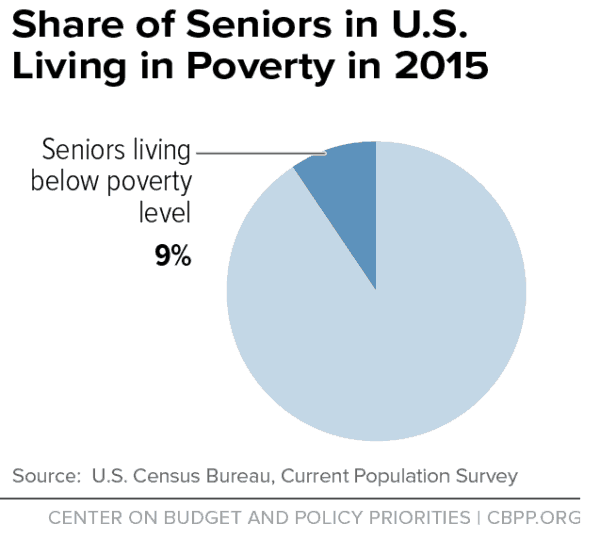 Food insecurity, which Merriam Webster defines as “unable to consistently access or afford adequate food,” can be a life and death issue for low-income seniors.
“Research indicates that food-insecure seniors have less nutritious diets, have worse health outcomes, and are at higher risk for depression than food-secure seniors. Compared to other adult age groups, seniors are particularly vulnerable to the health consequences of food insecurity.” – Center for Budget and Policy Priorities, 1/22/19
The average $1.40 per meal SNAP benefit may not be much, but it does help millions of seniors from slipping into a state of dire food insecurity. The government shutdown has imperiled those crucial benefits and put some of our most vulnerable citizens at risk.
********************************************************************************************************
Seniors dependent on federal food assistance are not the only ones in jeopardy during the shutdown. The Washington Post reported today that “cutbacks in government subsidies for low-income housing are imminent as the government remains closed.” According to the Post, Some 66% of the the households relying on subsidies from the Dept. of Housing and Urban Development (HUD) are elderly or disabled
Hill Democrats Get Tough on Big Pharma, Prescription Drug Prices

Elections have consequences, and one positive consequence of the midterms is that the new House majority is serious about reducing drug prices for seniors. Last week, Democrats introduced legislation to allow Medicare to negotiate prices directly with pharmaceutical companies. This week, the new chairman of a key House committee, Rep. Elijah Cummings (D-MD), announced an investigation into skyrocketing drug costs.
“It’s time to provide much-needed relief to the American people. They should not have to decide between paying their bills or paying for their prescriptions. We need real and immediate action to lower drug prices in this country. The American people deserve that, and I will do everything I can to help deliver that for them.” – Rep. Elijah Cummings
Cummings has just sent letters to 12 large drug companies demanding details and documents about the companies’ pricing practices. They include industry giants like AstraZeneca, Eli Lilly, Johnson & Johnson, Novartis, Novo Nordisk, and Pfizer, whose profits and CEO compensations are – to say the least – quite healthy.
Despite tepid pleas from the Trump administration, Big Pharma hiked the prices of hundreds of medications at the beginning of the year. According to Cummings’ office, some 94% of the most often prescribed brand-name drugs more than doubled in price between 2005 and 2017.
Meanwhile, the percentage of Medicare Part D beneficiaries who paid at least $2,000 out-of-pocket for prescriptions nearly doubled from 2011 to 2015.
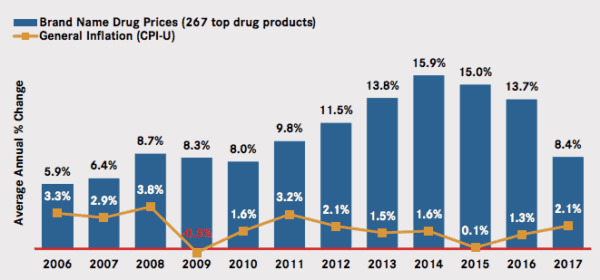
Source: AARP Progressive Policy Institute
Seniors living on fixed incomes are the least able to afford rising drug prices. The average Medicare beneficiary has about $25,000 in annual income, which is only 200% of the federal poverty level. Too many seniors still must choose between groceries and prescription drugs – or cutting pills in half to save money.
This is not lost on Congressman Cummings and like-minded elected leaders on Capitol Hill. Rep. Cummings and Senator Bernie Sanders (I-VT) rolled out an ambitious package of bills last week that could make a serious dent in drug prices:
- The Prescription Drug Price Relief Act, which would peg the price of prescription drugs in the United States to the median price in five major countries: Canada, the United Kingdom, France, Germany and Japan;
- The Medicare Drug Price Negotiation Act, which would direct the Secretary of Health and Human Services (HHS) to negotiate lower prices for prescription drugs under Medicare Part D;
- The Affordable and Safe Prescription Drug Importation Act, which would allow patients, pharmacists and wholesalers to import safe, affordable medicine from Canada and other major countries.
If enacted, these bills would save Americans and the federal government billions of dollars in prescription drug costs. In fact, Stat news reported that the government could have saved more than $14 billion on the 50 most frequently prescribed medications in 2016 if Medicare were able to negotiate prices with Big Pharma like the Department of Veterans Affairs does.
There are myriad other proposals to bring down drug prices, recapped nicely by Dylan Scott in Vox earlier this week. These include measures to expedite the production of lower-priced generic drugs, cap patients’ out-of-pocket costs, allow the government to manufacture certain medications, and reform the U.S. patent system. “The current proposals on the table range from the realistic to the purely aspirational,” Scott observes. “Drug prices are a thorny problem. What we do know for sure is people want something done.”
******
Watch our discussion about prescription drug prices on “Behind the Headlines” on Facebook Live.
Congress Moves to Tackle Prescription Drug Prices

While the government shutdown rightly dominates the headlines, there is activity on Capitol Hill to address another urgent issue: rising prescription drug prices. At the beginning of the year, the Wall Street Journal reported that more than three dozen pharmaceutical companies hiked the prices of hundreds of medicines, despite the Trump administration’s pleas that they be lowered. Rising drug prices continue to pummel the pocketbooks of seniors living on fixed incomes. Too many older Americans are still having to choose between groceries and medicine – or cutting pills in half.
But the tide may be turning. Champions of seniors are assuming powerful committee chairmanships in the House of Representatives. Momentum is building for legislation – some of it solidly bipartisan – that would help bring prescription drug prices under control. In other words, the new Congress may begin to stand up to Big Pharma:
Hope is strong among health-care advocates and lawmakers that 2019 could be the year Congress and the executive branch finally make significant moves against the powerful prescription drug industry, after long acknowledging a need for action but doing little about it. – Washington Post, 1/7/19
Members of the new 116th Congress are introducing bills to bring seniors some relief at the pharmacy counter. On Thursday, Senator Bernie Sanders (I-VT) and Congressman Elijah Cummings (D-MD) unveiled legislation that would, among other things, direct the Medicare program to negotiate prescription drug prices with pharmaceutical companies. (The U.S. Veterans Administration has been doing it for years.) Congressional Democrats estimate that these negotiations would save Medicare beneficiaries at least $15 billion a year.
On the House side, Congressman Lloyd Doggett (D-TX) will re-introduce similar legislation. (With the Democratic takeover of the House, Doggett is expected to become chairman of the influential House Ways and Means health subcommittee.) His bill would allow the Secretary of Health & Human Services to directly negotiate prices for prescription drugs. If negotiations were to fail, Doggett’s bill would empower the HHS Secretary to issue a competitive license allowing other manufacturers to produce the drug for Medicare.
The Hill reports that the new House leadership, including Speaker Nancy Pelosi and House Energy and Commerce Committee Chairman Frank Pallone (D-NJ) support allowing Medicare to negotiate prescription drug prices.
Momentum also appears to be gathering for legislation affecting generic drugs. Big pharmaceutical companies have long engaged in anti-competitive behavior to keep lower cost generic drugs off the market. The bipartisan CREATES Act would make it harder for brand name drug-makers to impede cheaper generic competition. According to The Hill, the CREATES Act enjoys the support of many Republicans, including Senator Chuck Grassley (R-Iowa), the new chair of the Senate Finance Committee.
While Senator Grassley is on the wrong side of the Medicare price negotiation issue, he has joined forces with Democratic Senator Amy Klobuchar (D-MN) on the Preserve Access to Affordable Generics Act. The bill would prohibit “pay-for-delay” deals where pharmaceutical companies pay producers of generic drugs to delay rolling out those medications.
On the other end of Pennsylvania Avenue, President Trump (who said in 2017 that drug companies were “getting away with murder”) has proposed some administrative measures to lower drug prices. Unfortunately, most of these have been weak tea – and seemingly designed not to offend Big Pharma. Instead of waiting to see if the Trump administration will do more than nibble around the edges of the problem, many in the new Congress appear ready to try to alleviate the pain of soaring prescription drug prices.
New Alzheimer’s Funding is a Good Start, but ‘BOLDer’ Action is Needed

In the waning hours of 2018, President Trump signed into law a bipartisan bill to boost federal efforts to address the Alzheimer’s epidemic that impacts some 5.7 million Americans and their families. The BOLD Infrastructure for Alzheimer’s Act provides $100 million in new funding and “restates priorities” in the fight against a disease that’s aptly been called “The Long Goodbye.”
The BOLD Act was cosponsored by Senators Tim Kaine (D-VA), Susan Collins (R-ME), Shelley Moore Capito (R-WV), and Catherine Cortez-Masto (D-NV):
“The… Act will improve early detection and diagnosis, provide assistance for caregivers and educate the public on Alzheimer’s disease and brain health. This bipartisan legislation is the first step in addressing [this] ongoing public health crisis…” – Sen. Catherine Cortez-Masto, BOLD Act co-sponsor
The National Committee, which fights for the financial and health security of America’s seniors, endorsed the bill to confront Alzheimer’s (whose victims are mostly over 65 years of age).
“The BOLD Act would create a public health infrastructure to implement effective interventions to combat Alzheimer’s disease and related dementias including prevention, early detection and diagnosis and treatment.” – National Committee letter endorsing BOLD Act, 5/2/18
While it’s commendable that a bipartisan group of Senators sponsored the bill and that President Trump signed the BOLD ACT into law, defeating the Alzheimer’s epidemic will require much, much more. One-hundred million dollars in new spending over 5 years is a small step forward, and advocates for Alzheimer’s victims are right to celebrate. But federal funding for Alzheimer’s research continues to fall short of what is needed to invest in an aggressive and intensive research strategy to develop effective treatment and, hopefully, a cure.
Estimated federal spending on Alzheimer’s research was some $1.8 billion in 2018, compared to President Trump’s demand for $5.6 billion for his border wall. His administration’s Fiscal Year 2019 budget called for a freeze in biomedical research. A significant shift towards disease research priorities is urgently needed.
Alzheimer’s is a fatal scourge deserving considerably higher funding. It is the 6th leading cause of death in the United States, felling more Americans than breast and prostate cancer combined. A startling one in three seniors dies with Alzheimer’s or other form of dementia. By 2050, the disease is expected to claim 14 million victims – almost three times the number of Alzheimer’s patients today.
The disease also poses a direct threat to Medicare and Medicaid. In 2018, the two programs spent an estimated $186 billion caring for beneficiaries with Alzheimer’s and other dementias – representing nearly 70 percent of total costs. “By 2050, combined Medicare and Medicaid spending on patients with Alzheimer’s is expected to quadruple to $750 billion (in today’s dollars),” according to the nonprofit Alzheimer’s Impact Movement. This is an enormous financial burden for Medicare and Medicaid, which seniors’ advocates are already fighting to strengthen in the face of conservatives’ demands for benefit cuts.
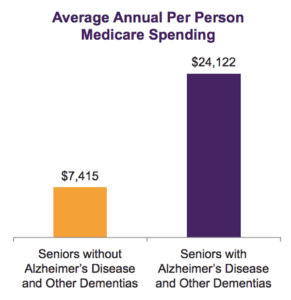
Source: Alzheimer’s Impact Movement
The nearly six million Americans suffering from Alzheimer’s, along with their families and caregivers, rightly expect an increased funding commitment from the federal government. The beginning of the 116th Congress – with its fresh faces and new leadership – presents an opportunity to build on the BOLD Act and put more brain power into the fight. It’s time for our national leadership to muster the political will to defeat Alzheimer’s before the grim estimates for the future become reality.