


Social Security Trust Fund Projected to Endure for an Additional Year, Trustees Say

Social Security’s trust fund received a one-year reprieve in the 2022 Social Security Trustees report, released late Thursday afternoon. The Trustees project that the combined disability and retirement trust fund will become depleted in 2035 – one year later than predicted last time – if Congress doesn’t take preventative action. When the trust fund becomes insolvent, the Trustees say, Social Security will only be able to pay 80% of scheduled benefits. That would mean a massive benefit cut for everyone who collects Social Security.
While the National Committee to Preserve Social Security and Medicare is relieved that the trust fund is projected to remain solvent for one additional year absent any action by lawmakers, President and CEO Max Richtman said in a press statement that Congress must act now to protect the program:
“While the trust fund insolvency date may fluctuate from year to year, the urgent need to boost the program’s financing and benefits remains consistent. The clock is running down. The time for fair, just, and equitable action that safeguards Social Security’s financial stability is now.” – Max Richtman, NCPSSM President and CEO
The National Committee supports legislation introduced in the House by Rep. John Larson (D-CT) that would put Social Security on a path to financial stability, Social Security 2100: A Sacred Trust. It would also boost benefits for everyone on Social Security and adopt a more accurate COLA formula to help seniors better cope with inflation. To pay for these improvements, the bill would require those earning over $400,000 a year in wages to contribute their fair share through an adjustment in the payroll wage cap.
Larson’s bill has more than 200 cosponsors in the House, but not a single Republican has stepped up to support Social Security 2100. In past years, the GOP has called for raising the retirement age, privatization, and more recently, ‘sunsetting’ Social Security and other vital programs every five years.
President Biden, who during the campaign called Social Security and Medicare “sacred obligations” to the American people, rejected the Republican approach:
“Led by (National Republican Senatorial Committee) Chair, Rick Scott, their plan would put (Social Security and Medicare) on the chopping block every five years. That’s not the way to strengthen these programs. I will work with anyone willing to have an open and honest conversation about… strengthening the programs that millions of Americans rely on.” – President Biden, 6/2/22
NCPSSM President Max Richtman says that the public supports boosting, not cutting, Social Security. “Poll after poll shows that, across party lines, the American people want the kind of improvements in Rep. Larson’s bill, not harmful benefit cuts.”
In their report yesterday, The Trustees themselves urged prompt, pro-active action by Congress to strengthen Social Security’s finances:
“Implementing changes sooner rather than later would allow more generations to share in the needed revenue increases or reductions in scheduled benefits. Social Security (plays) a critical role in the lives of 66 million beneficiaries and 182 million covered workers and their families… With informed discussion, creative thinking, and timely legislative action, Social Security can continue to protect future generations.” – 2022 OASDI Trustees Report, 6/2/22
According to the Washington Post, the Trustees based their new projections, in part, “on a stronger and faster economic recovery” than predicted in 2021 during the midst of the pandemic. Meanwhile, the New York Times reported that “for now, (the Trustees) are also assuming that the pandemic will not affect the long-term solvency of Social Security.”
The Trustees also reported, as they do every year, on the financial outlook for Medicare’s Part A trust fund. That forecast improved this year, with the shortfall date for the Part A trust fund projected to occur in 2028 – two years later than predicted in last year’s report. According to the Reuters, “That change is due mostly to the improved economic forecast, since the program is funded through payroll taxes.”
Social Security Trustees Project Trust Fund Depletion in 2035
National Committee President and CEO Max Richtman issued the following statement today in response to the just-released report from the Social Security Trustees:::
“The takeaway from the latest Social Security Trustees report is this: Congress must strengthen the program’s finances without delay. The Trustees project that the combined Social Security retirement and disability trust fund will become depleted by 2035, one year later than projected in their previous report. At that point, every Social Security beneficiary will suffer a 20% cut to their benefits. While the trust fund insolvency date may fluctuate from year to year, the urgent need to boost the program’s financing and benefits remains consistent. Rep. John Larson’s Social Security 2100: A Sacred Trust legislation would extend trust fund solvency by requiring high wage earners to contribute their fair share through an adjustment in the payroll wage cap. The bill has more than 200 Democratic cosponsors in the House, but not one Republican has stepped forward to endorse Social Security 2100. Over the years, we have heard the GOP call for raising the retirement age, privatization, and more recently, ‘sunsetting’ Social Security and other vital programs every five years. But poll after poll shows that, across party lines, the American people want the kind of improvements in Rep. Larson’s bill, not harmful benefit cuts. Seniors struggling to meet rising living expenses need Social Security to be boosted and strengthened. The pandemic, runaway inflation and devastating stock market losses serve to remind us how vital a robust Social Security program is to workers, retirees, the disabled and their families. The clock is running down. The time for fair, just, and equitable action that safeguards Social Security’s financial stability is now.” – Max Richtman, President and CEO, National Committee to Preserve Social Security and Medicare
All House Dems Should Cosponsor Social Security 2100 Bill

If you are represented by a Democrat in the U.S. House, chances are that your member of Congress has already cosponsored a piece of landmark legislation to boost and strengthen Social Security: Rep. John Larson’s Social Security 2100: A Sacred Trust. In fact, the bill currently has 202 Democratic cosponsors (and zero Republicans). But some Democrats have not signed on as cosponsors, even though improving Social Security benefits and extending the solvency of the trust fund are priorities that Democrats should agree on. The more Democratic co-sponsorships the bill garners, the stronger the case that House leadership should bring it to the floor for a vote.
Rep. Larson, chair of the House Ways and Means Social Security subcommittee, introduced a new version of the bill in October, 2021. Among other things, Social Security 2100 would provide an across-the-board benefit increase for all beneficiaries. It would also boost benefits for particularly vulnerable groups – including widows, widowers, and the ‘oldest of the old’ seniors. The bill also includes a new COLA formula that better reflects seniors’ spending priorities.
“The pandemic has only underscored what we already knew and has exacerbated systemic inequities — current benefits are not enough! 5 million seniors are living in poverty due to longstanding workplace discrimination affecting mostly people of color and women. For too long, Congress has forsaken its duty to enhance benefits. With 10,000 Baby Boomers a day becoming eligible, and with Millennials needing Social Security more than any generation, the time for Congress to act is now.” – Rep. John Larson, 10/26/21
Social Security 2100 covers the costs of expanding benefits by adjusting the payroll wage cap so that higher earners contribute their fair share. This would only impact those earning more than $400,000 per year in wages – or less than 2% of working Americans.
In addition to the 202 House cosponsors, Social Security 2100 has been endorsed by over 100 advocacy groups, including the National Committee to Preserve Social Security and Medicare. Among the members who have not yet stepped forward as cosponsors, the National Committee hopes that Reps. Cynthia Axne (D-IA), Rep. Susie Lee (D-NV), and Rep. Tom O’Halleran (D-AZ) will do so now. Each of these House members are Social Security champions who earned 100% ratings on the National Committee’s most recent legislative scorecard.
Some of these Democrats may be worried that if they cosponsor the bill, Republicans will run attack ads accusing them of raising taxes. But President Biden won the White House promising not to increase taxes on anyone earning less than $400,000 a year, and the Sacred Trust bill conforms with that pledge. Many high earners who would be affected by the bill have told pollsters they don’t mind paying their fair share. And the group Patriotic Millionaires has long advocated adjusting the payroll wage cap.
The measures in Rep. Larson’s bill have overwhelming public support. A poll by Lake Research Partners showed that across party lines, 79% supported paying for an increase in benefits by having wealthy Americans pay the same rate into Social Security as everyone else. A recent survey of our members and supporters indicated 96 percent support for raising the cap. Survey respondents were unequivocal in their comments:
“Eliminate the wage cap! It’s common sense.”
“Make them pay their fair share!”
“The wealthy should pay Social Security taxes on everything they earn – just like we do.”
“There should not be a cap at all!”
Rep. Larson’s bill is awaiting mark-up by the full House Ways and Means committee, which is expected to happen in June. Lawmakers are also waiting for the Congressional Budget Office (CBO) to score the legislation, which is required for Social Security 2100 to be brought to the House floor for a vote.
Rep. Larson’s bill is truly historic. Social Security benefits have not been increased in more than fifty years. Retirees, people with disabilities, and their families need a benefit boost and a better COLA formula to meet ever-rising costs. They need the certainty that Social Security’s trust fund will remain solvent past the projected depletion date of 2034. The Republican response to Social Security’s challenges is to raise the retirement age (or enact other benefit cuts) and privatize the program — or as the chairman of the party’s Senatorial campaign committee proposed, to sunset all federal programs (including Social Security and Medicare) after five years.
Social Security 2100: A Sacred Trust presents an opportunity for Democrats to continue building on the foundation that President Franklin D. Roosevelt built when the program was created in 1935. Eighty-six years later, the program is at a crossroads. For the sake of all Americans who rely on Social Security, Rep. Larson’s bill is something that all House Democrats can – and should – get behind.
SSA Woefully Underfunded, Struggling to Provide Customer Service, Witnesses Tell Congress
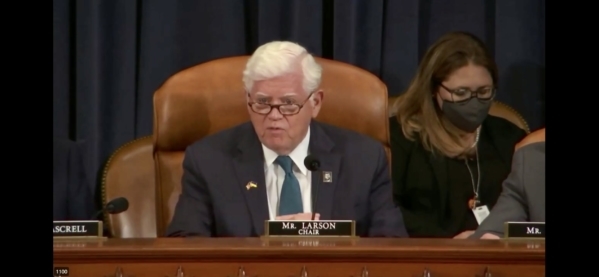
Witness after witness at Tuesday’s Congressional hearing on Social Security Administration (SSA) customer service testified that the agency is in dire need of additional resources in order to properly serve the public. The hearing was held by the House Ways and Means Social Security subcommittee, chaired by Rep. John Larson (D-CT), with testimony from a variety of witnesses from SSA and advocacy groups. While witnesses praised SSA employees for doing their best to provide the public with customer service during the pandemic, they painted a picture of an underfunded and overworked agency in desperate need of Congressional action.
“The Agency and its employees have done an extraordinary job of making the most effective use of the dollars they have been appropriated. But backlogs that pre-existed the pandemic have grown exponentially, staff levels have dropped precipitously, and the Agency will need the strong support of Congress if it is to continue fulfilling its mission to your constituents,” urged Max Richtman, President and CEO of the National Committee to Preserve Social Security and Medicare, in a written statement to the subcommittee.
Rebecca Vallas of the Century Foundation advocacy group told lawmakers at the hearing, “A decade-plus history of congress underfunding SSA’s already incredibly lean operating budget, worsened by the pandemic, has spurred several urgent crises in the agency’s customer service…The casualties are your constituents.”
Among the most pressing problems that have plagued SSA customer service are long hold times, disconnects, and busy signals on the agency’s toll-free phone line and excessive delays in Social Security Disability Insurance (SSDI) hearings. (Over 100,000 claimants have died waiting for their cases to be adjudicated.). In April, SSA was able to re-open most of its field offices after being shuttered for almost two years during the COVID pandemic.
SSA Deputy Commissioner for Operations, Grace Kim, credited managers, employees, labor unions, and advocates for the agency’s “ability to transition from remote work to walk-in service.” The field office re-openings went more smoothly than many advocates expected, but the agency must now contend with a huge backlog of work with inadequate resources.
“We are doing what we can with current staff and funding. The demand for service is high; we are losing staff; and morale is low,” testified Peggy Murphy, Director of the Social Security field office in Great Falls, Montana. “SSA is at a critical juncture as we face the future.”
Chairman Larson blamed SSA’s problems on budget cuts that Congress began imposing in 2010, pointing out that the agency’s operating funds have shrunk by 14% since then (adjusted for inflation), at the same time as demand for its services has skyrocketed as waves of Baby Boomers retire (at the rate of 10,000 every day).
Those budget cuts have forced SSA to lay off workers or allow vacant positions to remain unfilled, said Chairman Larson. “SSA has the lowest number of workers in 25 years despite almost double the number of beneficiaries.”
The Chairman pointed out that most of SSA’s operating budget is funded by payroll contributions from American workers “with each and every paycheck,” and that it is unjust for Congress to suppress funding for the agency that administers workers’ earned benefits.
Several witnesses voiced support for Chairman Larson’s Social Security 2100: A Sacred Trust legislation that would safeguard SSA customer service, including:
*A provision to prevent field office closures unless certain requirements are met.
*A provision to clarify that Congress did indeed intend for annual Social Security Statements to be mailed to workers age 25 and older so that they can plan for their financial security
The National Committee to Preserve Social Security and Medicare has enthusiastically endorsed Chairman Larson’s bill, which also boosts Social Security benefits across the board and extends the solvency of the program’s trust fund. Chairman Larson says that the bill will be marked-up in committee later in May or early June. The legislation has over 200 cosponsors in the House.
While the Social Security 2100 bill would improve SSA customer service, witnesses said that Congress must provide more robust funding for the struggling agency. “Our FY2022 appropriation is insufficient to provide the level of service your constituents expect and deserve,” said SSA’s Grace Kim.
The National Committee to Preserve Social Security and Medicare urges lawmakers to boost SSA funding to $15.55 billion for FY 2023, which is the amount submitted by the Agency itself to the Office of Management and Budget (OMB).
“Adequate funding for SSA is vitally important to your constituents and to our millions of members and supporters across the country who either are receiving Social Security or expect to do so in the future,” wrote Max Richtman in his statement to the subcommittee, “both to ensure that they receive the benefits they have earned and to maintain the public’s strong support for this essential program.”
The Part D Prescription Drug Bait and Switch

Medicare Part D prescription drug beneficiaries can be in for a rude surprise after they sign up for coverage. In an article this week in Kaiser Health News, Susan Jaffe writes that the price of a drug may jump within a month of a patient enrolling in a Part D drug plan. She cites the case of Linda Griffith, a California woman who used Medicare’s plan finder to select coverage last December, only to find that the price of one of her medications had jumped from $70 to $275 by January.
“As early as three weeks after Medicare’s drug plan enrollment period ends on Dec. 7, insurance plans can change what they charge members for drugs — and they can do it repeatedly.” – Kaiser Health News, 5/3/22
In fact, an AARP analysis found that the prices for the 75 most frequently prescribed drugs for Medicare beneficiaries climbed by as much as 8% between the end of December 2021 and the end of January 2022.
If this sounds like a bait-and-switch, the Centers for Medicare and Medicaid Services says that is just the way our current drug pricing system works. According to Medicare’s website, “Your plan may raise the copayment or coinsurance you pay for a particular drug when the manufacturer raises their price, or when a plan starts to offer a generic form of a drug,”
“I want my money back, and I want to be charged the amount I agreed to pay for the drug… I think this needs to be fixed because other people are going to be cheated.” – Linda Griffith, Medicare Part D beneficiary (Kaiser Health News)
Fixing the problem would require a change in the law. The 2003 Medicare Modernization Act, passed during the George W. Bush administration, established Part D drug coverage (to be provided by private insurance companies like Humana, Aetna, and Cigna), but forbade Medicare from negotiating prices with Big Pharma. NCPSSM President and CEO Max Richtman recently told CNBC that the ban on price negotiation “was put in in the middle of the night. We were not in the room when that deal was made.”
For many years, the National Committee to Preserve Social Security and Medicare and other seniors’ advocates have fought for new legislation empowering Medicare to negotiate prices. That goal finally seemed within reach when Congress took up President Biden’s Build Back Better plan, which contained a Medicare price negotiation provision.
The House-passed version of the bill would have allowed negotiations for a limited number of drugs. It wasn’t everything that advocates had hoped, but it would have been a good start. In the end, the Build Back Better plan failed to garner enough support in the Senate, due largely to the opposition of Senator Joe Manchin (D-WV).
Though Medicare price negotiation would be the single most effective way to lower seniors’ drug costs, other solutions have been percolating on Capitol Hill. These include an out-of-pocket cap on Part D drug costs and limiting drug price increases to the rate of inflation. All of these proposals have garnered the support of wide majorities in public opinion surveys. A 2021 Kaiser Health News poll found 83% of the public — including majorities of Democrats and Republicans —favored the federal government negotiating lower drug prices for both Medicare and private insurance.
Unfortunately, Big Pharma has used its multi-billion dollar lobbying and advertising arsenal to kill meaningful drug price reform so far. Some lawmakers apparently feel more beholden to drug makers than to their constituents, many of whom are skipping life-saving medications they can’t afford. Until Congress musters the political will to take another run at reform, the industry will continue to raise prices at will – leaving everyday Americans like Linda Griffith scrambling to cover the costs.