


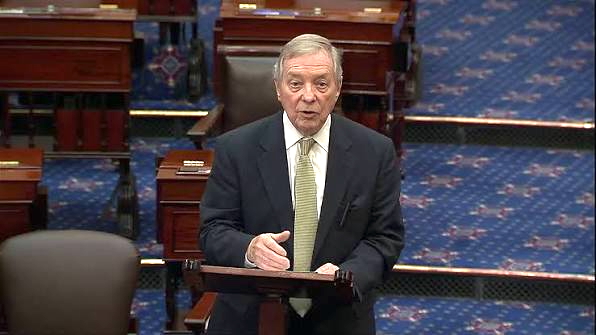
Soon-to-be retired Senator Dick Durbin’s (D-IL) new PROMISE Act is the latest in a wave of proposals to establish a ‘fiscal commission’ to address Social Security’s looming financial shortfall, instead of allowing Congress to do its job and devise its own proposals.
Durbin’s bill would authorize the four-person Social Security Advisory Board to draft a 50‑year solvency bill that would be fast‑tracked through Congress by the end of the current legislative session. While it differs from earlier commission proposals, Durbin’s legislation still relies on an outside body to formulate changes to a program that 70 million Americans rely on for basic financial security.
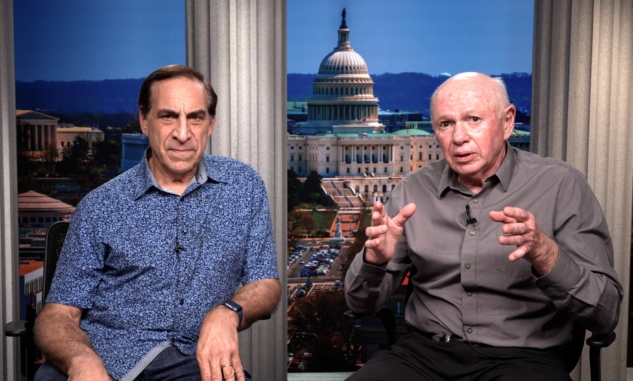
On the latest episode of our Capital Quick Takes video series, communications director Walter Gottlieb interviews our President and CEO Max Richtman about Durbin’s bill and other efforts to create fiscal commissions for Social Security.
WALTER: Senator Durbin and several cosponsors have a bill to create a ‘fiscal commission’ to address Social Security’s solvency problem. We don’t love the idea because it punts the ball over to an outside panel to propose solutions for Social Security – instead of just letting Congress come up with ideas on its own and act. Is that about right?
MAX: These commissions are kind of a legislative approach to avoiding responsibility and accountability. Just to be clear, I have great respect and admiration for Senator Durbin. He has been a longtime champion of Social Security, Medicare, the Older Americans Act, and all of the programs older Americans rely on. I commend him for that.
That said, I have serious concerns about his proposal for a commission that could push through major changes to Social Security in the final days of this Congress. It would likely occur during a lame-duck session, after the election, when many members are on their way out. Those members could be asked to vote on sweeping changes to Americans’ earned benefits, when they’ll no longer be accountable because they’re leaving office. I think that’s a real problem. And I think members of Congress should be 100% responsible for any changes to the Social Security program.
WALTER: Many of the Fiscal Commission proposals we’ve seen would bypass ‘regular order’ in Congress, meaning that any changes could be fast-tracked to a floor vote before the public or advocates have adequate time to respond.
MAX: That’s exactly right. All these commissions have expedited procedures that do not go through regular order. You know, Social Security is such an important program to everybody, not just seniors, but working people who need these benefits when they retire, who have coverage for life and disability insurance. It’s so important.
Why not allow members to introduce bills? Hold hearings in committees of jurisdiction? Allow advocates like ourselves testify on proposals? Have legislation that’s voted on, debated and voted on? That’s the way these changes should be made.
WALTER: And just to be clear, we favor revenue-side solutions that would bring more money into Social Security.
MAX: Yes, we support legislation that demands the wealthy begin paying their fair share into Social Security by scrapping the payroll wage cap. The last time Social Security was ‘reformed,’ in 1983, about 90% of wages were subject to the payroll tax. Now, because of rising income inequality, only about 80% of wages are covered. So adjusting the cap is only fair.
On the other hand, we reject proposals that would cut benefits, including raising the retirement age, means-testing or ‘capping’ benefits, or adopting a more miserly formula for cost-of-living adjustments (COLAs). Seniors should not be asked to bear the burden of strengthening Social Security’s finances. Unfortunately, benefits could be cut more easily through a commission process where individual members of Congress have less accountability.
WALTER: You worked on Capitol Hill for a long time. Fiscal commissions don’t have a stellar track record, right? In 1983, there was the Greenspan Commission, and in the 2000s we had the Simpson-Bowles Commission.
MAX: Well, they’re different. The Simpson-Bowles Commission collapsed. They didn’t have the votes to even get a recommendation to Congress, unlike the Greenspan Commission, which produced a proposal for Congress to consider. Back in 1983, Social Security was only months away from being unable to pay full benefits. The commission helped develop a plan that extended solvency well beyond that immediate crisis. But its proposals still had to go through Congress, which embellished and changed the Greenspan Commission proposal quite extensively.
WALTER: If the Greenspan Commission actually came through with a proposal that was embellished and acted on, why don’t we want another Greenspan-style Commission today?
MAX: Because unlike the current commission proposals, the Greenspan panel’s recommendations were not fast-tracked through Congress. After the commission issued its proposals, Congress held public hearings – and lawmakers actively debated and amended the legislation in both the House and Senate Committees of jurisdiction before it was signed into law.
That is not how Durbin’s commission idea would work, nor any of the similar proposals we’ve seen on Capitol Hill in recent years. Creating a fiscal commission now would set the stage for members of Congress to avoid responsibility. That isn’t right, because it’s their job to step forward and strengthen Social Security without relying on a commission for political cover. We need to make sure they do that.
WALTER: So, these commission proposals would give individual members of Congress political cover to do something deeply unpopular, like cutting benefits?
MAX: Absolutely. And I’d like to note, since this is an election year, that a candidate simply saying, “I support Social Security” isn’t good enough. Candidates need to say where they stand on improving the program for the long term. Do they support bringing in more revenue in a fair, equitable way, or do they support cutting benefits — which I don’t believe most Americans would accept.
Looking Ahead
The National Committee is joining other prominent seniors’ advocates — including AARP — in opposing the latest fiscal commission proposal. Social Security reforms must be made transparently through standard Congressional processes, with ample time for public scrutiny and debate. Any legislative effort to address the program’s long‑term challenges should start from a simple principle: benefits must be protected and strengthened, not cut — and older Americans, people with disabilities, and survivors deserve a real voice in shaping Social Security’s future.
******************
Watch the full conversation with Walter and Max on Capital Quick Takes here.