- Published On: March 25th, 2020Categories: Medicaid, Medicare, Social Security, Trump, Trump Administration

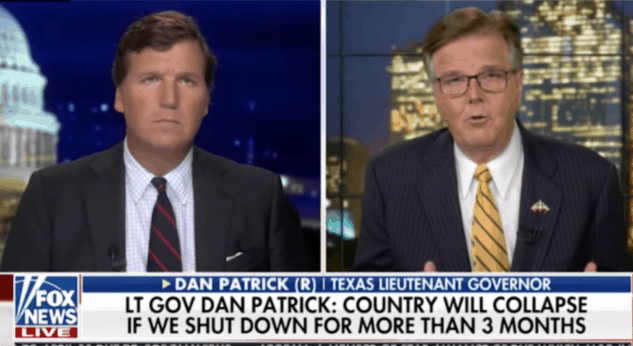
Listening to President Trump and some of his political allies, you might think that the lives of society’s most vulnerable members in this pandemic were less important than the economy – especially seniors. While the president was in a rush to restart normal economic activity by Easter (against the advice of the nation’s top health experts), a prominent Republican – Texas Lt. Governor Dan Patrick – suggested that seniors are expendable in the face of economic turmoil. As he told FOX news:
“No one reached out to me and said, ‘As a senior citizen, are you willing to take a chance on your survival in exchange for keeping the America that America loves for its children and grandchildren?’ And if that is the exchange, I’m all in.” – Lt. Gov. Dan Patrick (R-TX)
Lt. Gov. Patrick, a 69 year-old Tea Party favorite, presumes to speak for all seniors when he says that they would gladly sacrifice their lives so that younger people don’t have to suffer through a COVID-19 recession. For starters, most older Americans most certainly would prefer to stay alive while the nation takes reasonable steps to contain COVID-19, understanding that public health is paramount even if the economy takes a temporary hit. Secondly, prematurely re-starting economic business as usual would endanger the economic and financial health of all Americans – regardless of age.
“Anybody who thinks we should prematurely end social distancing for the sake of the economy is fooling themselves. In the long run, the economy is going to be much better off if we end the pandemic — and the only way we can do that is by social distancing.” – Dan Adcock, Director of Government Relations and Policy, National Committee to Preserve Social Security and Medicare
On Tuesday, President Trump seemed to pick-up on talk of sacrificing seniors for the greater economic good, posting a paradoxical tweet that pays lip service to protecting older Americans while pushing to re-start the economy as if it wouldn’t risk seniors’ health.
“Our people want to return to work… Seniors will be watched over protectively and lovingly. We can do two things together. THE CURE CANNOT BE WORSE THAN THE PROBLEM!” – President Trump’s tweet, 3/24/20
Fortunately, there has been considerable public pushback against both Lt. Gov Patrick’s comments and the president’s apparent hurry to re-start regular commerce within a couple of weeks, the consequences be damned.
“Patrick seems to envision a dynamic in which the economy returns to normal as some elderly Americans succumb to a deadly virus, effectively taking one for the team. But among the reasons that’s ridiculous is there can be no economic normalcy while a pandemic sweeps through the populace.” – Steve Benen, MSNBC columnist
Twitter lit up with objections to Trump’s and Patrick’s comments under the hashtag #NotDying4WallStreet:
I’m #NotDying4WallStreet and neither should you, your parents, or your grandparents.
People over 60 are providers, parents, grandparents, friends, colleagues, and spouses. They are human beings who are loved and add value.
I’m definitely #NotDyingForWallStreet, nor are my parents, in-laws, or 103 year old grandmother!
I vow to keep older Americans & those at higher risk safe by staying quarantined.
Mainstream media commentators (including CNN’s Gloria Borger) and state leaders (especially New York Governor Andrew Cuomo) have also condemned calls to restart business as usual too fast – and risking seniors’ lives to do so.
While it’s gratifying that many Americans reject Patrick’s and Trump’s pronouncements, there is a larger context here. No one really believes seniors will be pressured to forfeit their lives for the economy, but President Trump and his allies have frequently advocated policies that will cost seniors a considerable degree of their financial and health security – which ultimately can become life and death issues for the elderly.
The President championed a full payroll tax holiday in response to COVID-19, which would undermine Social Security – a program 64 million seniors and disabled Americans rely on. His budgets have called for billions of dollars in cuts to Social Security, Medicare, and Medicaid (which pays for impoverished seniors’ long-term care). The administration and its allies in Congress have an intense desire to use senior’s programs to help pay for the added deficit created by the Trump/GOP tax cuts of 2017, which primarily benefitted the wealthy and big corporations. Even Meals on Wheels and home energy assistance for low-income seniors were on Trump’s chopping block.
Meanwhile, the Trump administration has imposed work requirements and erected other barriers that are stripping low-income patients (including older Americans) of their Medicaid benefits. During annual open enrollment, the Center for Medicare and Medicaid Services has actively undermined traditional Medicare, tilting consumer information toward privatized Medicare Advantage plans – which can cost seniors more in the long run and limit their choice of providers.
To advance their agenda, the “entitlement reformers” who have the president’s ear (despite his promises not to touch Social Security or Medicare), often employ the tactic of generational warfare to pit younger against older Americans. In truth, the interests of both generations are aligned, because today’s young people are tomorrow’s seniors – and will depend on their earned benefits in retirement more than ever. Besides, most children and grandchildren do not want to see their older loved ones’ benefits endangered.
The National Committee will continue to take every opportunity to remind the public how seniors – and the programs they paid for – stabilize our families, our communities, and, yes, our economy. Asking Americans to choose between the interests of seniors and younger people presents a false choice. Their well-being is deeply intertwined. Older Americans and their families shouldn’t tolerate rhetoric or policies that threaten seniors’ health and security – or their value to our nation.
- Published On: March 24th, 2020Categories: payroll taxes, Senate, Social Security
The National Committee to Preserve Social Security and Medicare sent the following letter to members of the United States Senate last night, as they formulate a final version of an economic stimulus package:::
March 23, 2020
Dear Senator:
On behalf of the millions of members and supporters of the National Committee to Preserve Social Security and Medicare, I am writing to state our strong opposition to:
-
Senators David Perdue and Thom Tillis’s amendment to the coronavirus stimulus bill suspending payment of Social Security payroll taxes for the rest of the year, and
-
A provision in the bill deferring payment of the employer share of Social Security payroll tax – half until next year and the other half until 2022.
We oppose any proposals that would divert Social Security Trust Funds for purposes for which they were not intended, such as a means to stimulate the economy.
While we agree that providing tax relief to middle class Americans is an important consideration as we respond to the many possible economic and social dislocations as a result of the coronavirus epidemic, we do not believe that eliminating or deferring the Social Security payroll tax is an appropriate way to accomplish this goal. Any reductions to this vitally important revenue stream would threaten Social Security’s ability to pay future benefits to 64 million Americans.
Moreover, these proposals would undermine the earned benefit nature of the program. Social Security is an earned benefit fully funded by the contributions of workers throughout their working lives. A payroll tax suspension or deferral chips away at that fundamental idea, making it easier each time it is enacted to turn to it again to meet some future crisis, until the payroll tax is permanently eliminated, undermining the program in this manner would help achieve the goals of opponents of Social Security including those who would privatize the program. This is equally true even if the funds are replaced by general revenues from the Treasury.
Furthermore, there are alternatives to a payroll tax cut or deferral which would be more targeted and effective to stimulate an economy slowed by the spread of the coronavirus. For example, a one-time payment by the federal government can put money in the hands of taxpayers quickly, and the Making Work Pay Tax Credit can be passed by Congress rapidly as can an expansion of the Earned Income Tax Credit. In addition, we strongly support Senators Chuck Schumer, Elizabeth Warren and Ron Wyden’s plan to increase by $200 the monthly benefit for all Social Security, Veterans, and Supplemental Security Income (SSI) beneficiaries through the end of 2021.
Again, the National Committee to Preserve Social Security and Medicare on behalf of its members and supporters are opposed to any alteration to the payroll tax that reduces revenue flowing into the trust funds or undermines the “earned right” nature of the program. We appreciate your consideration.
Sincerely,
Max Richtman
President and CEO of the National Committee to Preserve Social Security and Medicare
-
- Published On: March 19th, 2020Categories: Budget, Social Security Administration (SSA)
The coronavirus crisis has thrust extraordinary challenges onto the already beleaguered Social Security Administration (SSA). As the administrator for Social Security, Social Security Disability Insurance (SSDI), and Supplemental Security Income (SSI), few federal agencies touch the lives of so many Americans so directly. Yet, the SSA faces the same issues as other federal agencies striving to cope with the coronavirus outbreak – protecting workers while keeping operations running as smoothly as possible.
SSA field office across the country were closed to the public as of Tuesday. But SSA employees remain at work – and operations continue. The agency has urged the public to visit its website or to call its toll-free number, 800-772-1213 for customer service. (The public still can obtain limited in person service at those offices if they are blind or terminally ill, or need SSI or Medicaid eligibility issues resolved related to work status.). SSA has also created a special webpage with updates on customer service during the crisis.
“The decision [to close field offices] protects the population we serve – older Americans and people with underlying medical conditions – and our employees during the coronavirus pandemic… However, we are still able to provide critical services.” – SSA statement, 3/16/20
Today, House Ways and Means Committee leadership sent a letter to SSA administrator Andrew Saul, urging the agency to protect its workers against coronavirus while processing claims and benefits without interruption.
“Throughout its 85 year-history, Social Security has never missed a payment. Seniors, families who have lost a breadwinner, and people with disabilities rely on Social Security to pay their rent or mortgage, put food on the table, pay medical bills, and meet other basic needs. It is vital that SSA remains able to send benefits on time.” – House Ways & Means committee leadership letter to SSA administrator, 3/19/20
Most SSA employees work in cubicles and cannot maintain the recommended six feet of separation from others in the workplace. They are just as susceptible to infection as every other federal worker. But they are under pressure to continue processing benefits and claims in a timely manner.
The Ways and Means committee leaders suggest SSA allow employees to telework where possible, in accordance with federal guidelines. National Committee senior legislative representative (and former 35-year SSA employee) Webster Phillips says the agency’s teleworking capabilities have been diminished since Andrew Saul came on board as administrator – and will take time and resources to build back up.
Meanwhile, SSA will discontinue several of its normal activities in order to prioritize beneficiaries’ needs. “There are workloads that they’re not going to process while this is going on, focusing exclusively on paying benefits,” says Phillips. Those include stopping all Continuing Disability Reviews (CDRs) and curtailing eligibility re-determinations for SSI recipients.
SSA also has discontinued in-person disability hearings to protect the health of claimants and employees. Instead, those hearings will take place via telephone or video conference, where possible.
Before the coronavirus pandemic, the agency was already reeling from draconian budget cuts that Congress imposed on the agency between 2010-2017. (Never mind that SSA was already one of the most cost-effective federal agencies – spending no more than 1% of its revenue on administration and overhead.) The agency’s operating budget has only begun to recover lost ground in the past two years. Even now, the Trump administration has proposed a budget increase that amounts to only half of what SSA needs to adequately service its customers. SSA administrator Saul requested a $1 billion hike in operating funds; the President’s budget only proposed $480 million.
With its operating funds constricted for so many years, SSA was forced to furlough employees and close field offices throughout the country – some of them in underserved urban areas where claimants rely on public transportation. Customers encountered busy signals and lengthy hold times on the agency’s toll-free number; elderly and disabled claimants waited in long lines in field offices with limited seating; SSDI applicants languished up to two years waiting for an appeal hearing. Thousands of disabled applicants died before they could obtain one.
Before the coronavirus crisis, SSA was slowly restoring customer service to 2010 levels – but there still was a long way to go. The pandemic will put new strains on this already struggling agency. Beginning now, SSA should receive the funding it truly needs to deliver quality service during – and after – this crisis. It is past time to make SSA’s workers and customers the number one priority.
- Published On: March 16th, 2020Categories: Bernie Sanders, Election 2020, GOP, Joe Biden, Max Richtman, Politics, Social Security, Social Security Administration (SSA), Social Security Disability Insurance, Trump
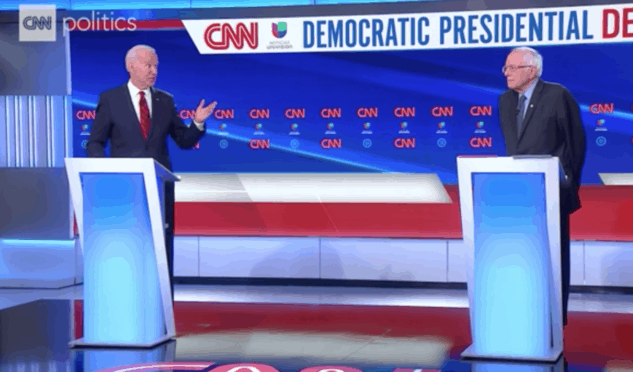
For the first time in 11 debates, Social Security was a prominent topic during last night’s face-off between the Democratic presidential candidates. Unfortunately, the discussion focused on Joe Biden’s and Bernie Sanders’ past positions rather than the very real threat that the Trump administration poses to the program.
As usual, the moderators didn’t raise the topic of Social Security. But about halfway through the debate, Biden did:
“My Lord, Bernie, you’re running ads saying I’m opposed to Social Security.” – Joe Biden, 3/15/20
That began a lengthy exchange between the candidates, with Sanders attacking Biden’s record on Social Security – and the former Vice President defending it.
Sanders: Let me ask you a question, Joe… Have you been on the floor of the Senate… talking about the necessity [of] cutting Social Security…?
Biden: No.
Sanders: You never said that?
Biden: No.
Sanders: Alright, America… go to the YouTube right now.
The Sanders campaign has been running an ad claiming that “Biden has advocated cutting Social Security for 40 years.” But Politifact says Sanders’ broad claim does not stand up to scrutiny. Throughout his political career, Biden has advocated for expanding Social Security – indeed, it is part of his 2020 platform – with some exceptions over the years.
“In roughly 10-year hops, starting in the 1970s, he went from calling for a 7% increase, then for a one-year freeze, then floated raising the retirement age, then backed a change in how benefits would increase, and has ended up today calling for higher benefits.” – Politifact, 3/11/20
Biden re-iterated that he wants to boost Social Security benefits – and urged that the Democratic candidates focus on the future, instead of litigating the past. He pointed out that President Trump is the one who poses the true threat to Americans’ earned benefits. Yet almost all of the discussion in last night’s debate centered on the two Democrats’ past positions rather than clear indications from the Trump administration that it is targeting “entitlements” for future cuts.
*In January, responding to a CNBC interviewer, the president said that he would “look at” cutting Medicare and Social Security because it’s “actually the easiest of all things, because it’s such a big percentage (of the debt).”
*During a town hall on Fox News on March 5th, a moderator asked the president whether he would cut ‘entitlements’ to reduce the soaring debt. Trump replied, “Oh, we’ll be cutting.”
*The President and his advisors are pushing a Social Security payroll tax cut to stimulate the economy. Cutting payroll taxes would choke the flow of much-needed revenue into the Social Security program, endangering benefits, while giving working people little more than pocket change.
Fiscal hawks in the administration and on Capitol Hill have been in President Trump’s ear since 2017, insisting that Social Security be “reformed” in order to help pay for the reckless Trump/GOP tax cuts. Last August, Senator John Barrasso (R-WY) told the New York Times, “We’ve brought it up with President Trump, who has talked about it being a second-term project.”
The President’s 2021 budget cuts Social Security Disability Insurance (SSDI) by some $90 billion over ten years, and underfunds the Social Security Administration as it struggles to service the 10,000 Baby Boomers who turn 65 every day.
Meanwhile, the President propagates the falsehood that he will “protect” Social Security, claiming that the Democrats will “destroy it.” Social Security was created by Democrats. The party has protected Social Security from conservative assault for nearly 85 years. Both of the remaining Democratic presidents would expand – not cut – the program. Squabbling between Joe Biden and Bernie Sanders about the past only serves to distract voters from what President Trump will do to seniors’ earned benefits if he wins a second term.
What National Committee president Max Richtman wrote in The Hill newspaper in January still holds true:
“Today, the Democratic party is nearly unified behind the cause of boosting benefits and strengthening the program’s finances for the long-term future. That’s why it makes little sense for the Democratic presidential candidates to attack each other on Social Security policy. Their focus needs to be on the here and now.”
- Published On: March 13th, 2020Categories: Budget, Congress, Social Security Administration (SSA), Trump Administration
New federal sick leave benefits working their way through Congress in response to the coronavirus will be administered through the Social Security Administration (SSA) — if proposed legislation is enacted in its current form. The House is poised to vote on this and other economic measures to alleviate Americans’ financial pain during the coronavirus epidemic.
Details of the relief package have been worked out by House Speaker Nancy Pelosi and Treasury Secretary Steve Mnuchin on behalf of the Trump administration, which is why the legislation is expected to pass both houses of Congress.
Under the new legislation, workers without employer-provided paid sick leave could apply for up to $4,000 in federal benefits through the Social Security Administration (SSA), with the following conditions:
*The worker has a current diagnosis of COVID-19.
*The worker is quarantined (including self-imposed quarantine), at the instruction of a health care provider, employer, or government official, to prevent the spread of COVID-19.
*The worker is caring for another person who has COVID-19 or who is under a quarantine related to COVID-19.
*The worker is caring for a child or other individual who is unable to care for him/herself due to the COVID-19-related closing of their school, child care facility, or other care program.
House leadership agreed to funnel federal benefits through SSA after the business community objected to the burden that employers would face implementing the program on their own.
The National Committee and other seniors advocates appreciate the need to provide federal paid sick leave during this time of crisis, but are concerned about the additional workload the program will impose on the already strained SSA. The agency’s operating budget was cut by more than 10% (adjusted for inflation) between 2010-2017, and has only recently begun to recover. Those draconian budget cuts forced layoffs and drastic reductions in customer service for everyday Social Security beneficiaries, who have had to endure interminable wait times on SSA phone lines, long delays for in-person service, outright closures of field offices, and years-long delays for Social Security Disability (SSDI) hearings. Thousands of disabled applicants have died awaiting those hearings.
For these reasons, Congress should appropriate at least $1 billion in increased operating funds for FY 2021. That would represent a healthy 7% boost – more than double the $480 million in the Trump administration’s own budget for 2021. Only with those additional operating funds can SSA reasonably be expected to handle the growing workload of serving retiring Baby Boomers plus the new burden of processing paid sick leave claims by millions of workers.
SSA is largely funded through workers’ payroll contributions in order to administer their earned retirement, disability, and survivor’s benefits. The agency typically does not handle anything unrelated to Social Security, Supplemental Security Income (SSI), and some aspects of Medicare. SSA is one of the most efficient federal agencies, spending only 1% of workers’ Social Security payroll contributions on overhead costs.
Here are some of the other key features of the draft legislation:
*Benefit amount: Two-thirds of the individual’s average monthly earnings (based on the most recent year of wages or self-employment income for which records are readily available), up to a cap of $4,000.
*Program and benefit period: The benefits will be available for leave that occurs from January 19, 2020 (the date of the first U.S. COVID-19 diagnosis) through one year after the bill’s enactment.
*Retroactive benefits: Benefits can be paid retroactively, and applications can be filed up to 6 months after enactment.
*Application: Applications will be taken online, by phone, or by mail. Individuals will not visit SSA field offices to apply. Payments will in most cases be issued electronically.
*Program integrity: Applicants must attest that they meet the criteria for eligibility and existing penalties for fraud or misrepresentation with regard to Social Security benefits are applied to the federal emergency paid leave benefits program.
It is imperative that the federal government enact paid sick leave benefits in order to encourage workers with symptoms to stay home and keep the disease from spreading, and to spare those workers from undue financial pain during the coronavirus epidemic. Congressional leadership has decided that SSA is the best option for paying out those benefits. Now Congress must ensure that the agency has the financial resources it needs to administer the new program, while continuing to improve customer service for the 63 million Social Security beneficiaries who already depend on it.