


Prescription Drug Prices a Top Priority for Congress After Summer Recess

When Congress returns from summer recess on Monday, lawmakers will have plenty on their plates, especially the vexing issue of high prescription drug prices. Hill-watchers expect action on legislation from both parties which aim to reduce prices at the pharmacy counter, though there is scant consensus on specific policies. Most Congressional Democrats believe (and the National Committee agrees) that the Department of Health and Human Services must be allowed to negotiate drug prices with pharmaceutical companies on behalf of Medicare.
As Politico reported this week, the Democratic caucus awaits the release of Speaker Nancy Pelosi’s prescription for lowering drug prices:
“[The Speaker’s proposal] has been wrung through multiple closed-door negotiations with progressives to work out how many drugs the government could negotiate prices on and what penalties would be in store for defiant manufacturers. But divisions remain.” – Politico
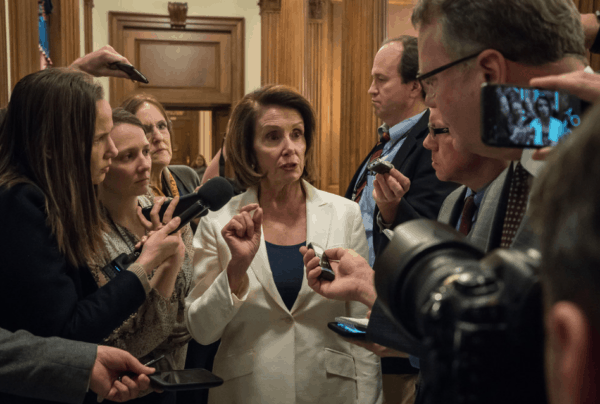
Speaker Pelosi is expected to unveil leadership’s drug pricing plan soon
Those divisions center around the question of what happens if Big Pharma refuses to negotiate drug prices in good faith. Pelosi’s bill is expected to call for binding arbitration if HHS and drug-makers reach an impasse; Progressive Democrats want to empower HHS to allow the licensing of generic versions of medications for which Big Pharma won’t negotiate fair prices. In fact, that’s exactly what a bill introduced by Rep. Lloyd Doggett (D-TX) would achieve.
“The National Committee endorses Congressman Doggett’s bill,” says Dan Adcock, NCPSSM’s Director of Government Relations and Policy, “But we’d support a bill from Democratic leadership that allows Medicare to negotiate drug prices, even if it doesn’t go as far as Rep. Doggett’s.”
Soon we will see whether leadership and Progressive Democrats can bridge their differences:
“Progressives warned Pelosi in a letter that locking them out of plans could turn them against the bill. On their wish list: permitting direct negotiation for all drugs and setting harsh penalties for manufacturers that refuse to cooperate.” – Politico
On the Senate side, the bipartisan Prescription Drug Pricing Reduction Act (PDPRA), introduced by Sens. Charles Grassley (R-IA) and Ron Wyden (D-OR), faces an uncertain future. The bill would cap Medicare beneficiaries’ out of pocket prescription drug costs at $3,100 – and penalize pharmaceutical companies for raising drug prices beyond the rate of inflation. Under the PDPRA, Medicare beneficiaries would save $27 billion in out-of-pocket costs over ten years.
The National Committee has endorsed the Grassley-Wyden bill, but Majority Leader Mitch McConnell has already expressed his opposition to the legislation and is unlikely to allow a floor vote.
“The question is: Who’s side is [McConnell] on? The side of the pharmaceutical lobby or is he on the side of patients and taxpayers?” – Sen. Ron Wyden (D-OR)
Seniors, in particular, need relief from soaring prescription drug prices. A recent AARP study found that older Americans with cancer, diabetes, and heart disease have experienced 100-200% price increases for common medications.
“When senior citizens are living on an average benefit of $26,000 of income annually and (they’re) facing a 200 percent increase in the cost of… medication – it’s time for action.” – Elaine Ryan, AARP vice president for state advocacy
National Committee President Urges Proactivity on Seniors Issues at Dem Gathering
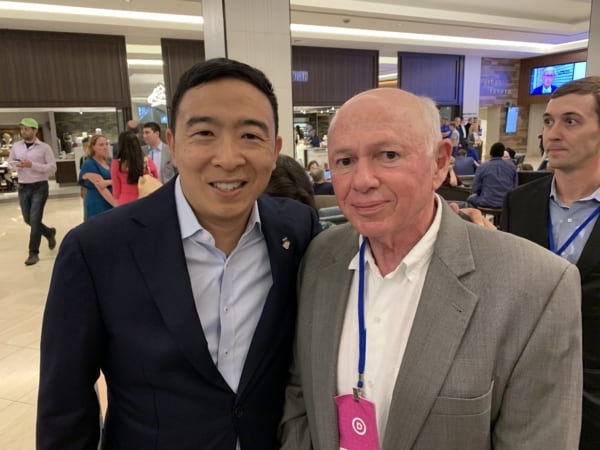
National Committee president Max Richtman and presidential contender Andrew Yang
The Democratic National Committee Summer Meeting in San Francisco was a chance for 2020 presidential candidates from Corey Booker to Elizabeth Warren to pitch and mingle with DNC members. But it was also an opportunity for the National Committee to Preserve Social Security and Medicare to remind party members (and leaders) about the importance of seniors’ issues in next year’s elections. National Committee president Max Richtman carried that message to San Francisco, meeting with presidential contenders Julian Castro, Corey Booker, Amy Klobuchar, Tim Ryan, Andrew Yang, and Michael Bennett – and speaking at an event for the DNC Seniors Council.
“While the issues of health care reform and lowering prescription drug prices have been receiving their due consideration in many campaign events and related media coverage, Social Security, an equally important program for workers, retirees, the disabled and their families, has not yet been afforded the same level of attention from candidates.” – Max Richtman, NCPSSM president
In July, the National Committee sent letters to each of the major Democratic presidential candidates, imploring them to be “very proactive in raising this topic as frequently as possible when you meet with voters around the country.” After all, there are 188 million Americans registered to vote – and 175 million American workers covered by Social Security.
During the DNC Summer Meeting, Richtman also reminded each candidate that Social Security was conspicuously missing from the first two rounds of Democratic debates.
“I asked the candidates, ‘Did you notice that there wasn’t a single question about Social Security in the first two Democratic debates?’ That’s not right. I said, ‘Even if the moderators don’t ask a question about Social Security in September’s debate, bring it up, anyway.’”– Max Richtman
In advance of July’s Democratic debates, Richtman also sent a letter to CNN moderators Don Lemon, Dana Bash, and Jack Tapper:
“Is Social Security a vitally important American program? Yes. Does it deserve to be the focus of at least one meaningful question to be included during the next Democratic Presidential Primary Debate this month? Absolutely.” – Max Richtman’s letter to the CNN debate moderators, 7/16/19
Unfortunately, the moderators did not heed the letter and – for the second time in a row – failed to ask a question about Social Security. But the next Democratic debate on September 12th in Houston will present another opportunity for the candidates to raise the issue.
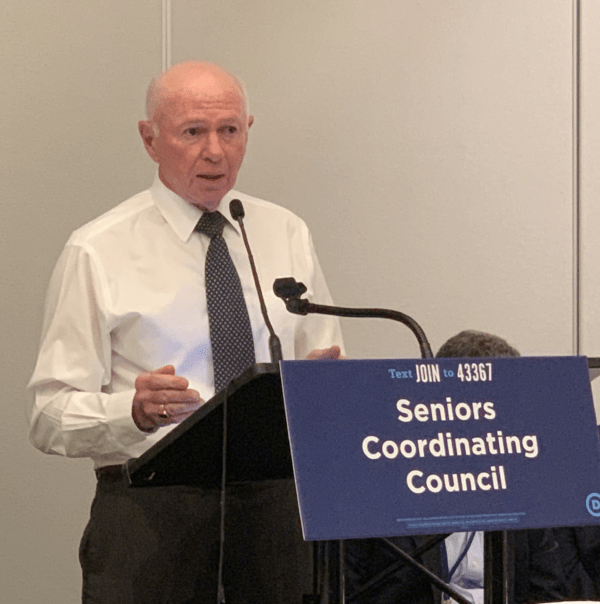
NCPSSM President Max Richtman wants senior voters back in the Democratic fold
On day one of the DNC Summer Meeting, Richtman, who is Vice Chair of the party’s Seniors Council, appeared on a panel about issues affecting older Americans. He and fellow panelist Rich Fiesta, Executive Director of the Alliance for Retired Americans, hammered home the importance of continuing to lead senior voters back into the Democratic fold in 2020. After years of casting ballots against their own interests, older voters swung toward the Democrats again in the 2018 midterms.
National Committee Advisory Board Vice Chair and grandson of President of Franklin D. Roosevelt, James Roosevelt, Jr., briefly addressed the attendees at the Seniors Council event. Roosevelt told the audience that while he is proud of being FDR’s grandson, he was “even prouder” to serve on NCPSSM’s advisory board. (His father, James Roosevelt, Sr., founded the National Committee to Preserve Social Security and Medicare in 1982.)
The DNC’s next summer meeting is set for July 17, 2020, during the Democratic National Convention in Milwaukee, less than four months before an election that will determine whether seniors’ financial and health security will be dangerously eroded – or strengthened for decades to come.
Trump Once Again Betrays Social Security, Medicare Promises
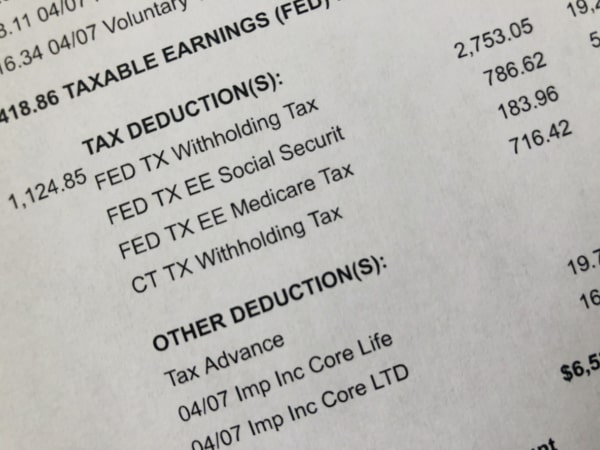
We hardly needed more evidence that President Trump didn’t really mean it when he promised as a candidate “not to touch” Social Security and Medicare. But the past week’s news has once again shown how hollow that promise is. First, the White House floated the idea of temporarily cutting FICA payroll taxes to stimulate an economy buffeted by President Trump’s trade war, only to back off the proposal within 48 hours.
“Trump said Tuesday that a payroll tax is ‘something we think about.’ But when he was asked about it the following day, he said it wasn’t being considered.” – The Hill, 8/23/19
If the payroll tax cut idea truly has been put to rest for now, that’s a good thing. Social Security relies on payroll contributions to fund benefits. Cutting payroll taxes – even temporarily – undermines the financial health of the system. In fact, Social Security needs more, not less, revenue to continue paying full benefits in the decades to come. That’s why Congressman John Larson’s Social Security 2100 Act increases revenue to keep the program financially sound – and expand benefits at the same time.
Not surprisingly, the benefit from a payroll tax cut would accrue mostly to high earners, who tend to save rather than spend extra cash – muting any economic stimulus effect for working people.
“The Penn-Wharton Budget Model estimated in a report Thursday that if a 2 percentage point payroll tax cut were enacted for 2020, about 43% of the tax change would go to those in the top fifth of income (earners).” – The Hill, 8/23/19
On the same day that the President denied that a payroll tax cut was in the works, the New York Times reported that key Republican Senators were pressuring Trump to support Social Security and Medicare cuts if he wins a second term.
“With the budget deficit set to surpass $1 trillion in 2020 thanks in large part to Trump’s tax cuts and trade war, Republicans and right-wing groups are pressuring the president to take a sledgehammer to Social Security and Medicare, widely popular programs Trump vowed not to touch during his 2016 campaign.” – Common Dreams, 8/23/19
Again betraying his pledge not to cut either program, Trump seemed to be receptive to the Republicans’ entreaties. Senator John Barrasso (R-WY) told the New York Times, “We’ve brought it up with President Trump, who has talked about it being a second-term project.”
The administration has already proposed cutting billions of dollars from both Social Security and Medicare in its FY ’19 and ’20 budgets. Fortunately, Congress ignored these proposals. But the past week’s developments foreshadow what President Trump and a Republican-controlled Congress might do if they prevail in 2020. That’s a scenario that current and future seniors – and their families – should find deeply disturbing.
National Committee Engages Voters at Town Halls
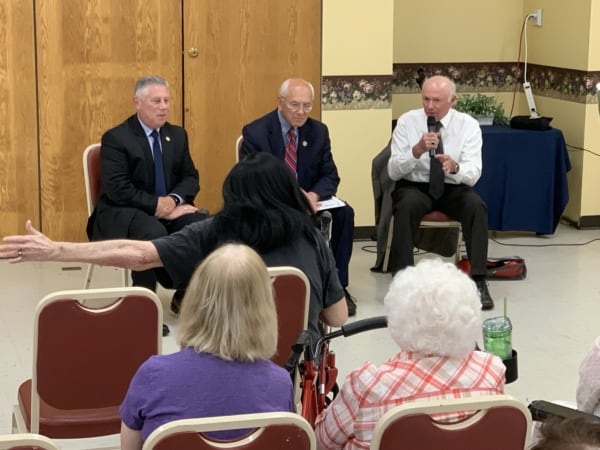
National Committee president Max Richtman (right) at a town hall with Rep. Paul Tonko (center)
As we rush headlong toward the 2020 election year, the National Committee is ramping up its efforts to engage voters on the issues that matter most to seniors – Social Security, Medicare, and the soaring cost of prescription drugs. During the past week alone, NCPSSM President Max Richtman has been participating in town halls from New York state to California – bearing a message that Social Security and Medicare should be strengthened, not cut – and demanding that Congress act to reduce prescription drug costs.
Today, Richtman meets with voters at a Seniors Town Hall in Santa Rose, CA, hosted by Rep. Mike Thompson (D-CA-05). Last week, Richtman joined Rep. Paul Tonko (D-NY-20) for a forum about seniors’ financial and health security in Cohoes, NY on the 84th anniversary of Social Security. During that event, Richtman promoted the Social Security 2100 Act – introduced by Rep. John Larson (D-CT) – which increases benefits and adopts a more generous formula for calculating cost-of-living adjustments (COLAs).
The expansions in the Social Security 2100 Act would be funded, in part, by adjusting the amount of income subject to FICA payroll taxes – meaning the wealthy would pay their fair share into the system.
“If you are working right now and you make above $132,900 dollars in wages, you don’t pay any more Social Security tax on that. That’s called the cap on wages subject to the payroll tax. So if you make $132,000 or $100 million, you pay the same amount. You think that’s right?” – Max Richtman, National Committee president, 8/13/19
Congressman Tonko has cosponsored the Social Security 2100 Act (which keeps the program financially solvent through the end of the century). He supports several bills to expand Medicare – including the Seniors Have Eyes, Ears, and Teeth Act – which would provide beneficiaries with vision, hearing, and dental coverage. The Congressman also backs legislation that would make cheaper, generic drugs more widely available.
Tonko says health care is a top priority for voters heading into the 2020 elections.
“When we talk about a forum like this, you begin with recognizing the importance and the relevance of (these issues) in the lives of the elderly…. I think that when you look at polling… the number one issue remains healthcare, affordability, and accessibility to quality care.” – Rep. Paul Tonko (D-NY)
Voters’ concern for these issues was palpable at the town hall in Cohoes, a Hudson Valley community within Tonko’s district where a total of 100,000 retirees live. “These voters showed up because they feel these issues keenly in their lives and in their pocketbooks,” says Richtman. “They came, they asked pointed questions, and hopefully they’ll go into the voting booth next year ready to elect candidates committed to strengthening seniors’ earned benefits.”

Max Richtman (R) presents boxing gloves to a seniors “champion,” Rep. Paul Tonko (L)
At the end of the town hall, Richtman presented Tonko with a pair of the National Committee’s trademark red boxing gloves – to signify that the Congressman is a fighter for seniors’ financial and healthy security. Richtman has another pair ready to give Rep. Mike Thompson – another champion of Social Security, Medicare, and prescription drug price reform – at the town hall today in Santa Rosa.
On Social Security’s Anniversary, Lawmakers Defend SSDI Claims Process

As we commemorate Social Security’s 84th anniversary, lawmakers are working to reverse a brazen attempt by the Trump administration to undermine the rights of Social Security disability claimants. Senators Maria Cantwell (D-WA) and Susan Collins (R-ME) have introduced a bipartisan bill protecting the independence of the administrative law judges (ALJs) who preside over disability insurance appeals. The ALJ Competitive Service Restoration Act is a companion bill to legislation introduced by Rep. Elijah Cummings in the House. Last year, President Trump issued an executive order creating the opportunity for ALJs to be chosen based on their political beliefs instead of more time-honored, objective criteria.
“Administrative law judges perform very important roles for Social Security cases, and it’s essential that they remain independent and not politically influenced in making decisions… They should be knowledgeable about the subject area they’re overseeing and without any conflict of interest.” – Sen. Maria Cantwell
The Senators’ bill effectively overturns Trump’s executive order by moving AJLs back into “competitive service,” ensuring that they are chosen based on their qualifications – unlike political appointees who are not subject to the same criteria. The National Committee supports the new legislation out of concern that politically-appointed ALJs might deny claimants benefits based on ideology rather than the merits of the case.
The executive order is part of an effort to undermine Social Security Disability Insurance itself. The administration’s proposed 2019 budget included more than $64 billion in cuts to SSDI. And Budget Director Mick Mulvaney has argued (disingenuously) that SSDI is not really part of Social Security – a verbal sleight of hand designed to exempt the program from candidate Trump’s repeated promises not to cut Social Security.
Like Social Security retirement and Medicare, SSDI is an earned benefit. Workers can’t collect disability unless they have paid into Social Security for a required amount of time. By various means, the Trump administration is trying to cut benefits that rightfully belong to workers.
This is in keeping with the administration’s insensitivity – some would say cruelty – toward vulnerable populations, including disabled workers. Claimants apply for SSDI because they cannot work due to serious mental or physical disabilities. These include:
* Musculoskeletal problems
* Cardiovascular conditions
* Vision and hearing loss
* MS, cerebral palsy, Parkinson’s disease, and epilepsy
* Depression, anxiety, and schizophrenia
* HIV/AIDS, lupus, and rheumatoid arthritis
Even so, eligibility standards are stringent. Only about 40% of SSDI applications are approved. Claimants who are denied benefits can request a hearing before an administrative law judge. Because Congress chronically underfunded SSA operations from 2010-2017, wait times for disability hearings escalated – up to two years in some cases. Thousands of claimants have died waiting for hearings.
The National Committee believes it’s imperative that once a worker finally receives a hearing, the presiding administrative law judge be fair and impartial, and not politically motivated. The president’s order sabotages that expectation; the Senators’ bill would guarantee a fair process for the millions of Americans whose disabilities prevent them from working.