


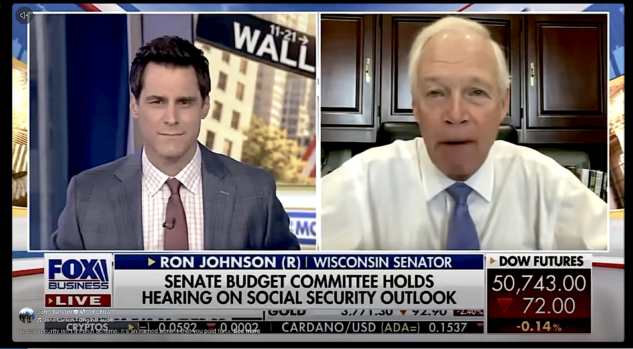
It’s been quite a week for Senator Ron Johnson (R-WI), the chairman of the Senate Budget Committee. First, he makes inflammatory comments about Social Security on Fox Business, only to try to clean up those remarks at a committee hearing he chaired that same day, only to hastily introduce a new bill that would fundamentally alter the program.
Appearing on Fox Business on November 18th, the Wisconsin Republican called Social Security a “legal Ponzi scheme” and suggested ending it entirely:
“There’s really no way to fix Social Security… you just shut it down and hope that you can recover some of your money.” – Senator Ron Johnson, 11/18/26
For the tens of millions of Americans who paid into Social Security their entire working lives — and the millions more who rely on it to pay rent and fill prescriptions — those words were alarming. We’ve heard this rhetoric from the political right since Social Security was enacted. The fact that it apparently still has currency 90 years later is of concern.
Hours after the tv interview, Johnson chaired a Senate Budget Committee hearing with an ironic title: “Social Security: The Reality.” He spent most of his time trying to walk back what he’d said on Fox Business, claiming his wording had been “imprecise.”
As MS NOW’s Steve Benen observed, the retreat rang hollow: “It’s not too surprising that Johnson tried to hedge a bit. The incumbent senator is up for re-election in just two years in a state that voted Democratic in the midterms — but it won’t be that easy to shake off his record.”
Democrats weren’t buying it. Senator Ron Wyden (D-OR) put it plainly:
“This is the first time in decades that a senior senator, the chairman of the Budget Committee, said he would rather shut down Social Security than fix it.” – Sen. Ron Wyden, 11/18/26
Here’s the core problem: if you truly believe Social Security is a “scam,” shutting it down is the logical endgame. Of course, Social Security is not a scam; it’s a social insurance program that has provided generations of workers and their families with basic financial security.
Johnson wants voters to believe he misspoke. The record says otherwise.
MS NOW documented a clear pattern of hostility spanning years. During his 2022 re-election campaign, Johnson freely admitted he wanted to move Social Security into Congress’ discretionary budget — a move that would subject it to annual cuts and end guaranteed benefits. He also argued the system “was set up improperly” and that its funds “would have been better off” in the stock market. A year later, he lamented that Social Security hadn’t been privatized decades earlier.
“The GOP lawmaker’s problem… isn’t that he was ‘imprecise’ with his choice of words, but rather that he’s opposed to a pillar of modern American life.” – Steve Benen, MS NOW
Johnson frames his opposition as concern about the national debt. That framing is false. Social Security is self-financed and does not add a single dollar to the national debt. The program actually holds trillions in U.S. Treasury bonds — it lends money to the government, just like any other bondholder.
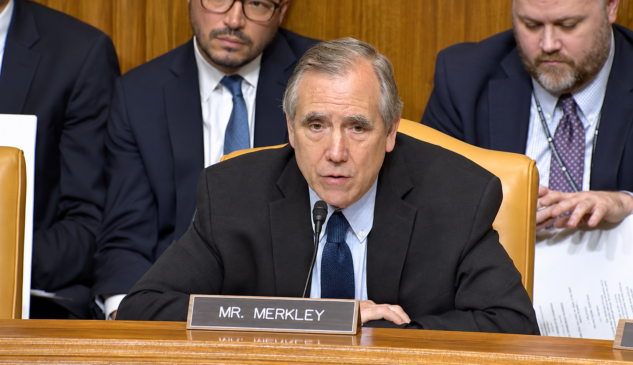
The real drivers of the debt? Senator Jeff Merkley (D-OR) pointed to them at the hearing: three unfunded wars and four rounds of tax cuts for the wealthy under Republican presidents, together adding trillions in red ink. Your Social Security benefits didn’t do that.
Within 24 hours of the hearing, Johnson introduced a bill, the laughably titled “Stop Scaring Seniors Act,” which would empower the Treasury Department to use general revenue to plug any future funding gaps in Social Security. This would not only alter the fundamental design of Social Security as a self-financed program that workers and employers pay into, it also would add more than $190 trillion to the debt over 75 years. That’s ironic, given Johnson’s posture as a crusader against debt. He simply refuses to support taxing high earners more in order to strengthen Social Security.
Johnson’s influence is about to shrink — Democrats take control of Congress in January, and he loses his gavel. But the fight over Social Security’s future is just beginning. Congress must address a projected shortfall in 2032, and the right answer isn’t cutting benefits or gambling retirement funds on Wall Street. It’s lifting the payroll tax cap and taxing a portion of unearned income so the wealthy contribute their fair share, as legislation introduced by Democrats would do.
As polling consistently shows, bipartisan majorities of the public agree. As labor economist Kathryn Edwards testified at the hearing:
“Americans have resoundingly said they do not want Social Security benefits cut, even if that means paying higher taxes themselves. The will of the people can be seen as the obstacle — or the assignment.” – Dr, Kathryn Anne Edwards, 11/18/26
We call on the new Congress and the President to take up the assignment: protect earned benefits, strengthen the program, and make the wealthy pay their fair share. After 90 years of phony attacks on Social Security, Americans deserve nothing less.