- Published On: January 3rd, 2019Categories: Alzheimer's, Budget, Congress, Medicaid, Medicare, President Trump

In the waning hours of 2018, President Trump signed into law a bipartisan bill to boost federal efforts to address the Alzheimer’s epidemic that impacts some 5.7 million Americans and their families. The BOLD Infrastructure for Alzheimer’s Act provides $100 million in new funding and “restates priorities” in the fight against a disease that’s aptly been called “The Long Goodbye.”
The BOLD Act was cosponsored by Senators Tim Kaine (D-VA), Susan Collins (R-ME), Shelley Moore Capito (R-WV), and Catherine Cortez-Masto (D-NV):
“The… Act will improve early detection and diagnosis, provide assistance for caregivers and educate the public on Alzheimer’s disease and brain health. This bipartisan legislation is the first step in addressing [this] ongoing public health crisis…” – Sen. Catherine Cortez-Masto, BOLD Act co-sponsor
The National Committee, which fights for the financial and health security of America’s seniors, endorsed the bill to confront Alzheimer’s (whose victims are mostly over 65 years of age).
“The BOLD Act would create a public health infrastructure to implement effective interventions to combat Alzheimer’s disease and related dementias including prevention, early detection and diagnosis and treatment.” – National Committee letter endorsing BOLD Act, 5/2/18
While it’s commendable that a bipartisan group of Senators sponsored the bill and that President Trump signed the BOLD ACT into law, defeating the Alzheimer’s epidemic will require much, much more. One-hundred million dollars in new spending over 5 years is a small step forward, and advocates for Alzheimer’s victims are right to celebrate. But federal funding for Alzheimer’s research continues to fall short of what is needed to invest in an aggressive and intensive research strategy to develop effective treatment and, hopefully, a cure.
Estimated federal spending on Alzheimer’s research was some $1.8 billion in 2018, compared to President Trump’s demand for $5.6 billion for his border wall. His administration’s Fiscal Year 2019 budget called for a freeze in biomedical research. A significant shift towards disease research priorities is urgently needed.
Alzheimer’s is a fatal scourge deserving considerably higher funding. It is the 6th leading cause of death in the United States, felling more Americans than breast and prostate cancer combined. A startling one in three seniors dies with Alzheimer’s or other form of dementia. By 2050, the disease is expected to claim 14 million victims – almost three times the number of Alzheimer’s patients today.
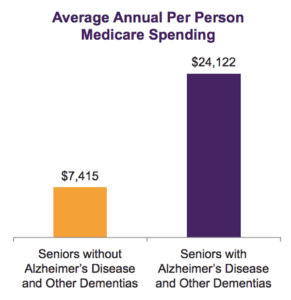
The disease also poses a direct threat to Medicare and Medicaid. In 2018, the two programs spent an estimated $186 billion caring for beneficiaries with Alzheimer’s and other dementias – representing nearly 70 percent of total costs. “By 2050, combined Medicare and Medicaid spending on patients with Alzheimer’s is expected to quadruple to $750 billion (in today’s dollars),” according to the nonprofit Alzheimer’s Impact Movement. This is an enormous financial burden for Medicare and Medicaid, which seniors’ advocates are already fighting to strengthen in the face of conservatives’ demands for benefit cuts.
Source: Alzheimer’s Impact Movement
The nearly six million Americans suffering from Alzheimer’s, along with their families and caregivers, rightly expect an increased funding commitment from the federal government. The beginning of the 116th Congress – with its fresh faces and new leadership – presents an opportunity to build on the BOLD Act and put more brain power into the fight. It’s time for our national leadership to muster the political will to defeat Alzheimer’s before the grim estimates for the future become reality.
- Published On: November 8th, 2018Categories: Boost Social Security, Congress, Democrats, Election 2018, entitlement reform, Medicare, Rep. John Larson, Social Security
Voters have put champions of Social Security and Medicare back in control of the U.S. House of Representatives for the first time in 8 years. Candidates who promised to protect and expand seniors’ earned benefits scored victories in races across the country, including many endorsed by the National Committee to Preserve Social Security and Medicare.
“This is a victory for seniors and their families who have seen their earned benefits threatened time and again under Republican control of the House. The election results mean that Congress can cast aside the tired trope of ‘entitlement reform’ (code for cutting benefits), and work vigorously to boost Social Security and Medicare for current and future retirees. The new majority will serve as a firewall against further attempts to slash Medicaid and repeal or sabotage the Affordable Care Act – and challenge President Trump to fulfill his campaign promises to protect Social Security and Medicare.” – Max Richtman, National Committee President and CEO
Legislation to protect and expand seniors’ earned benefits can now receive serious consideration in the 116th Congress after languishing under Republican control. This includes Rep. John Larson’s Social Security 2100 Act, which would increase benefits and keep the system solvent for the rest of the century – and several other bills supported by the National Committee to boost Social Security and Medicare.
When the new Congress convenes in January, Congressman Larson (D-CT) likely will assume the chairmanship of the House Social Security Subcommittee. Another champion of Social Security and Medicare, Rep. Richard Neal (D-MA), is expected to wield the gavel in the powerful House Ways and Means Committee, while Rep. Frank Pallone (D-NJ) probably will head the House Energy and Commerce Committee, which oversees Medicare.
“We will work with the new House leadership and members to give retirees a much-needed raise in their earned benefits – and defend seniors from demands that Social Security, Medicare, and Medicaid be slashed to pay for tax cuts for the wealthy and big corporations. This is a tremendous opportunity to restore American values of fairness and compassion – including caring for the sick and elderly – to the people’s house.” – Max Richtman, National Committee President and CEO
- Published On: October 30th, 2018Categories: affordable care act, Democrats, Election 2018, Medicare, Republicans
The Republican candidate for the open Senate seat in Arizona, Martha McSally, probably speaks for other GOP contenders across the country when she says, “I’m getting my a– kicked” on the issue of health care. Congresswoman McSally has been hammered by her Democratic opponent, Krysten Sinema, for twice voting to repeal the Affordable Care Act, which, among many benefits, protects Americans with pre-existing conditions from denials of coverage and punitive premiums.
“Now locked in a competitive statewide Senate race against Democrat Kyrsten Sinema, McSally finds herself blistered by campaign attack ads and having to explain her past votes and current views on health care and the Affordable Care Act, which has grown in popularity in recent years. About 20 million more Americans gained health insurance after the act passed.” – Arizona Republic, 10/29/18
With more than 70% of voters telling pollsters health care is a crucial issue in the mid-term elections, Republican candidates like McSally have been selling themselves as protectors of patients with pre-existing conditions – when they and the Trump administration have spent the past two years trying to obliterate protections that Democrats like Sinema truly support:
“Before the Affordable Care Act, we know many, many people could not get health insurance because they had some sort of condition like diabetes, asthma, heart disease… Someone very close to me filed for bankruptcy over medical bills because of this issue.” – Krysten Sinema, Democratic candidate for U.S. Senate in Arizona
“Republicans are not really interested in this project, but they know the voters really want [health care], so they’re trying to pretend to support it when they don’t,” author and journalist Jonathan Cohn told MSNBC today. Republicans are “trying to rewrite history… brazenly,” he said.
When Trump and the GOP failed by a thin margin to repeal the Affordable Care Act, they began sabotaging the law. The administration reneged on Affordable Care Act payments to keep insurance markets stable, failed to provide adequate public outreach during open enrollment periods, and changed the rules to allow the sale of skimpier policies that don’t protect pre-existing conditions. Congress passed the Trump/GOP tax cuts, which neutralized the Affordable Care Act insurance mandate – further weakening the law.
Twenty Republican state attorneys general filed a lawsuit arguing that the zeroing-out of the Obamacare mandate should render the entire law null. One of them is Missouri attorney general Josh Hawley, who seeks to unseat Democratic Senator Claire McCaskill. He had the audacity to claim that he supports protections for pre-existing conditions while being party to a lawsuit that would erase them.
In Florida, Governor Rick Scott has displayed similar hypocrisy in his bid for Bill Nelson’s Senate seat:
“Scott, in a tight race, desperately launched a last-minute ad campaign declaring his support for protections for people with preexisting conditions — despite trying to kill Obamacare for years.” – Washington Post, 10/26/18
President Trump has set a problematic example for Republican Congressional candidates by twisting the truth for partisan ends. He claims that Republicans – not Democrats – will protect Social Security and Medicare, despite proposing budgets that would slash both programs by billions of dollars over ten years. The President spreads the myth that Republicans will protect people with pre-existing conditions, despite being the saboteur-in-chief of the Affordable Care Act.
The President, McSally, Hawley, Scott and other Republicans should not count on voters having amnesia about GOP actions to undermine the Affordable Care Act, before they suddenly became ‘champions’ of pre-existing conditions for the mid-terms. Americans remember the relentless late night votes for Obamacare repeal bills (the American Health Care Act, the Better Care Reconciliation Act, the ‘Skinny Repeal’) that the GOP pursued like a dog with a bone, and thankfully lost. They remember the Trump/GOP tax scam that neutered the insurance mandate at the heart of the Affordable Care Act. Voters know which party has fought for people with pre-existing conditions and which one simply postures while trying to gut affordable health care for all Americans.
“Anybody even dimly aware of recent history ― specifically, the part where Democrats passed the Affordable Care Act, only to have Republicans spend eight years trying to repeal it ― should recognize the claim as a lie… GOP leaders have already made clear that they will try once again to repeal the health care law if they can.” – Huffington Post, 10/25/18
It’s true. While many GOP candidates cling to the falsehood that they support protections for pre-existing conditions, party leaders have hinted that they may renew their attempt to repeal the Affordable Care Act after the midterms. That’s just one more reason not to trust the current majority with the future of Americans’ health care. Of all the issues in the coming election, none goes to Americans’ fundamental well-being like this one. At some point in their lives, most voters will have pre-existing medical conditions – and won’t want to be locked out of coverage or pay exorbitant premiums. That’s why it’s so important to separate the health care charlatans from the health care champions, and vote accordingly.