


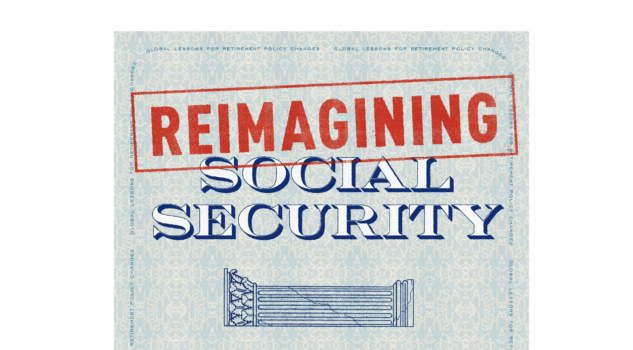
What do you get when a libertarian think tank publishes a book proposing to radically change Social Security in collaboration mostly with other right-leaning organizations? You get something like “Re-imagining Social Security,” authored by the CATO Institute’s Ivane Nachkebia and Romina Boccia (who more than once has called the program a ‘legal Ponzi scheme’). Not surprisingly, to these authors, “re-imagining” the program that some 70 million Americans depend on for financial security essentially means altering the program beyond recognition and cutting benefits for future retirees. To which we say: better not to let their imaginations run away with our earned benefits.
The libertarian Cato Institute (which never met a federal program it liked) appears to be on a crusade to undermine the existing Social Security program. Just this week, Boccia published a post in Cato’s ‘Debt Dispatch’ blog, claiming that Social Security “operates on the Robin Hood principle in reverse.” This is, pardon the expression, quite rich coming from a think tank whose funders include the Koch network and mega-corporations like Google, Facebook, Philip Morris, the American Petroleum Institute and Chevron.
Here’s what we call “reverse Robin Hood”: a right-leaning think tank funded by financial elites striving to compromise future seniors’ earned benefits. The book and blog post are simply the latest fusillade in a decades-long campaign to discredit Social Security, arguably one of the greatest legacies of that conservative bogeyman: FDR’s New Deal. (See more about this below, including Cato’s 1983 screed, “Achieving a Leninist Strategy.”)
We do give Nachkebia and Boccia credit for raising a serious issue: the very real financial challenges facing Social Security. The program’s trustees project that the Social Security trust fund reserves will become depleted in the early 2030s – unless Congress takes pre-emptive action. The authors are simply wrong about the cause and the cure.

NCPSSM President Max Richtman (center) debates author Romina Boccia (left) about Social Security policy at a 2024 forum
The book’s first mistake is ascribing the predicted shortfall purely to ‘demographic’ changes in American society (older people becoming a bigger chunk of the population while birthrates decline), which the 1983 Social Security reforms already anticipated and addressed with a mix of revenue enhancements and benefit cuts. That is why Social Security’s full retirement age has been gradually increased from 65 to 67.
The authors ignore the current culprit – rising wealth inequality – which has been depriving Social Security of much-needed revenue for years. After all, we’re living in an age when Elon Musk, Jeff Bezos, and Mark Zuckerberg own more wealth than the bottom 50% of American society. Four decades ago, Social Security payroll taxes captured about 90% of all wages. Today, that figure has slipped to about 80%, as the wage and wealth gap widens (and higher earners make more of their money from investment income).
In 2026, annual wages exceeding $184,500 will not be subject to Social Security payroll taxes. Under this system, Musk, Bezos, and Zuckerberg will finish contributing to Social Security shortly after the ball drops in Times Square in January, while most of us pay into the program for the entire year.
The most painless and equitable fix to this problem would be to adjust – or outright eliminate – the payroll wage cap, in addition to folding-in some of wealthier earners’ non-wage income. Of course, the “Reimagining” authors do not favor this solution, because right-of-center groups do not want the wealthy to pay higher taxes for any reason. (Cato Institute and the Heritage Foundation, one of the book’s contributors, championed Trump’s 2025 massive tax giveaway for the wealthy, funded by more than $1 trillion in Medicaid and food assistance cuts. Talk about ‘Reverse Robin Hood!’)
The public appears to feel quite differently. Americans say they are willing to pay more for Social Security if it means the program will survive and thrive well into the 21st century. A survey published in 2025 by the National Academy of Social Insurance (NASI) found that a majority of Americans support eliminating the payroll wage cap on income over $400,000. Further, according to NASI, “Americans across all groups, including a majority of Republicans, say they are willing to contribute more by gradually increasing the payroll tax rate to strengthen the program’s finances.”

The right-leaning Cato Institute is funded by financial elites, including the Koch Network and Big Oil
On the other hand, the survey found that, given a “broad set of options to address Social Security’s financing gap,” Americans strongly reject benefit reductions. The public’s wishes do not seem to resonate with Cato’s authors, who advocate, among other measures:
- Raising the retirement age again
- Transitioning to a flat-benefit structure
- Indexing initial benefits to prices instead of wages
- Cutting the annual Cost-of-Living Adjustment (COLA)
Make no mistake: these proposals would cut benefits and turn Social Security into a welfare program instead of social insurance for everyone, which it was designed to be. The authors claim to have the interests of today’s younger adults in mind. Never mind that tomorrow’s seniors will rely even more on Social Security than current seniors do, thanks to the disappearance of employer-provided pensions, rising wealth inequality, and the soaring costs of everything from college tuition to medical care — making it harder for younger adults to save for retirement. (Today, only about 50% of workers have a retirement plan.)
It’s probably not a coincidence that, more than 40 years before the publication of “Reimagining Social Security,” CATO issued a white paper entitled, “Achieving A Leninist Strategy” (1983), which mapped out a scheme to undermine public support for Social Security by dividing the generations. The strategy was: convince young people that Social Security is a bad deal, making it easier to chip away at the program that many on the right have opposed since the very beginning. (1936 Republican presidential candidate Alf Landon called Social Security “a fraud on the working man.”) Some conservatives would love to see Social Security privatized so that workers’ hard-earned contributions could be funneled to Wall Street.
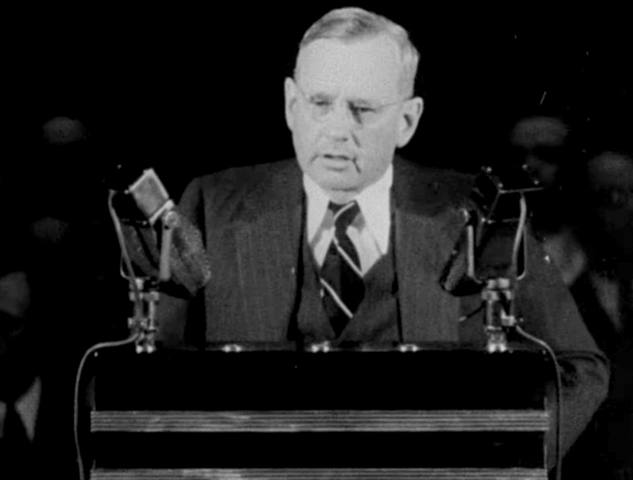
1936 GOP presidential candidate Alf Landon called Social Security “a fraud on the working man.”
Boccia and Nachkebia take a slightly different tack. Their core claim is that the U.S. retirement benefit system is overly generous compared to other Western nations. They analyze retirement benefits in Canada, New Zealand, Germany and Sweden and find them to be less fulsome than ours, as if to say, “These other countries don’t feel the need to support seniors on the same level as Social Security does here. Maybe we are doing too much.”
What the authors don’t mention is that these four social democracies provide more overall services and supports to their people than we do – including universal health care[1]. They also offer subsidies (for housing, transportation, heating/cooling assistance, etc.) that lower the cost of living[2]. Sweden and Germany have free college tuition, which can significantly reduce the debt burden faced by young workers. With these fundamental supports, seniors in other Western nations do not necessarily need the level of retirement benefits that Social Security provides here.
At the same time, let’s bear in mind that Social Security benefits are relatively modest. Next year’s estimated average annual retirement benefit is $24,852, only nine thousand dollars above the federal poverty line. Without Social Security, 22 million adults and dependent children would fall into poverty. Before Franklin D. Roosevelt signed Social Security into law 90 years ago, many seniors literally lived in poorhouses.
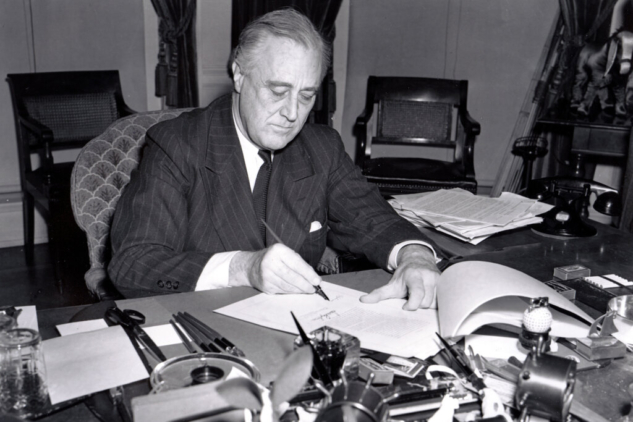
FDR wanted workers to have a “moral right” to collect Social Security (Wikimedia Commons)
The design of Social Security (which Cato is attempting to undermine) was very much intentional. It is social insurance. Everyone contributes and everyone benefits. From the beginning, FDR insisted that Social Security be earned through workers’ payroll contributions “so as to give the contributors a legal, moral, and political right to collect their (benefits).” The book’s prescriptions would upend the program’s founding principle.
While it might be in the interest of some of the book’s contributors — including the American Enterprise Institute, the Mercatus Center, and the Heritage Foundation (authors of the notorious Project 2025) — and their donors to shrink Social Security in the name of ‘saving it,’ we’re hard pressed to think of anyone else who would truly benefit. Instead of “Reimagining Social Security,” we prefer to imagine a future where the program that has worked so well for 90 years is strengthened and preserved as an earned benefit, just as FDR intended.
[1] The Commonwealth Fund, “International Health Care System Profiles”, https://www.commonwealthfund.org/international-health-policy-center/system-profiles
[2] Government of Canada, “Benefits”, https://www.canada.ca/en/services/benefits.html; KiwiEducation, “Social Benefits in New Zealand”, https://kiwieducation.com/nz/lifehack/social-benefits-in-new-zealand/; Facts About Germany, “Strong Welfare State”, https://www.tatsachen-ueber-deutschland.de/en/germany-glance/strong-welfare-state; Forsakringskassan, “Social Insurance in Sweden”, https://www.forsakringskassan.se/english/moving-to-working-studying-or-newly-arrived-in-sweden/social-insurance-in-sweden