


In his latest column for The Atlantic titled “An Oligarchy of Old People,” author Idrees Kahloon correctly identifies a troubling symptom of the 21st century economy — a younger generation left worse off than those who came before them — while misdiagnosing the cause.
Rather than identifying the true culprit, namely wealth inequality and the concentration of power at the very top of the economic food chain, the article shifts blame to older Americans as some sort of monolithic class, regardless of income. This kind of scapegoating is exactly what (middle-aged!) finance and tech oligarchs like Thiel, Musk, Zuckerberg, and other billionaires want.
In fact, that same group has repeatedly sought to sow division and redirect blame for income inequality toward immigrants, minorities, and now older Americans. Kahloon plays into that narrative by framing the problem as “Boomers vs. everyone else,” rather than “the wealthy elite vs. everyone else,” needlessly pitting generations against each other.

Many in the media are trying to pit the generations against each other
The simple facts are that older people of varying income levels generally have a higher net worth and more assets than their younger counterparts. This is a normal feature of a functioning economy.
Ultimately, what we have seen over the last 50 years is a consistent decline in wealth equality and workers’ rights across the board. The built-in disparity between young and old has not been created by Social Security and Medicare; rather, it has grown because of broader structural forces (which we will get into later).
Now, let’s take a look at some of Kahloon’s claims, particularly those that touch on Social Security and Medicare.
“In 1965, Medicare was created. A major expansion of Social Security followed in 1972. These changes were remarkably effective: The share of elderly people living in poverty dropped by more than one-third within a decade. But because these programs are broad-based entitlements, they have transferred huge sums to the prosperous, too. The portfolios of that latter group, meanwhile, have been swelled by a rising stock market and rising home values, outcomes that may not be entirely replicable for younger generations. As a result of all of these factors, intergenerational inequality between old and young has not merely reversed. It has accelerated.”
Mr. Kahloon is correct that the changes made by FDR’s “New Deal” and LBJ’s “Great Society” were “remarkably effective” and remain so. In fact, Social Security and Medicare are the most successful anti-poverty programs in American history. But the article makes a huge leap in citing Social Security and Medicare as the main factors behind the rise in intergenerational inequality. The grounds for that causal claim are shaky at best.
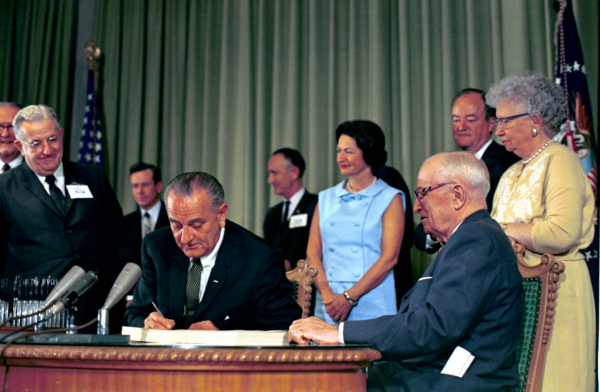
LBJ signs Medicare and Medicaid into law in 1965
The real drivers of rising wealth concentration and intergenerational disparity (aka the oligarchs) are far more to blame than Americans’ earned benefits. The last several decades have seen:
- Decline of unions and labor’s bargaining power: Union coverage has fallen dramatically since the 1970s, weakening wage growth, reducing retirement benefits, and shifting power from workers to owners.
- Rising top incomes of “superstars,” finance, and executive pay: The share of income going to the top 1% and 0.1% has exploded, driven by finance, tech, and corporate governance changes that reward executives and shareholders far more than workers.
- Tax and transfer policy changes: Since the 1970s, effective tax rates on the very top earners fell substantially. For the top 0.01%, the effective federal tax rate dropped from about 59% in 1979 to 35% in 2004. Today, that number sits at a staggeringly low 24%. Meanwhile, middle-class and working-class families faced rising costs in every area of importance: Housing, education, and health care, with fewer public supports.
Social Security and Medicare have reduced old-age poverty and provided baseline income for seniors on fixed incomes. They are not the cause of rising wealth inequality, and without them, 40% of seniors would slip into poverty, while even more would lose their health care.
Taking a more cultural view, Kahloon opines that:
“Respect for elders is being replaced by resentment of elders. A majority of young Americans no longer believe in the American dream. Many Millennials and Gen Zers expressly blame the Boomers for that, accusing them of hoarding wealth, jobs, and power. Many of these accusations are inchoate, but they are not entirely baseless.”
These accusations are in fact, inchoate — and baseless, but Kahloon does nothing to correct that. Instead, it appears the author would rather further stoke these fears and divisions than place blame on the real culprits. Doing so might upset The Atlantic’s primary owners/investors — the Emerson Collective — a venture capital firm also known for its involvement in the AI, Crypto, and oil industries.
Blaming “Boomers” as a class allows the real architects of inequality (like the Emerson Collective) to avoid scrutiny. It lets them redirect anger from the concentration of wealth and power at the top to a generational fight between older and younger workers. No wonder ageism in this country remains rampant.
Finally, Kahloon suggests:
“An intergenerational recalibration can come about in gentler ways than Moyn’s: The wealthiest Social Security recipients, for instance, could forgo some of their scheduled benefits, which could instead be contributed annually to “baby bond” accounts for America’s children.”
This is a classic straw man that is nothing more than a call for means-testing Social Security benefits. As we’ve argued before, means-testing undermines the very nature of Social Security, which is social insurance, not welfare. It is designed to be universal, tied to work and contributions, and protected from the political whims that target traditional welfare programs.

It’s in the interest of America’s oligarchs to divide the generations
Once that dam breaks, Social Security will become like any other welfare program, subject to cuts whenever Republicans control Congress and the White House. To save significant money, means testing would have to cut deep into the heart of the middle class.
Slashing Social Security and Medicare to address wealth inequality would do nothing to address the core issues and causes of inequality. In fact, many conservatives want to slash the social safety net (See the massive cuts to Medicaid and food assistance in Trump’s Big, Ugly Bill), while stoking divisions among us. The real fight is not old vs. young. It is workers and families vs. financial elites that benefit from a K-shaped economy – and a distracted populace arguing over generational differences.
****************************
Listen to our podcast interview about ageism in America with expert S. Jay Olshansky here.