


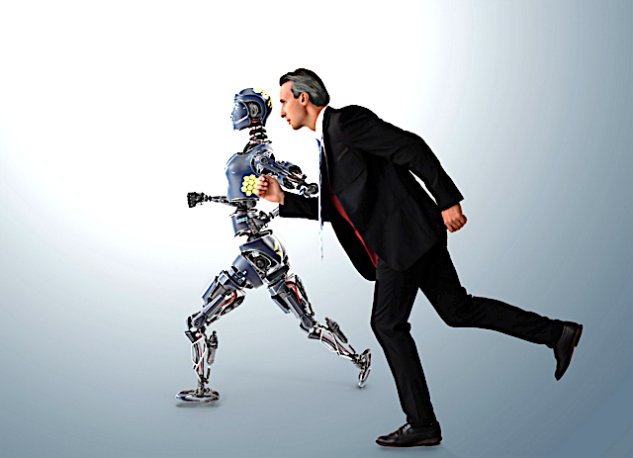
Many on the political right contend that Americans are living longer*, so they should be working longer. But what happens when technological changes — largely developed by the “Tech Right” — make that harder to do?
On a recent episode of our “You Earned This” podcast, economics professor Geoffrey Sanzenbacher of Boston College says that many older workers in occupations highly exposed to artificial intelligence (AI) are exiting the workforce. Sanzenbacher’s June 2026 brief for Boston College’s Center for Retirement Research compares changes in employment before and after ChatGPT’s November 2022 launch.
Sanzenbacher found that some older workers are being laid off as AI takes over. Others are voluntarily leaving the workforce, wary of AI changing their jobs. He says these workers are asking themselves, “Do I want to learn this whole new technology, which I’ll only be using for a relatively short period of time before I retire?”
“When you’re learning new things when you’re young, you have a lot of time to use that knowledge. It’s worth it to learn because you can use it for forty or fifty years. When you’re near the end of your career, it’s not quite as worth it,” Sanzenbacher observes.
He points out that while previous tech revolutions hit blue collar workers harder, the ascendancy of AI is displacing white collar employees – especially older ones. Many may become unemployed before they are eligible for Social Security, leaving them without a stable income. The earliest claiming age is 62 (with reduced benefits); the full retirement age is now 67, having been gradually raised from 65 by the last major Social Security reforms in 1983.
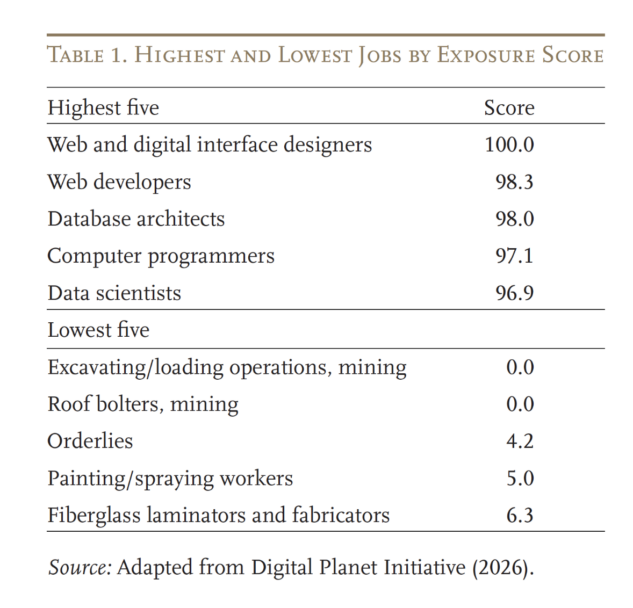
Finding a new job that might be less exposed to AI can be difficult for older workers, because of ageism in hiring – among other factors. Just as these workers may be exiting the job market before they’re eligible for Social Security, the political right is pushing to raise the retirement age again – to 69 or even 70. The timing couldn’t be worse for the type of workers in Sanzenbacher’s study.

Professor Geoffrey Sanzenbacher of Boston College & the Center for Retirement Research
“Raising the retirement age is a benefit cut,” says Sanzenbacher. “You’re collecting less in benefits over the remainder of your life. At the same time, we have this technology coming along that could very well force many workers out of the labor force faster.”
Sanzenbacher says this doesn’t mean that every older worker should retreat from the emergence of AI in the workplace. He argues that AI can empower employees who are willing and able to harness it. AI can handle routine tasks, allowing experienced workers to focus on activities that require human judgment, relationships, and creativity.
His advice is twofold: learn how AI can help, and strengthen your skills that it cannot readily replace. “I think it’s both learning how to use these tools so that you can use them if you need to,” he said, “but also focusing on the things that AI can’t do.”
Prof. Sanzenbacher’s brief, Are the Careers of Older Workers Being Cut Short by AI? is available here.
______________________________________________________________________
*While overall life expectancy for Americans has rebounded since the Covid epidemic, it remains lower for most minority groups.