


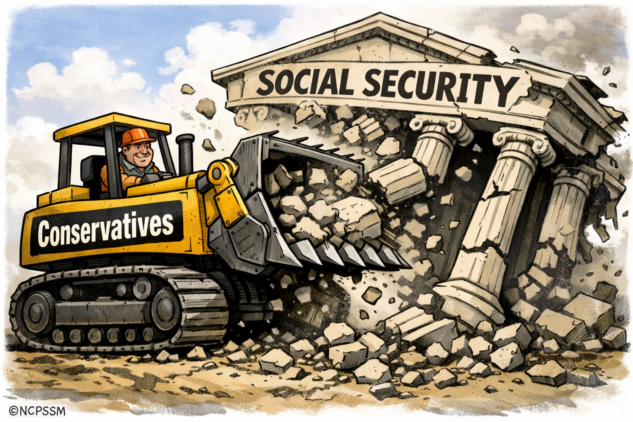
Conservative think tanks are working full-time to destroy Social Security as we know it. This week, Cato Institute’s Romina Boccia is peddling the fiction that Social Security doesn’t work and must be “re-designed.” In a recent post on Cato’s blog, she rolls out the “greatest hits” from a time-worn catalogue of conservative talking points to justify altering the program beyond recognition. While it might benefit the financial elites who fund Cato to shrink Social Security, it would hurt working Americans. We asked our senior Social Security expert, Maria Freese, to fact-check some of Boccia’s key claims. Let’s start with the headline:::
BOCCIA: “Social Security Isn’t a Retirement Account — and Congress Must Stop Pretending It Is.”
FREESE: Boccia is correct. Social Security is not a personal retirement account like a 401k. Perhaps some in Congress are “pretending” that it’s an individual retirement account, but anyone who knows Social Security understands that it is social insurance. Workers’ and employers’ payroll contributions are pooled, with benefits payable upon retirement, disability, or death of a family breadwinner. Those insurance benefits are calculated to replace a portion of workers’ incomes based on their earnings history.
If anything, conservatives ignore the program’s disability and survivors’ benefits, framing Social Security as purely a retirement program. In fact, some 3.5 million children collect Social Security benefits because a parent has died or become disabled.
It’s also important to remember that Social Security was never intended to be the only source of income in retirement. Rather, it was expected to be combined with employer-provided pensions and personal savings as part of the old “three-legged stool.” But most non-governmental employers have eliminated pensions — kicking out one leg of the stool. Growing wealth inequality and rising costs have prevented many Americans from saving for retirement on their own. (Only 50% of workers participate in 401K plans!) There goes another leg of the stool — making Social Security all the more crucial.
BOCCIA: “Politicians routinely describe Social Security payroll taxes as ‘contributions,’ speak of a ‘trust fund’ as if it held real savings, and define benefits as ‘earned.’”
FREESE: Yes, they do, and they are correct. The Social Security Trust Fund is invested in treasury bonds backed by the full faith and credit of the United States government. These assets are as “real” as any portfolio of Treasury bonds. College endowments and overseas investors would be shocked to learn that their US-backed assets are somehow fake! (In fact, you can watch our CEO and President, Max Richtman, debunk Boccia’s ‘trust funds aren’t real’ argument in a 2025 debate.) Right now, there are more than $2 trillion in assets in the Social Security trust fund.
Benefits are very much earned. Social Security benefits are tied to workers’ payroll contributions. The benefit formula links monthly Social Security checks to lifetime earnings. Social Security benefits are progressive in nature — meaning lower-income workers receive proportionally higher benefits. Americans understand that Social Security is a social contract: People pay in during their working years, and receive benefits upon retirement, disability, or the death of a family breadwinner. Social Security is fundamentally different from a means-tested welfare benefit.
BOCCIA: “When Social Security is framed as a retirement account, any benefit reduction sounds like unfair confiscation.”
FREESE: Workers rightly see benefit cuts as unfair, not because they mistake Social Security for a 401(k), but because they have kept their end of the bargain with every paycheck. Contributions are deducted automatically (and matched by employers), with the explicit promise that Social Security benefits will be paid in full.
Boccia’s own polling shows that Americans are wary of large benefit cuts once the real dollar amounts are spelled out. Younger workers, who Boccia casts as unfairly burdened by Social Security, are facing a future with fewer pensions, more unstable jobs, and displacement; for them, a robust, predictable Social Security benefit will be even more important, not less.
BOCCIA: “Lifting the payroll tax cap becomes a decision to raise taxes on higher earners to fund redistribution.”
FREESE: When Social Security was created, payroll taxes applied to roughly 92% of all wage income; after the 1983 reforms, about 90% of wage earnings were subject to the tax. Today, due to the widening wealth gap (the rich getting richer), only about 83% of the nation’s total wage income is subject to Social Security taxes. An adjustment of the payroll wage cap (now set at $184,500 in annual wages) would ensure that high earners contribute their fair share, just like everyone else. In the meantime, Elon Musk and Jeff Bezos stop paying into Social Security shortly after January 1 while the rest of us contribute all year.
It’s also important to remember that the highest-income individuals have found ways to reclassify their income so it doesn’t appear as wages — a luxury most workers do not have. Private equity managers, for example, convert compensation into “carried interest,” to avoid paying their fair share.
This is why the polling consistently indicates that large majorities of Americans across party lines prefer that high earners contribute more, rather than cutting benefits or raising the retirement age for those who rely on Social Security.
BOCCIA: “Congress should stop pretending Social Security is a contribution-based retirement account and design it accordingly. The most straightforward approach is a flat benefit: a uniform, anti-poverty payment for eligible seniors.”
FREESE: Sorry, but a “flat benefit” would hurt middle class workers. According to a 2022 analysis, while the lowest quintile (20%) of working families would see a lifetime benefit increase from a flat benefit, the middle quintile would see benefit cuts. Lower income workers already benefit from the progressive structure of Social Security (and can also receive Supplemental Security Income or SSI), but middle class beneficiaries would have a hard time withstanding the cut from a flat benefit. A flat benefit would subvert the fundamental nature of Social Security, where benefits are based on workers’ lifetime earnings — and turn it into a welfare program that could be demonized and cut over time.
************************************************
Read our review of Romina Boccia’s book “Re-Imagining Social Security.”
Listen to our podcast episode about recent public polling showing overwhelming support for Social Security.
Listen to our podcast episode about the spike in anti-Social Security propaganda from the political right.
Watch our documentary about the 90-year history of Social Security!