


Medicaid work requirements are coming for millions of people’s health care. This is thanks to Trump’s Big, Ugly Bill, which mandates that states institute work requirements in order for patients to enroll or maintain health coverage under Medicaid. Work requirements are projected to strip 5-10 million people of health insurance in the coming years. And for no good reason, other than Republicans’ ideological opposition to government health care programs — and as a way to pay for Trump’s massive tax giveaway to the wealthy. (Although recently, Trump offered a little more context recently, saying the nation “can’t ‘afford’ Medicaid” anymore because of spending on “military protection” (AKA, his Iran War.)
The Big Ugly Bill — championed by wealthy GOP donors, tech bros, Big Pharma, and Big Oil — mandates that adults enrolled in Medicaid demonstrate that they are working, in school, or volunteering in order to obtain or maintain coverage. States are required to enforce these work requirements no later than January 1, 2027, though they have the option to implement them sooner. As of Friday, May 1, Nebraska will have the dubious distinction of becoming the first state to implement these new work requirements. (They’re just SO excited to take people’s health care away!)
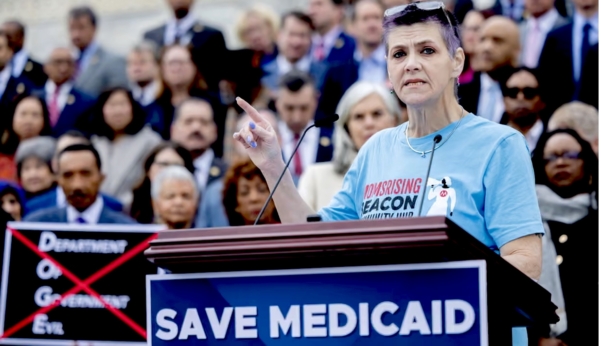
Save Medicaid rally in 2025, before Trump’s Big, Ugly Bill became law
Work requirements are incredibly gratuitous (and enforcing them can be costly). Seventy percent of Medicaid recipients already work or are in school. The others may not be able to work because of physical or mental disabilities, job discrimination, and other extenuating circumstances.
Let’s be clear: When Medicaid was enacted in 1965 as part of President Lyndon Johnson’s Great Society, there was no requirement that recipients work. Medicaid was designed to provide health coverage for vulnerable Americans who could not otherwise afford medical insurance. Full stop. It was enacted in tandem with Medicare, which also did not have any kind of work mandate.
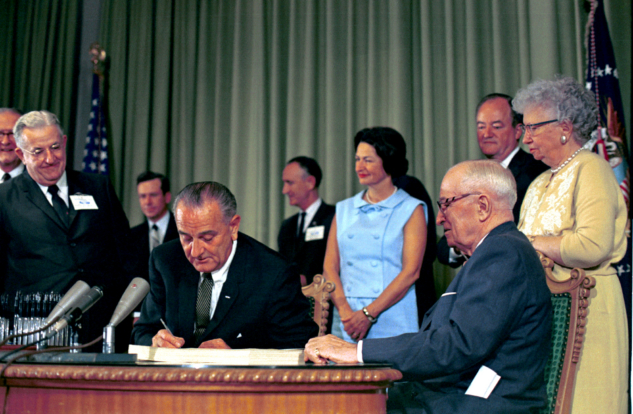
LBJ believed that in a nation as prosperous as America, no one should be denied medical care because of their financial status. He didn’t mention anything about having to work for benefits.
We are one of the world’s only industrial nations that does not offer its residents universal health care. Nearly 80% of the world’s countries provide their residents some form of government-sponsored health care.
There is a straight line between the Republicans’ current obsession with punishing society’s ‘undeserving’ and less fortunate and Ronald Reagan’s “Welfare Queen” rhetoric. As the New York Times noted last year, “Republicans targeting safety net programs once invoked women they claimed were living lavishly on government funds. Now as they seek to pare back Medicaid, the imagery has changed — but not the argument.”
Meanwhile, some red states have decided that the federal minimum work requirement is too lenient. Indiana is leading that charge. Idaho has already followed Indiana’s lead, with the governor signing a stringent requirement into law on April 10. Similar efforts are gaining traction in Arizona, Missouri, and Kentucky.
If the aim is to promote employment, work requirements are failing spectacularly. They have not appreciably boosted employment in the states that have tried them (before the Big, Ugly Bill’s mandate). If, on the other hand, the objective of work requirements is to punish vulnerable people by stripping them of health coverage, it’s already promising to work splendidly.
“They (work requirements) haven’t worked in Arkansas which was the first state to experiment with them. The result was that 18,000 fewer people were on Medicaid. It’s obvious that when you’re sick and need health care — regardless of if you’re working — you need that access to health care. That’s why it makes no sense to tie work requirements to Medicaid.” – Anne Montgomery, NCPSSM senior health policy analyst
The data from Arkansas paints a clear picture. Many were booted off Medicaid not because they weren’t working, but because they couldn’t prove that they met the state’s work requirements. Doing so requires navigating a lot of bureaucratic red tape; many people give up or simply can’t complete the certification process. The new policy is even more unforgiving, as it reviews eligibility at both application and renewal, creating a cycle of exclusion that makes it increasingly difficult to enroll or maintain a spot in the program.

Older Medicaid patients could be hit hard by work requirements (Istock)
The risks are even higher for older workers who are not yet eligible for Medicare – a group we refer to as “near seniors.”
“Those who are near elderly — older workers ages 50-64 — have never been subject to any kind of work requirement before. We are worried about this group in particular. They are being laid off at higher rates. There is an idea that we need to clear room for a younger, newer workforce.” – Anne Montgomery, NCPSSM senior health policy analyst
Most modern societies view health care as a right, not a privilege. Under Trump’s reign, the privileged are stripping health care from those who can least afford it.
*************************************************************************************************
Note: Here are some of the groups likely to be hurt by Trump’s work requirements:
- Low-income adults or “gig” economy workers with unstable work (source)
- Parents and caregivers — especially single parents (source)
- People with disabilities or chronic conditions (source)
- Students (source)
- Rural and transportation constrained enrollees (source)
Listen to our podcast HERE
Learn more about this from Health Policy Expert Anne Montgomery HERE