


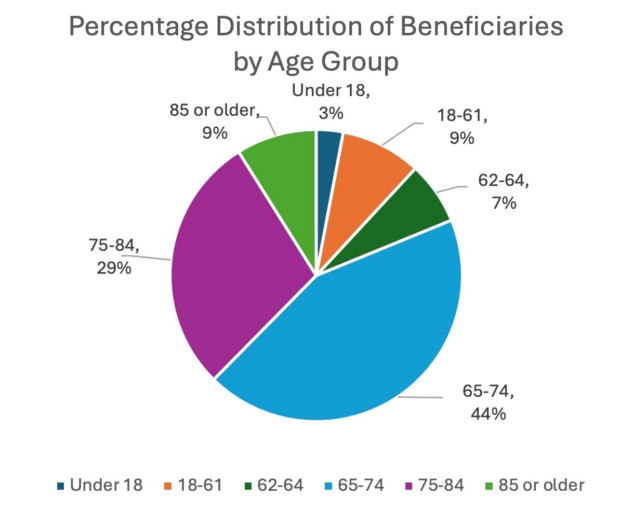
Source: SSA, https://www.ssa.gov/policy/docs/chartbooks/fast_facts/2026/fast_facts26.pdf Note: Totals do not necessarily equal the sum of rounded components
Although Social Security provides important financial protection for people in their working years by way of disability or survivors, over four-fifths of all OASDI beneficiaries in current-payment status at the end of December 2025 were aged 62 or older. Of this total, about 9 percent were persons aged 18–61 receiving benefits as disabled workers, survivors, or dependents. Another 3 percent were children under age 18.
The chart below illustrates the age distribution by age cohort of Social Security beneficiaries age 62 and older as of June 2026.
| Social Security beneficiaries aged 62 and over, end of June 2026 (number in thousands) |
|||||
| Age group | Total | Men | Women | ||
| Number | Percent of total | Number | Percent of total | ||
| 62-69 | 19,686 | 9,005 | 45.7 | 10,681 | 54.3 |
| 70-84 | 36,649 | 16,674 | 45.5 | 19,975 | 54.5 |
| 85 & older | 6,450 | 2,452 | 38.0 | 3,998 | 62.0 |
| Total, age 62 & older | 62,786 | 28,131 | 44.8 | 34,654 | 55.2 |
Note: Excludes adults who became disabled as children.
Totals do not necessarily equal the sum of rounded components.
In each age bracket, women are the majority of beneficiaries. In the most advanced bracket, age 85 and older, women hold a supermajority at 62 percent. This is critical from a policy and legislative perspective because the importance of Social Security benefits increases incrementally each year as you age. This gradual increase in the importance of Social Security as a dependable, inflation-protected income flows from the increase in health expenses and steady depletion of assets that accompany advancing age.
Source:
https://www.ssa.gov/oact/progdata/byage.html
Government Relations and Policy, October 2026